
The large carpenter bees (Hymenoptera: Apidae: Xylocopa spp.) of Nuevo León, México
DOI:
https://doi.org/10.26786/1920-7603(2012)3Abstract
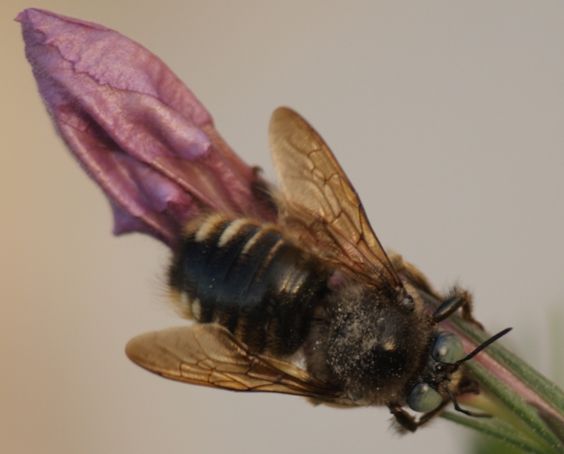
There is a severe information gap regarding wild bees in northern Mexico. The present study is a contribution to knowledge of the distribution, habitat preferences and floral usage patterns of bees of the genus Xylocopa in the state of Nuevo León. Field sampling was done using aerial net and pan traps (yellow, blue, white and pink) at 35 sites throughout the state. Xylocopa species were found at only seven of these sites. Four of the five species, previously reported for the state were collected plus two new state records (Xylocopa micans and X. strandi), bringing the total number of species in the state to seven. Individuals were collected visiting only flowers of the Fabaceae and Bignoniaceae families, and they occurred primarily in shrub lands and disturbed areas.
References
Alanís-Flores GJ, Cano G, Rovalo MM (1996) Vegetación y flora de Nuevo León, una guía botánico ecológica. Impresora Monterrey, S.A. de C.V., México.
Ascher J, Pickering J (2011) Discover Life´s Bee species guide. [online] URL: www.discoverlife.org/mp/20q?search=Xylocopa (accessed December 2011).
Ayala R, Griswold TL, Yanega D (1996) Apoidea (Hymenoptera). In: Llorente BJ, García AN, Soriano E (eds) Biodiversidad, Taxonomía y Biogeografía de Artrópodos de México. Hacia una síntesis de su conocimiento. UNAM-CONABIO, México. pp 423-464.
Campbell JW, Hanula JL (2007) Efficiency of Malaise traps and colored pan traps for collecting flower visiting insects from three forested ecosystems. Journal Insect Conservation, 11(4): 399-408.
Droege S (2008) The Very Handy Manual: How to Catch and Identify Bees and Manage a Collection. [online] URL: www.nbii.gov/images/uploaded/152986_1215796993080_Handy_Bee_Manual_Jun_2008.pdf; (accessed April 2009).
Droege S, Tepedino VJ, Lebuhn G, Link W, Minckley RL, Chen Q, Conrad C (2009) Spatial patterns of bee captures in North American bowl trapping surveys. Insect Conservation and Diversity, The Royal Entomological Society. 3:15-23.
Hurd PD (1955) The Carpenter Bees of California (Hymenoptera: Apoidea). Bulletin of the California Insect survey. University of California Press. 4(2): 31-72.
Hurd PD (1956) Xylocopa (Notoxylocopa). Notes on the subgenera of the New World carpenter bees of the genus Xylocopa (Hymenoptera, Apoidea). American. Museum Novitates. 1776: 1-7 [2]
INEGI (1986) Síntesis geográfica del estado de Nuevo León. Secretaría de Programación y Presupuesto. México, D.F.
Kearns CA, Inouye DW (1993) Techniques for Pollination Biologists. University Press of Colorado. U.S.A.
Mclntyre NE, Hostetler ME (2001) Effects of urban land use on pollinator (Hymenoptera: Apoidea) communities in a desert metropolis. Basic and Applied Ecology. 2:209-218.
Michener CD, McGlinley RJ, Danforth B (1994) The Bee Genera of North and Central America (Hymenoptera:Apoidea). Smithsonian Institution Press. Washington y London.
Michener CD (2007) The Bees of the World, Second Edition. The Johns Hopkins University Press. USA.
NBII. 2011. Carpenter Bees - Both Pollinators and Nectar Robbers. [online] URL: http://www.nbii.gov/portal /server.pt/community/bees_and_wasps/857/carpenter_bees/5745 (accessed August 2011).
Porter CHC (1981) Ecological notes on Lower Rio Grande Valley Xylocopa (Hymenoptera: Anthophoridae). Florida Entomologist. 64 (1): 175-182.
Ramírez-Freire L (2008) La floración de cinco especies de cactáceas y sus insectos asociados en el area natural protegida “Sierra Corral de los Bandidos” municipio de García, Nuevo León. Tesis de Maestría. Facultad de Ciencias Biológicas, U. A. N. L.
Treviño-Garza EJ, Cavazos-Camacho C, Aguirre-Calderón OA (2001) Distribución y estructura de los bosques de galería en dos ríos del centro sur de Nuevo León. Madera y Bosques, 7(1): 13-25.
Velazco-Macías CG (2009) Flora del estado de Nuevo León: diversidad y análisis espacio-temporal. Tesis doctoral. Facultad de Ciencias Biológicas, Universidad Autónoma de Nuevo León.
Velazco-Macías CG, Alanis FGJ, Alvarado VMA, Ramírez FL, Foroughbakchk PR (2011) Flora endémica de Nuevo León, México y estados colindantes. Jornal of the Botanical Research Institute of Texas 5(1): 275 – 298.
Villarreal Quintanilla JA, Estrada C E (2008) Flora de Nuevo León. Listados florísticos de México, XXIV. Instituto de Biología, Universidad Nacional Autónoma de México.
Wilson JS, Griswold T, Messinger O (2008) Sampling Bee Communities (Hymenoptera: Apiformes) in a Desert Landscape: Are Pan Traps Sufficient? Journal of Kansas Entomological Society. 81(3): 288-300.
Downloads
Published
How to Cite
Issue
Section
License
Copyright (c) 2012 Liliana Ramirez-Freire, Glafiro Jose Alanis Flores, Ricardo Ayala Barajas, Humberto Quiroz Martínez, Carlos Gerardo Velazco Macías

This work is licensed under a Creative Commons Attribution 4.0 International License.