
Estimating pollination success with novel artificial flowers: Effects of nectar concentration
DOI:
https://doi.org/10.26786/1920-7603(2012)14Abstract
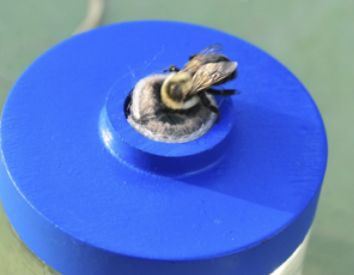
We developed novel artificial flowers that dispense and receive powdered food dyes as pollen analogues while their nectar is replenished by capillary action. Dye receipt, which can be measured colourimetrically, is a direct surrogate for pollen receipt or female reproductive success, but can also serve to compare pollen donation (male reproductive success) from flowers with different colours of dye. By allowing captive bumble bee colonies to visit large arrays of such flowers, we investigated whether total dye receipt depended on the sugar concentration of a flower’s nectar. Estimating pollen transfer, rather than simply visitation rate, is appropriate for this question because flowers with more concentrated nectar might accrue more pollen not only through higher visitation rates but also through longer visits that transfer more pollen per visit. Flowers with richer nectar did receive more dye regardless of their spatial arrangement, but the effect was greatest when rich and poor flowers were segregated in large blocks, as opposed to being intermingled.References
Biernaskie JM, Walker SC, Gegear RJ (2009) Bumble bees learn to forage like Bayesians. American Naturalist 174:413-423.
Cartar RV (2004) Resource tracking by bumble bees: Responses to plant-level differences in quality. Ecology 85:2764-2771.
Chittka L, Thomson JD (1997) Sensori-motor learning and its relevance for task specialization in bumble bees. Behavioral Ecology and Sociobiology 41:385-398.
Clements FE, Long FL (1923) Experimental pollination: An outline of the ecology of flowers and insects. Carnegie Institute of Washington, Washington DC.
Cnaani JC, Thomson JD, Papaj DR (2006) Flower choice and learning in foraging bumblebees: Effects of variation in nectar volume and concentration. Ethology 112:278-285.
Conover WJ, Iman RL (1981) Rank transformations as a bridge between parametric and nonparametric statistics. The American Statistician 35:124-129.
Gegear RJ, Laverty TM (2005) Flower constancy in bumblebees: A test of the trait variability hypothesis. Animal Behaviour 69:939-949.
Gegear RJ, Manson J, Thomson JD (2007) Ecological context influences pollinator deterrence by alkaloids in floral nectar. Ecology Letters 10:378-382.
Harder LD, Thomson JD (1989) Evolutionary options for maximizing pollen dispersal of animal-pollinated plants. American Naturalist 133:323-344.
Harris DC (2007) Quantitative Chemical Analysis, 7th ed. W. H. Freeman, New York.
Lloyd DG, Webb CJ (1992) The evolution of heterostyly. In: Barrett SCH (ed) The evolution and function of heterostyly. Springer-Verlag, Berlin, pp 152-178.
Makino TT, Sakai S (2007) Experience changes pollinator responses to floral display size: From size-based to reward-based foraging. Functional Ecology 21:854-863.
Ohashi K, Leslie A, Thomson JD (2008) Trapline foraging by bumble bees: V. Effects of experience and priority on competitive performance. Behavioural Ecology 19:936-948.
Pyke GH (1978) Optimal foraging: movement patterns of bumblebees between inflorescences. Theoretical Population Biology 13:72-98.
Real LA (1981) Uncertainty and pollinator-plant interactions: The foraging behaviour of bees and wasps on artificial flowers. Ecology 62:20-26.
Smithson A, Macnair MR (1997) Density-dependent and frequency-dependent selection by bumblebees Bombus terrestris (L.) (Hymenoptera: Apidae). Biological Journal of the Linnean Society 60:401-417.
Stone JL, Thomson JD (1994) The evolution of distyly: Pollen transfer in artificial flowers. Evolution 48:1595-1606.
Thomson JD (1986) Pollen transport and deposition by bumble bees in Erythronium: Influences of floral nectar and bee grooming. Journal of Ecology 74:329-341.
Thomson JD, Price MV, Waser NM, Stratton DA (1986) Comparative studies of pollen and fluorescent dye transport by bumble bees visiting Erythronium grandiflorum. Oecologia 69:561-566.
Waddington KD, Heinrich B (1979) The foraging movements of bumblebees on vertical “inflorescences”: An experimental analysis. Journal of Comparative Physiology 134:113-117.
Willmer P (2011) Pollination and floral ecology. Princeton University Press, Princeton.
Downloads
Published
How to Cite
Issue
Section
License
Copyright (c) 2012 James D. Thomson, Jane E. Ogilvie, Takashi T. Makino, Angela Arisz, Sneha Raju, Vanessa Rojas-Luengas, Marcus Tan

This work is licensed under a Creative Commons Attribution 4.0 International License.