Stingless bees further improve apple pollination and production
DOI:
https://doi.org/10.26786/1920-7603(2014)26Abstract
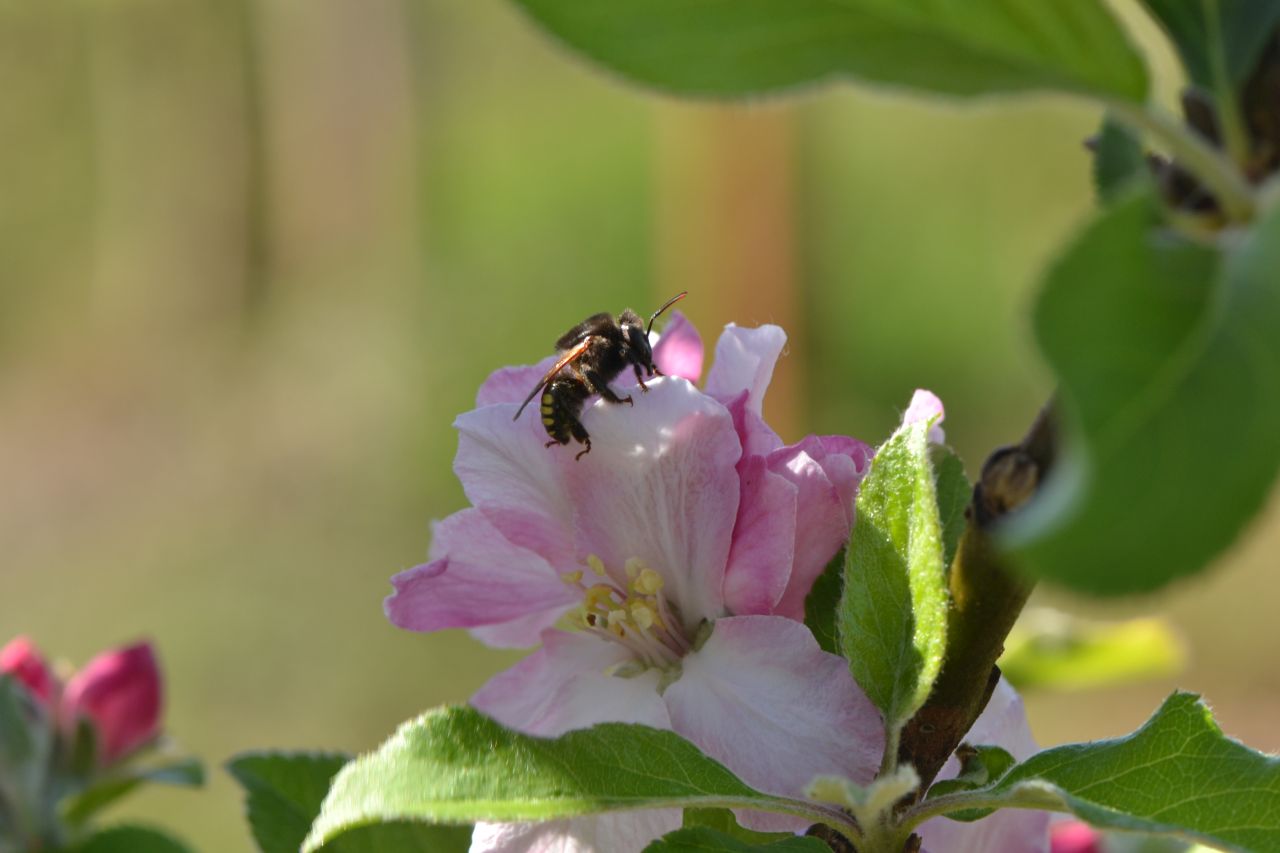
The use of Africanised honeybee (Apis mellifera scutellata Lepeletier) hives to increase pollination success in apple orchards is a widespread practice. However, this study is the first to investigate the number of honeybee hives ha-1 required to increase the production of fruits and seeds as well as the potential contribution of the stingless bee Mandaçaia (Melipona quadrifasciata anthidioides Lepeletier). We performed tests in a 43-ha apple orchard located in the municipality of Ibicoara (13º24’50.7’’S and 41º17’7.4’’W) in Chapada Diamantina, State of Bahia, Brazil. In 2011, fruits from the Eva variety set six seeds on average, and neither a greater number of hives (from 7 to 11 hives ha-1) nor a greater number of pollen collectors at the honeybee hives displayed general effects on the seed number. Without wild pollinators, seven Africanised honeybee hives ha-1 with pollen collectors is currently the best option for apple producers because no further increase in the seed number was observed with higher hive densities. In 2012, supplementation with both stingless bees (12 hives ha-1) and Africanised honeybees (7 hives ha-1) provided higher seed and fruit production than supplementation with honeybees (7 hives ha-1) alone. Therefore, the stingless bee can improve the performance of honeybee as a pollinator of apple flowers, since the presence of both of these bees results in increases in apple fruit and seed number.
References
Albuquerque-Junior CL, Denardi F, Dantas ACM, Nodari RO (2010) Número de anteras por flor, grãos de pólen por antera e capacidade germinativa do pólen de diferentes cultivares de macieiras. Revista Brasileira de Fruticultura 32: 1255-1260.
Ashton IW, Miller AE, Bowman WD, Suding KN (2010) Niche complementarity due to plasticity in resource use: plant partitioning of chemical N forms. Ecology 91:3252–3260.
Bosch J, Kemp WP (2002) Developing and establishing bee species as crop pollinators: the example of Osmia spp. (Hymenoptera; Megachilidae) and fruit trees. Bulletin of Entomological Research 92:3-16.
BRASIL. Ministério do Planejamento, Orçamento e Gestão. Instituto Brasileiro de Geografia e Estatística. Diretoria de Pesquisas, Coordenação de Agropecuária. Levantamento Sistemático da Produção Agrícola. Rio de Janeiro 10:1-80 [online] URL: <http://www.ibge.gov.br/home/estatistica/indicadores/agropecuaria/lspa/lspa_201110.pdf> (accessed on: jan. 2014).
Brittain C, Williams N, Kremen C, Klein AM (2013) Synergistic effects of non-Apis bees and honeybees for pollination services. Proceedings of the Royal Society B: Biological Sciences 280: 20122767.
Brittain C, Kremen C, Klein AM (2012) Biodiversity buffers pollination from changes in environmental conditions. Global Change Biology 19:540-547.
Cameron S, Lozier J, Strange J, Koch J, Cordes N, Solter L, Griswold T (2011) Patterns of widespread decline in North American bumble bees. Proceedings of national academy of sciences (PNAS) 108: 662–667.
Cardinale BJ, Palmer MA, Collins SL (2002) Species diversity enhances ecosystem functioning through interspecific facilitation. Nature 415: 426-429.
Carvalheiro LG, Veldtman R, Shenkute AG, Tesfay GB, Pirk CWW, Donaldson JS, Nicolson SW (2011) Natural and within-farmland biodiversity enhances crop productivity. Ecology Letters 14: 251–259.
Casula P, Wilby A, Thomas MB (2006) Understanding biodiversity effects on prey in multi-enemy systems. Ecology Letters, 9:995–1004.
Dag A, Doron I, Stern RA (2003) Recommendation for pollination of apple, pear and plum. Newsletter – The extension service, Galilee-Golan region (in hebrew), 2 pp.
Degrandi-Hoffman G, Hoopingarner R, Pulcer R (1987) Redapol: pollination and fruit-set prediction model for "delicious" apples. Enviromental Entomology 16:309-318.
Delaney DA, Tarpy DR (2008) The role honeybees in apple pollination. Department of Entomology, North Carolina State University, NCnc State apiculture program. Beekeeping note 3.03. (Rewrite of former Beekeeping Note #7A), NC State University, Cooperative Extension Service.
Delaplane KS, Mayer DF (2000) Crop pollination by bees. Cab publishing, Walling Oxon Ox 108 de UK, UK University Press, Cambridge.
Dietz A (1982) Honeybees. In: Henry H (Ed) Social Insects. Elsevier Inc., London, pp 323-354.
Finta K (2004) Insect pollination of apple orchards. University of West Hungary, Faculty of Agricultural and Food Science.
Freitas BM, Oliveira-Filho JH (2001) Criação racional de mamangavas para polinização em áreas agrícolas. Banco do Nordeste, Fortaleza.
Fründ J, Dorman CF, Holzschuh A, Tscharntke T (2013) Bee diversity effects on pollination depend on functional complementarity and niche shifts. Ecology 94(9): 2042-2054.
Garibaldi LA, Steffan-Dewenter I, Winfree R, Aizen MA, Bommarco R, Cunningham SA, Kremen C, Carvalheiro LG, Harder LD, Afik O, Bartomeus I, Benjamin F, Boreux V, Cariveau D, Chacoff NP, Dudenhöffer JH, Freitas BM, Ghazoul J, Greenleaf S, Sousa JH, Holzschuh A, Howlett B, Isaacs R, Javorek SK, Kennedy CM, Krewenka KM, Krishnan S, Mandelik Y, Mayfield MM, Motzke I, Munyuli T, Nault BA, Otieno M, Petersen J, Pisanty G, Potts SG, Rader R, Ricketts TH, Rundlöf M, Seymour CL, Schüepp C, Szentgyörgyi H, Taki H, Tscharntke T, Vergara CH, Viana BF, Wanger TC, Westphal C, Williams N, Klein AM (2013) Wild pollinators enhance fruit set of crops regardless of honeybee abundance. Science 6127: 1608-1611.
Garratt MPD, Truslove1 CL, Coston DJ, Evans RL, Moss ED, Dodson C, Jenner N, Biesmeijer JC, Potts SG (2014) Pollination deficits in UK apple orchards. Journal of Pollination Ecology 12: 9-14.
Greenleaf SS, Kremen C (2006) Wild bees enhance honeybees’ pollination of hybrid sunflower. Proceedings of the National Academy of Sciences 103: 13890–13895.
Hoopingarner RA, Waller GD (1993) Crop pollination. In: Graham JM (ed) The hive and the honeybee, Dadant and Sons, Carthage, Illinois, p.1044-1080.
Imperatriz-Fonseca VL, Canhos DAL, Alves DA, Saraiva AM (2012) Polinizadores no Brasil: Contribuição e perspectivas para a biodiversidade, uso sustentável, conservação e serviços ambientais. São Paulo: Editora da Universidade de São Paulo.
Kennedy CM, Lonsdorf E, Neel MC, Williams NM, Ricketts TH, Winfree R, Bommarco R, Brittain C, Burley AL, Cariveau D, Carvalheiro LG, Chacoff NP, Cunningham SA, Danforth BN, Dudenhöffer JH, Elle E, Gaines HR, Garibaldi LA, Gratton C, Holzschuh A, Isaacs R, Javorek SK, Jha S, Klein AM, Krewenka K, Mandelik Y, Mayfield MM, Morandin L, Neame LA, Otieno M, Park M, Potts SG, Rundlöf M, Saez A, Steffan-Dewenter I, Taki H, Viana BF, Westphal C, Wilson JK, Greenleaf SS, Kremen C (2013) A global quantitative synthesis of local and landscape effects on wild bee pollinators in agroecosystems. Ecology Letters 16:584-599.
Kevan PG (1997) Honeybees for better apples and much higher yields: study shows pollination services pay dividends. Canadian Fruitgrower 14:16.
Khan M, Khan M (2004) The role of honeybees Apis mellifera l. (Hymenoptera, Apidae) in pollination of apple. Journal of Biological Science 3:359-362.
Klein AM, Vaissière BE, Cane JH, Steffan-Dewenter I, Cunningham SA, Kremen C, Tscharntke T (2007) Importance of pollinators in changing landscapes for world crops. Royal Society of Biology 274:303-313.
Klein AM, Brittain C, Hendrix SD, Thorp R, Williams N, Kremen C (2012) Wild pollination services to
California almond rely on semi-natural habitat. Journal of Applied Ecology 49: 723– 732.
Kremen C, Miles A (2012) Ecosystem services in biologically diversified versus conventional farming systems: benefits, externalities, and trade-offs. Ecology and Society 17: 40.
Kremen C, Iles A, Bacon C (2012) Diversified farming systems: an agroecological, systems-based alternative to modern industrial agriculture. Ecology and Society 17: 44.
Kremen C, Williams NM, Thorp RW (2002) Crop pollination from native bees at risk from agricultural intensification. Proceedings of national academy of sciences 99:16812-16816.
Loper GM, Thorp RW, Berdel R (1985) Improving honeybee pollination efficiency in almonds. California Agriculture 39:19-20.
Manning R, Sakai H, Eaton L (2010) Methods and modifications to enhance the abundance of pollen on forager honeybees (Apis mellifera L.) exiting from beehives: implications for contract pollination services. Australian Journal of Entomology 49:278–285.
Nelson DL, McKenna D, Zumwalt E (1987) The effect of continuous pollen trapping on sealed brood, honey production and gross income in northern Alberta. Apicultural Research. 24:107-114.
Nogueira-Neto P. (1997) Vida e criação de abelhas nativas sem ferrão. São Paulo. São Paulo, Editora Nogueirapis.
Paranhos BAJ, Walder JMM, Marchini LC (1998). Densidade de colmeias de abelhas africanizadas, apis mellifera l. 1758 (Hymenoptera: Apidae), para polinizar maçã cv. Anna. Scientia Agricola 55:355-359.
Petri J, Leite GB, Couto M, Francescatto P (2011) Avanços da cultura da macieira no brasil. Revista Brasileira de Fruticultura 33: 48-56.
Pinheiro J, Bates D, DebRoy S, Sarkar D, Team RDC (2012) nlme: Linear and nonlinear mixed effects models.
Potts SG, Biesmeijer JC, Kremen C, Neumann P, Schweiger O, Kunin WE (2010a) Global pollinator declines: trends, impacts and drivers. Trends in Ecology & Evolution 25: 345–353.
Potts SG, Roberts SPM, Dean R, Marris G, Brown M, Jones R, Settele J (2010b) Declines of managed honeybees and beekeepers in Europe? Journal of ApiculturalResearch 49: 15–22.
R Development Core Team. (2011) R: A language and environment for statistical computing. Vienna, Austria. ISBN 3-900051-07-0: R Foundation for Statistical Computing. Retrieved from http://www.r-project.org/
Rashad AE, Parker RL (1958) Pollen as a limiting factor in brood rearing and honey production. Transactions of the Kansas Academy of Science 61:237-248.
Ricketts HT, Regetz J, Steffan-Dewenter I, Cunningham SA, Kremen C, Bogdanski A, Gemmill-Herren B (2008) Landscape effects on crop pollination services: are there general patterns? Ecology Letters 11:499-515.
Roubik DW (1989) Foraging behavior of competing africanized honeybees and stingless bees. Ecology 61: 836-845.
Taki H, Yamaura Y, Okabe K, Maeto K (2011) Plantation vs. natural forest: Matrix quality determines pollinator abundance in crop fields. Cientific Reports 1:132.
Tilman D, Cassman KG, Matson PA, Naylor R, Polasky S (2002) Agricultural sustainability and intensive production pratice. Nature 418:671-677.
Thomson JD, Goodell K (2002) Pollen removal and deposition by honeybee and bumblebee visitors to apple and almond flowers. Journal of Applied Ecology 38: 1032–1044.
Vaissière BE, Freitas BM, Gemmill-Herren, B (2011) Protocol to detect and assess pollination deficits in crops: a handbook for its use. Food and Agriculture Organization of the United Nations (FAO/IFAD), Rome.
Venturieri, GC (2008) Criação de abelhas indígenas sem ferrão. 2.ed. Belém: Embrapa Amazônia Oriental, 60p.
Viana, BF, Boscolo, D, Neto EM, Lopes LE, Lopes AV, Ferreira PA, Pigozzo CM, Primo LM (2012) How well do we understand landscape effects on pollinators and pollination services? Journal of Pollination Ecology 7(5): 31-41.
Downloads
Published
How to Cite
Issue
Section
License
Copyright (c) 2014 Blandina Felipe Viana, Jeferson Gabriel da Encarnação Coutinho, Lucas Alejandro Garibaldi, Guido Laercio Bragança Castagnino, Kátia Peres Gramacho, Fabiana Oliveira Silva

This work is licensed under a Creative Commons Attribution 4.0 International License.