
Pollinator dependency, pollen limitation and pollinator visitation rates to six vegetable crops in southern India
DOI:
https://doi.org/10.26786/1920-7603(2015)8Abstract
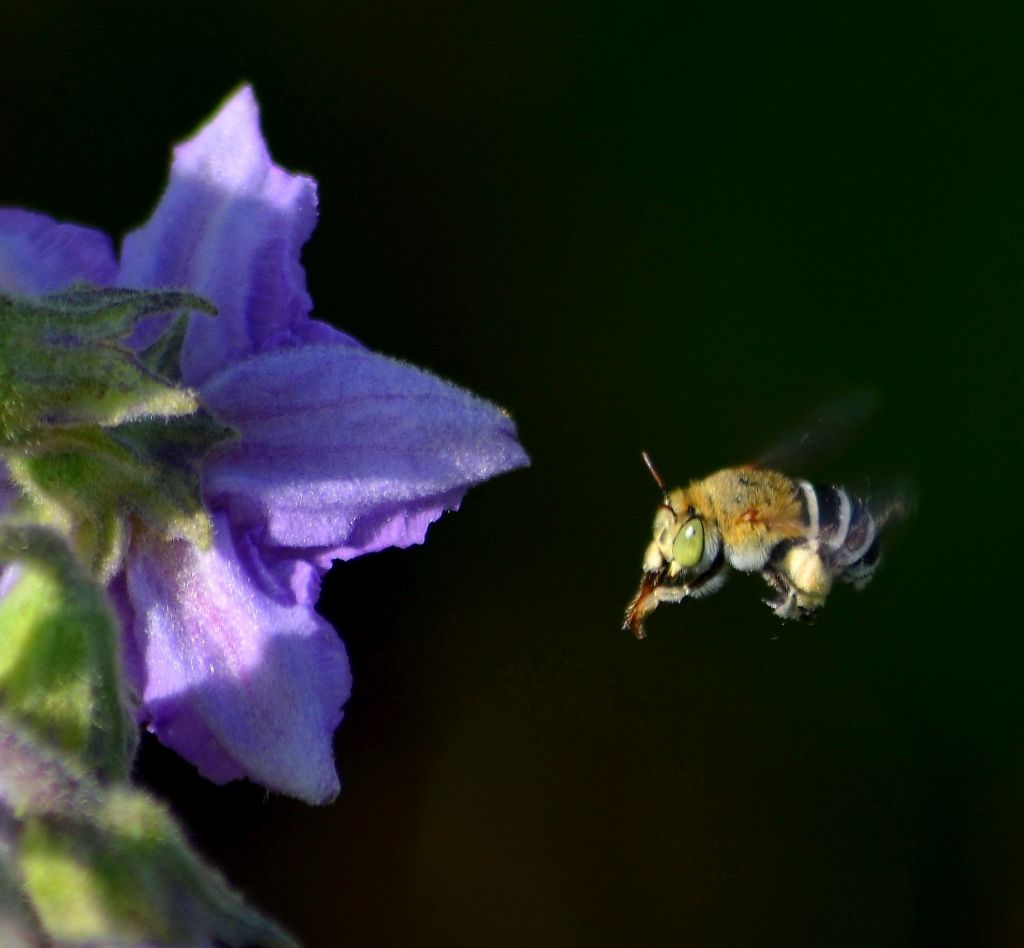
We investigated levels of pollinator dependency and pollinator visitation rates to flowers of six vegetable crops: brinjal (aubergine), tomato, chilli pepper (Solanaceae), okra (Malvaceae), bitter and snake gourds (Cucurbitaceae) in six small family farms in the Coimbatore region of southern India. We tested the null hypothesis that fruit set in these crops would be independent of pollinators. We assessed fruit set through self and cross pollination by pollen augmentation, by pollinator exclusion and open pollination. We evaluated pollen limitation by comparing percentage fruit set by hand outcrossed pollen with open pollination; pollinator dependency by differences in percentage fruit set by open pollination and autogamous pollination; and visitation rates to flowers by pollinating insects. Tomato, chilli and okra produced self-compatible hermaphrodite flowers, with higher levels of autogamous fruit set (32-76%) and significantly lower levels of pollinator dependency (0-37%), whereas andro-monoecious brinjal and monoecious gourds had significantly lower levels of fruit set through autogamy, and higher levels of pollinator dependency. Pollen limitation was not evident in any crop. Diverse pollinating insects visited the flowers, and the frequency of visits by different pollinator taxa differed with crop type. Native vegetation and uncultivated land may enhance pollinator diversity in small farms.
References
Aizen MA, Garibaldi LA, Cunningham SA, Klein AM (2009) Long-term global trends in crop yield and production reveal no current pollination shortage but increasing pollinator dependency. Current Biology 18: 1572-1575.
Allen-Wardell G, Bernhardt P, Bitner R, Burquez A, Buchmann S, Cane J, Cox PA, Dalton V, Feinsinger P, Ingram M, Inouye D, Jones CE, Kennedy K, Kevan P, Koopowitz H, Medellin-Morales S, Nabhan GP, Pavlik B, Tepedino V, Torchio P, Walker S (1998) The potential consequences of pollinator declines on the conservation of biodiversity and stability of food crop yields. Conservation Biology 12: 8–17.
Basu P, Bhattacharya R, Iannetta PPM (2011) A decline in pollinator dependent vegetable crop productivity in India indicates pollination limitation and consequent agro-economic crises. Nature Precedings URL: http://www.farmlandbirds.net/sites/default/files/Basu%20et%20al%202011.pdf (accessed May, 2013)
Bawa KS (1974) Breeding systems of tree species of a lowland tropical community. Evolution 28: 85-92.
Bhanti M, Taneja A (2007) Contamination of vegetables of different seasons with organo phosphorus pesticides and related health risk assessment in North India. Chemosphere 69: 63-68.
Blanche KR, Ludwig JA, Cunningham SA (2006) Proximity to rainforest enhances pollination and fruit set in orchards. Journal of Applied Ecology 43: 1182-1187.
Bradshaw CJ, Sodhi NS, Brook BW (2008) Tropical turmoil: a biodiversity tragedy in progress. Frontiers in Ecology and the Environment 7: 79-87.
Carr SA (2012) Pollination of selected crop plants in Coimbatore district of Tamil Nadu. Unpublished M. Sc. dissertation, Pondicherry University, India.
Chandel RS, Thakur RK, Bhardwaj NR, Pathania N (2004) Onion seed crop pollination: a missing dimension in mountain horticulture. Acta Horticulturae 631:79-86.
Davidar P (2009) Pollination services to NTFP and cultivated plants in the Nilgiri Biosphere Reserve., In: Dutt R, Seeley J, Roy, P (Eds.) Proceedings of the Biodiversity and Livelihoods Conference, pp 106-111.
Davidar P, Snow AA, Rajkumar M, Pasquet R, Daunay MC, Mutegi E (2015) The potential for crop-to-wild hybridization in eggplant (Solanum melongena, Solanaceae) in southern India. American Journal of Botany 102: 140-148.
De Marco Jr P, Coelho FM (2004) Services performed by the ecosystem: forest remnants influence agricultural cultures' pollination and production. Biodiversity & Conservation, 13: 1245-1255.
Garibaldi LA, Steffan-Dewenter I, Winfree R , Aizen MA, Bommarco R, Cunningham SA, Kremen C et al. (2013) Wild pollinators enhance fruit set of crops regardless of honey bee abundance. Science 339: 1608-1611.
Greenleaf SS, Kremen C (2006) Wild bee species increase tomato production and respond differently to surrounding land use in northern California. Biological Conservation 133: 81–87.
Hogendoorn K, Gross CL, Sedgley M, Keller MA (2006) Increased tomato yield through pollination by native Australian Amegilla chlorocyanea (Hymenoptera: Anthophoridae). Journal of Economic Entomology 99: 828-833.
Kearns CA, Inouye DW, Waser NM (1998) Endangered mutualisms: the conservation of plant-pollinator interactions. Annual Review of Ecology and Systematics 29: 83-112.
Kehimkar I (2008) The book of Indian butterflies. BNHS and Oxford University Press, New Delhi.
Klein AM, Vaissiere BE, Cane JH, Steffan-Dewenter I, Cunningham SA, Kremen C, Tscharntke T (2007) Importance of pollinators in changing landscapes for world crops. Proceedings of the Royal Society of London. Series B: Biological Sciences 274: 303–313.
Krishnan S, Kushalappa CG, Shaanker RU, Ghazoul J (2012) Status of pollinators and their efficiency in coffee fruit set in a fragmented landscape mosaic in South India. Basic and Applied Ecology 13: 277-285.
Kumari B, Madan VK, Kumar R, Kathpal TS (2002) Monitoring of seasonal vegetables for pesticide residues. Environmental Monitoring and Assessment 74: 263-270.
Lee JC, Menalled FD, Landis DA (2001). Refuge habitats modify impact of insecticide disturbance on carabid beetle communities. Journal of Applied Ecology 38: 472–483.
McGregor SE (1976) Insect pollination of cultivated crop plants. Agriculture Handbook 496, SDA-ARS, Washington, D.C.
Ollerton J, Winfree R, Tarrant S (2011) How many flowering plants are pollinated by animals? Oikos 120: 321-326.
Ollerton J, Erenler H, Edwards M, Crockett R (2014) Extinctions of aculeate pollinators in Britain and the role of large-scale agricultural changes. Science 346: 1360-1362.
Partap U (1999) Pollination management of mountain crops through beekeeping: trainer resource book. International Centre for Integrated Mountain Development, Kathmandu, Nepal.
Potts SG, Biesmeijer JC, Kremen C, Neumann P, Schweiger O, Kunin WE (2010) Global pollinator declines: trends, impacts and drivers. Trends in Ecology & Evolution 25: 345-353.
Ricketts TH, Daily GC, Ehrlich PR, Michener CD (2004) Economic value of tropical forest to coffee production. Proceedings of the National Academy of Sciences 101: 12579–12582.
Ricketts TH, Regetz J, Steffan Dewenter I, Cunningham SA, Kremen C, Bogdanski A, Gemmill-Herren B, Greenleaf SC, Klein AM, Mayfield MM, Morandin LA, Ochieng A, Viana BF (2008) Landscape effects on crop pollination services: are there general patterns? Ecology Letters 11: 499-515.
Robbins P (2001) Tracking invasive land covers in India, or why our landscapes have never been modern. Annals of the Association of American Geographers 91: 637-659.
Roubik DW (ed) (1995). Pollination of cultivated plants in the tropics (Vol. 118). Food & Agriculture Organisation, Rome, Italy.
Roy SS, Mahmood R, Niyogi D, Lei M, Foster SA, Hubbard KG, Douglas E, Pielke R (2007) Impacts of the agricultural Green Revolution–induced land use changes on air temperatures in India. Journal of Geophysical Research 112 D21, DOI: 10.1029/2007JD008834.
Sinu PA, Shivanna KR (2007a) Pollination biology of large cardamom (Amomum subulatum). Current Science 93: 548-552.
Sinu PA, Shivanna KR (2007b) Pollination ecology of cardamom (Elettaria cardamomum) in the Western Ghats, India. Journal of Tropical Ecology 23: 493-496.
SPSS Inc. (2000) Systat, Version 10. SPSS Inc., Chicago, IL.
Surendran U, Murugappan V (2008) A micro- and meso-level modeling study for assessing sustainability in semi-arid tropical agro ecosystem using NUTMON-tool box. Journal of Sustainable Agriculture 29: 151-179.
Tur C, Castro-Urgal R, Traveset A (2013) Linking plant specialization to dependence in interactions for seed set in pollination networks. PLoS ONE 8: e78294. doi:10.1371/journal.pone.0078294.
Zapata TR, Arroyo MTK (1978) Plant reproductive ecology of a secondary deciduous tropical forest in Venezuela. Biotropica 10: 221-230
Downloads
Published
How to Cite
Issue
Section
License
Copyright (c) 2015 Priya Davidar, Saranya Arwen Carr

This work is licensed under a Creative Commons Attribution 4.0 International License.