
Floral biology of Adolphia infesta and the reproductive profile of Colletieae (Rhamnaceae)
DOI:
https://doi.org/10.26786/1920-7603(2015)12Abstract
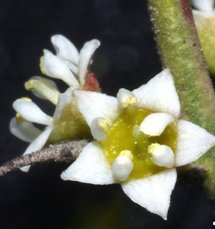
The reproduction of the shrub Adolphia infesta was studied in a population included in a Mexican agricultural landscape with small, cultivated plots and fragments of natural habitat. Adolphia infesta had reproductive traits consistent with those known for its tribe Colletieae, including small zoophilous flowers exposed to both xenogamous, geitonogamous and visitor-facilitated intrafloral pollination, with selfing being at least partially hindered by self-incompatibility. Visual and olfactory cues, together with easily accessible rewards (nectar and pollen), explain the diversity (68 species of 29 families) of insects attracted to the flowers. However, only a small subset can be considered potential pollinators (honeybee and three muscoid flies). In late floral development, pedicel bending brings the developing fruit to an upright position, which might later optimise explosive seed dispersal. The finding of this trait in A. infesta makes fruit erection a synapomorphy of the Adolphia – Discaria – Kentrothamnus clade of the tribe Colletieae. At the study site, A. infestaplayed a significant role as food source for the local anthophilous insect community, and through its flower visitors, the plant was indirectly connected to 11 other plant species. Knowledge derived from community studies should be applied in conservation initiatives directed at enhancing farmers’ appreciation of extant local biodiversity.References
Aagesen L, Medan D, Kellermann J, Hilger HH (2005) Phylogeny of the tribe Colletieae (Rhamnaceae) – a sensitivity analysis of the plastid region trnL – trnF combined with morphology. Plant Systematics and Evolution 250:197-214
Aide TM, Clark ML, Grau HR, López-Carr D, Levy MA, Redo D, Bonilla-Moheno M, Riner G, Andrade-Núñez MAJ, Muñiz MA (2013). Deforestation and reforestation of Latin America and the Caribbean (2001-2010). Biotropica 45:262-271
Aizen MA, Harder LD (2007) Expanding the limits of the pollen-limitation concept: Effects of pollen quantity and quality. Ecology 88:271-281
Bloch D, Erhardt A (2008) Selection toward shorter flowers by butterflies whose probosces are shorter than floral tubes. Ecology 89:2453-2460
Cruz-Cisneros R, Valdés M (1991) Actinorhizal root nodules on Adolphia infesta (H.B.K.) Meissner (Rhamnaceae). Nitrogen Fixing Tree Research Reports 9:87-89
Dafni A, Pacini E, Nepi M (2005) Pollen and stigma biology. In: Dafni A, Kevan PG, Husband BC (eds) Practical pollination biology. Enviroquest, Cambridge, pp 83-146
Garrison WJ, Miller GL, Raspet R (2000) Ballistic seed projection in two herbaceous species. American Journal of Botany 87:1257-1264
Kellermann J, Medan D, Aagesen L, Hilger HH (2005) Rehabilitation of the South American genus Ochetophila Poepp. ex Endl. (Rhamnaceae: Colletieae). New Zealand Journal of Botany 43:865-869
Martin FW (1959) Staining and observing pollen tubes in the style by means of fluorescence. Biotechnic & Histochemistry 34:125-128
Medan D (1985) Fruit morphogenesis and seed dispersal in the Colletieae (Rhamnaceae). I. The genus Discaria. Botanische Jahrbücher für Systematik 105:205-262
Medan D (1991) Reproductive phenology, pollination biology, and gynoecium development in Discaria americana (Rhamnaceae). New Zealand Journal of Botany 29:31-42
Medan D, Aagesen L (1995). Comparative flower and fruit structure in the Colletieae (Rhamnaceae). Botanische Jahrbücher für Systematik 117:531-564
Medan D, Devoto M (2005) Reproductive ecology of a perennial outcrosser with a naturally dissected distribution. Plant Systematics and Evolution 254:173–184
Medan D, Montaldo NH (2005) Ornithophily in the Rhamnaceae: the pollination of the Chilean endemic Colletia ulicina. Flora 200:339-344
Medan D, Schirarend C (2004) Rhamnaceae. In: Kubitzki K (ed.) The Families and Genera of Vascular Plants, Vol. 6. Springer, Berlin, Heidelberg, pp 320–338
Medan D, Torretta JP (2014) The reproduction of Colletia hystrix and late-flowering in Colletia (Rhamnaceae: Colletieae). Plant Systematics and Evolution (DOI 10.1007/s00606-014-1142-5)
Medan D, Zarlavsky G, Bartoloni NJ (2013) Plant reproduction in the high-Andean Puna: Kentrothamnus weddellianus (Rhamnaceae: Colletieae). Plant Systematics and Evolution 299:841-851
Millennium Ecosystem Assessment (2005). Ecosystems and human well-being: scenarios. Washington DC
Moré M, Sérsic AN, Cocucci AA (2007) Restriction of pollinator assemblage through flower length and width in three long-tongued hawkmoth–pollinated species of Mandevilla (Apocynaceae, Apocynoideae). Annals of the Missouri Botanical Garden 94:485-504
Nilsson LA (1988) The evolution of flowers with deep corolla tubes. Nature 334:147–149
Ramos AC, González MF (1972) La vegetación de la zona árida veracruzana. Anales del Instituto de Biología de la UNAM 43, Serie Botánica 1:77-100
Soto EM, García E (1989) Atlas climático del estado de Veracruz. Xalapa: Instituto de Ecología A.C.
Soto M, Lozano F, Diez A, Mejía C, Villa J (1977). Estudio piloto de la vegetación en la región Alchichica-Perote por medio de percepción remota. Biotica 2:19-36
Stamp N, Lucas JR (1983) Ecological correlates of explosive seed dispersal. Oecologia 59:272–278
Swaine MD, Dakubu T, Beer T (1979) On the theory of explosively dispersed seeds. A correction. New Phytologist 82:777-787
Thiers B (2014, continuously updated) Index Herbariorum: A global directory of public herbaria and associated staff. New York Botanical Garden's Virtual Herbarium. http://sweetgum.nybg.org/ih/
Tortosa RD (1993) Revisión del género Adolphia (Rhamnaceae-Colletieae). Darwiniana 32:185-189
Tortosa RD, Aagesen L, Tourn GM (1996) Morphological studies in the tribe Colletieae (Rhamnaceae): analysis of architecture and inflorescences. Botanical Journal of the Linnaean Society 122:353-367
Webb CJ (1984) Flower and fruit movements in Muntingia calabura: A possible mechanism for avoidance of pollinator-disperser interference. Biotropica 15:37-42
Witztum A, Schulgasser K (1995) Seed dispersal ballistics in Blepharis ciliaris. Israel Journal of Plant Sciences 43:147–150
Downloads
Published
How to Cite
Issue
Section
License
Copyright (c) 2015 Diego Medan, Gonzalo Castillo-Campos, Gabriela Zarlavsky

This work is licensed under a Creative Commons Attribution 4.0 International License.