
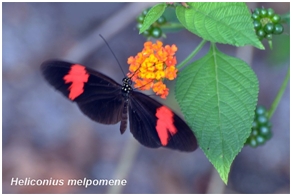
Honest signalling and the billboard effect: how Heliconiid pollinators respond to the trichromatic colour changing Lantana camara L. (Verbenaceae)
DOI:
https://doi.org/10.26786/1920-7603(2017)threeAbstract
Plants communicate with their pollinators through an astonishing range of signals that serve as either honest or deceptive cues which draw in and inform potential visitors of possible rewards. In wild type sweet sage, Lantana camara, floral colour signals were associated with nectar volume and sucrose concentration, and many pollinator taxa quickly learned to associate these varying colour signals with rewards. We tested the hypothesis that if sweet sage is employing a generalist pollinator strategy based on a trichromatic changing floral presentation system of honest rewards for pollinators, then the following predictions will be realized: 1) pre-change yellow flowers will be visited more frequently by pollinators than post change orange, or red flowers; 2) pre-change yellow flowers will produce higher quality and greater quantities of sucrose rewards than post-change orange, or red flowers; 3) inflorescences with higher ratios of rewarding flowers to unrewarding flowers are more attractive at short distances; and 4) inflorescences with a combination of pre-change rewarding and post-change rewarding and unrewarding flowers will act as a multi-coloured advertising billboard and as such be most attractive at long distances. We found corroboration for all of the aforementioned predictions. Thus, sweet sage evolved a generalized pollination visitation system based on honest signalling―of reward quantity and quality tied to colour changing visual signals acting in consort to produce a billboard that was easily perceived and deciphered. These resulted in high visitation rates by many different taxa of pollinators, thus contributing to higher individual plant fitness.
References
Ackerman JD (1986) Mechanisms and evolution of food-deceptive pollination systems in orchids. Lindleyana 1:108-113.
Barcant M (1970) Butterflies of Trinidad and Tobago. Collins, London.
Barrows EM (1976) Nectar robbing and pollination of Lantana camara (Verbenaceae). Biotropica 8:132-135.
Bolin JF, Maass E, Musselman LJ (2009) Pollination biology of Hydnora africana Thumb. (Hydnoraceae) in Namibia: brood-site mimicry with insect imprisonment. Journal of plant Science 170:157-163.
Borror DJ, White RE (1970) A Field Guide to the Insects. Houghton Mifflin Company, New York.
Bourne GR, Bourne CM (2010). The Biological Station and Its Programs. In: The CEIBA Reader. Yerfdog Publishing for CEIBA, Missouri, pp.44.
Briscoe AD (2008) Reconstructing the ancestral butterfly eye: focus on the opsins. Journal of Experimental Biology 211: 1805-1813.
Briscoe AD, Chittka L (2001) The evolution of color vision in insects. Annual review of entomology 46:471-510.
Campbell DR, Bischoff M, Lord JM, Robertson, AW (2012) Where have all the blue flowers gone: pollinator responses and selection on flower colour in New Zealand Wahlenbergia albomarginata. Journal of Evolutionary Biology 25:352-364.
Campbell JW, Hanula JL (2007). Efficiency of Malaise traps and colored pan traps for collecting flower visiting insects from three forested ecosystems. Journal of Insect Conservation 11:399-408.
Carrión-Tacuri J, Berjano R, Guerrero G, Figueroa ME, Tye A, Castillo JM (2012) Nectar Production by Invasive Lantana camara and Endemic L. peduncularis in the Galápagos Islands 1. Pacific Science 66:435-445.
Darwin C (1877) Fritz Müller on flowers and insects. Nature 17:78.
DeVries PJ (1987) The butterflies of Costa Rica and their natural history: Papilionidae, Pieridae, Nymphalidae. Princeton University Press, Princeton New Jersey.
Ghisalberti EL (2000) Review Lantana camara L. (Verbenaceae). Fitoterapia 71: 467-486.
Gibernau M, Macquart D, Przetak G (2004) Pollination in the genus Arum: a review. Aroideana 27:147-166.
Goodrich KR (2012) Floral scent in Annonaceae. Botanical Journal of the Linnean Society 169: 262-279.
Gori DF (1989). Floral color change in Lupinus argenteus (Fabaceae): why should plants advertise the location of unrewarding flowers to pollinators? Evolution 42:870-881.
Graham LE, Graham JM, Wilcox LW (2003) Plant Biology. Prentice Hall, Pearson Education, Inc., Upper Saddle River, New Jersey.
Graham VE (1963) Tropical Wild Flowers. Hulton Educational Publications, London.
Hamilton WD, Brown SP (2001) Autumn tree colours as a handicap signal. Proceedings of the Royal Society of London. Series B: Biological Sciences 268:1489-1493.
Holland JS (2011) Gold dusters. National Geographic 219:114-131.
Hughes JH (1947) Forest Resources of British Guiana: Handbook of Natural Resources of British Guiana. Daily Chronicle Ltd., Georgetown.
Hsu R, Briscoe AD, Chang BS, Pierce NE (2001) Molecular evolution of a long wavelength‐sensitive opsin in mimetic Heliconius butterflies (Lepidoptera: Nymphalidae). Biological Journal of the Linnean Society 72:435-449.
Ida TY, Kudo G (2003) Floral color change in Weigela middendorffiana (Caprifoliaceae): reduction of geitonogamous pollination by bumble bees. American Journal of Botany. 90:1751-1757.
Ida TY, Kudo G (2010) Modification of bumblebee behavior by floral color change and implications for pollen transfer in Weigela middendorffiana. Evolutionary Ecology 24:671-684.
IBM Corp. (2015) IBM SPSS Statistics for Windows, Version 23.0. Armonk, IBM Corp., New York
Johnson SD, Steiner KE (2000) Generalization versus specialization in plant pollination systems. Trends in Ecology and Evolution 15:140-143.
Kampny CM (1995) Pollination and flower diversity in Scrophulariaceae. The Botanical Review 61:350-366.
Keasar T, Pollak G, Arnon R, Cohen D, Shmida A (2006) Honesty of signaling and pollinator attraction: the case of flag-like bracts. Israel Journal of Plant Sciences 54: 119-128.
Kudo G, Hiroshi IS, Hirabayashi Y, Ida TY (2007) A test of the effect of floral color change on pollination effectiveness using artificial inflorescences visited by bumblebees. Oecologia 154: 119-128.
Lack AJ, Diaz A (1991) The pollination of Arum maculatum L: a historical review and new observations. Watsonia 18:333-342.
Maharaj G (2010) An Introduction to Butterflies of the Iwokrama Forest and Communities of the North Rupununi District. Darwin Initiative, University of Warwick, Warwick.
Marshall SA (2008) Five Hundred Insects: A Visual Reference. Firefly Books, Buffalo, New York.
Menzel R (1967) Untersuchungen zum Erlernen von Spek- tralfarben durch die Honigbiene (Apis mellifica). Zeit- schrift fur vergleichende Physiologie 56:22-62.
Menzel R (1985) Learning in honey bees in an ecological and behavioral context in B. Holldobler and M.
Lindauer, editors. Experimental behavioral ecology and sociobiology. Sinauer, Sunderland, Massachusetts, USA, pp. 55-74.
Lunau K, Maier EJ. (1995) Innate colour preferences of flower visitors. Journal of Comparative Physiology 177:1-9.
Milne L, Milne M (1980) National Audubon Society Field Guide to North American Insects and Spiders. Alfred A. Knopf, New York.
Munir AA (1996) A taxonomic review of Lantana camara L. and L. montevidensis (Spreng.) Briq. (Verbenaceae) in Australia. Journal of the Adelaide Botanic Garden 17:1-27.
Myiant A (1994) Common Weeds of Guyana. National Agricultural Research Institute, Guyana.
Nilsson LA (1992) Orchid pollination biology. Trends in Ecology and Evolution 7:255-259.
Nuttman CV, Semida FM, Zalat S, Willmer PG (2005) Visual cues and foraging choices: bee visits to floral colour phases in Alkanna orientalis (Boraginaceae). Biological Journal of the Linnean Society 87:427-435.
Oberrath R, Böhning-Gaese K (1999). Floral color change and the attraction of insect pollinators in lungwort (Pulmonaria collina). Oecologia 121:383-391.
Opler P (1992) A Field Guide to Eastern Butterflies. Houghton Mifflin Company, New York.
Ostler WK, Harper KT (1978) Floral ecology in relation to plant species diversity in the Wasatch Mountains of Utah and Idaho. Ecology 59:848-861.
Pereira AC, da Silva JB, Goldenberg R, Melo GA, Varassin IG (2011) Flower color change accelerated by bee pollination in Tibouchina (Melastomataceae). Flora-Morphology, Distribution, Functional Ecology of Plants. 206:491-497.
Proctor M, Yeo P, Lack A (1996) The Natural History of Pollination. Harper Collins, London.
Pyle MR (1981) National Audubon Society Field Guide to North American Butterflies. Alfred Knopf, New York.
R Development Core Team (2015) R: A language and environment for statistical computing. R Foundation for Statistical Computing, Vienna, Austria.
Raguso RA (2004) Flowers as sensory billboards: progress towards an integrated understanding of floral advertisement. Current opinion in plant biology 7:434-440.
Restall RL, Rodner C, Lentino R (2007a) Birds of northern South America: An Identification Guide, Volume 1: Species Accounts. Yale University Press, New Haven and London.
Restall RL, Rodner C, Lentino R (2007b) Birds of northern South America: An Identification Guide, Volume 2: Plates and Maps. Yale University Press, New Haven and London.
Schaefer HM, Schaefer V, Levey DJ (2004) How plant–animal interactions signal new insights in communication. Trends in Ecology & Evolution 19:577-584.
Seymour RS, Matthews PG (2006) The role of thermogenesis in the pollination biology of the Amazon waterlily Victoria amazonica. Annals of Botany 98: 1129-1135.
Sharma GP, Raghubanshi AS, Singh JS (2005) Lantana invasion: an overview. Weed Biology and Management 5:157-165.
Simpson BB, Neff JL (1981) Floral rewards: alternatives to pollen and nectar. Annals of the Missouri Botanical Garden 68:301-322.
Sison-Mangus MP, Bernard GD, Lampel J, Briscoe AD (2006) Beauty in the eye of the beholder: the two blue opsins of lycaenid butterflies and the opsin gene-driven evolution of sexually dimorphic eyes. Journal of Experimental Biology 209:3079-3090.
Smithe FB (1975) Naturalist’s Color Guide. The American Museum of Natural History, New York.
von Arx M, Goyret J, Davidowitz G, Raguso RA (2012) Floral humidity as a reliable sensory cue for profitability assessment by nectar-foraging hawkmoths. Proceedings of the National Academy of Sciences 109:9471-9476.
Stavenga DG, Arikawa K (2006) Evolution of color and vision of butterflies. Arthropod structure & development 35(4):307-18.
Suzuki MF, Ohashi K (2014) How does a floral colour‐changing species differ from its non‐colour‐changing congener? – a comparison of trait combinations and their effects on pollination. Functional ecology 28:549-560.
Waser NM, Chittka L, Price M, Williams N, & Ollerton J (1996). Generalization in Pollination Systems, and Why it Matters. Ecology, 77:1043-1060. doi:1. Retrieved from http://www.jstor.org/stable/2265575
Waser NM, Price MV (1981) Pollinator choice and stabilizing selection for flower color in Delphinium nelsonii. Evolution 35:376-390.
Waser NM, Price MV (1985) The effect of nectar guides on pollinator preference. Experimental studies with a montane herb. Oecologia 67:121-126.
Weiss MR (1991) Floral colour changes as cues for pollinators. Nature 354: 227-229.
Weiss MR (1995) Floral color change: a widespread functional convergence. American Journal of Botany 82:167-185.
Weiss MR (1997) Innate color preferences and flexible colour learning in the pipevine swallowtail. Animal Behaviour 53:1043-1052.
Weiss MR, Lamont BB (1997) Floral color change and insect pollination: a dynamic relationship. Israel Journal of Plant Sciences 45:185-199.
Wickler W (1968) Mimicry in Plants and Animals (translated from the German by R.D. Martin). World University Library. McGraw Hill, New York.
Willmer P, Stanley DA, Steijven K, Matthews IM, Nuttman CV (2009) Bidirectional flower color and shape changes allow a second opportunity for pollination. Current Biology 19: 919-923.
Wolff D. (2006) Nectar sugar composition and volumes of 47 species of Gentianales from a southern Ecuadorian montane forest. Annals of Botany 97:767-777.
Wright GA, Schiestl FP (2009) The evolution of floral scent: the influence of olfactory learning by insect pollinators on the honest signalling of floral rewards. Functional Ecology 23:841-851.
Yoshida K, Miki N, Momonoi K, Kawachi M, Katou K, Okazaki Y, ... Kondo T (2009) Synchrony between flower opening and petal-color change from red to blue in morning glory, Ipomoea tricolor cv. Heavenly Blue. Proceedings of the Japan Academy. Series B, Physical and biological sciences 85:187-197.
Yuan F, Bernard GD, Le J, Briscoe AD. (2010) Contrasting modes of evolution of the visual pigments in Heliconius butterflies. Molecular biology and evolution 27:2392-2405.
Zaccardi G, Kelber A, Sison-Mangus MP, Briscoe AD. (2006) Color discrimination in the red range with only one long-wavelength sensitive opsin. Journal of Experimental Biology 209:1944-1955.
Downloads
Published
How to Cite
Issue
Section
License
Copyright (c) 2017 Gyanpriya Maharaj, Godfrey Bourne

This work is licensed under a Creative Commons Attribution 4.0 International License.