Contrasting pollination efficiency and effectiveness among flower visitors of Malva sylvestris, Borago officinalis and Onobrychis viciifolia
DOI:
https://doi.org/10.26786/1920-7603(2017)421Abstract
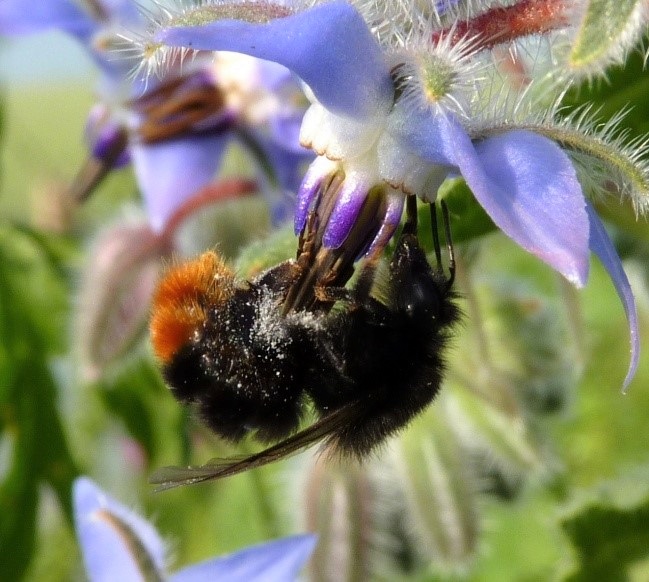
Biotic pollination is an important factor for ecosystem functioning and provides a substantial ecosystem service to human food security. Not all flower visitors are pollinators, however, and pollinators differ in their pollination performances. In this study, we determined the efficiencies of flower visitors to the plant species Malva sylvestris, Borago officinalis and Onobrychis viciifolia by analysing stigmatic pollen deposition. We further calculated pollinator effectiveness by scaling up single-visit pollen deposition using visitation frequency. Flower-visitor groups differed in their efficiencies at the single-visit level and not all of them deposited more pollen compared to unvisited stigmas. Bumblebees tended to be most efficient in depositing pollen per single visit across the three plant species. Due to the by far highest visitation frequencies, Apis mellifera showed the highest effectiveness in depositing pollen per hour for M. sylvestris and B. officinalis, but not for O. viciifolia, for which the Bombus lapidarius complex was both the most frequent and the most effective pollinator group. Hence, the most frequent flower visitors were most effective in our study. For non-dominant pollinator groups, however, visitation frequencies contributed disproportionally to pollinator effectiveness. Thus, combining pollen deposition per single-visit with visitation frequency is necessary to reveal true pollinator performance and to better understand flower-visitor interactions.
References
Adler LS, Irwin RE (2006) Comparison of pollen transfer dynamics by multiple floral visitors: experiments with pollen and fluorescent dye. Annals of Botany 97:141-150.
Ballantyne G, Baldock KCR, Willmer PG (2015) Constructing more informative plant–pollinator networks: visitation and pollen deposition networks in a heathland plant community. Proceedings of the Royal Society of London B: Biological Sciences 282:20151130.
Buchmann SL (1983) Buzz pollination in angiosperms. In: Jones CE, Little RJ (eds) Handbook of experimental pollination biology. Van Nostrand Reinhold Company Inc., New York, pp 73-113.
Buchmann SL, Nabhan GP (1996) The forgotten pollinators. Island Press/Shearwater Books, Washington, DC.
Calderone SA, Lozier JD, Strange JP, Koch JB, Cordes N, Solter LF, Griswold TL (2012) Insect pollinated crops, insect pollinators and US agriculture: trend analysis of aggregate data for the period 1992–2009. PLoS ONE 7:e37235.
Chittka L, Gumbert A, Kunze J (1997) Foraging dynamics of bumble bees: correlates of movements within and between plant species. Behavioral Ecology 8:239-249.
Comba L, Corbet SA, Hunt L, Warren B (1999) Flowers, nectar and insect visits: evaluating British plant species for pollinator-friendly gardens. Annals of Botany 83:369-383.
Corbet SA, Chapman H, Saville N (1988) Vibratory pollen collection and flower form: bumble-bees on Actinidia, Symphytum, Borago and Polygonatum. Functional Ecology 2:147-155.
Corbet SA, Williams IH, Osborne JL (1991) Bees and the pollination of crops and wild flowers in the European Community. Bee World 72:47-59.
Córdoba SA, Cocucci AA (2011) Flower power: its association with bee power and floral functional morphology in papilionate legumes. Annals of Botany 108:919-931.
De Haro-Bailón A, Del Rio M (1998) Isolation of chemically induced mutants in borage (Borago officinalis L.). Journal of the American Oil Chemists’ Society 75:281-283.
De Luca PA, Vallejo-Marín M (2013) What's the “buzz” about? The ecology and evolutionary significance of buzz-pollination. Current Opinion in Plant Biology 16:429-435.
Fenster CB, Armbruster WS, Wilson P, Dudash MR, Thomson JD (2004) Pollination syndromes and floral specialization. Annual Review of Ecology, Evolution, and Systematics 35:375-403.
Fumero-Cabán JJ, Meléndez-Ackerman EJ (2007) Relative pollination effectiveness of floral visitors of Pitcairnia angustifolia (Bromeliaceae). American Journal of Botany 94:419-424.
Gallai N, Salles J-M, Settele J, Vaissière BE (2009) Economic valuation of the vulnerability of world agriculture confronted with pollinator decline. Ecological Economics 68:810-821.
Galloni M, Podda L, Vivarelli D, Cristofolini G (2007) Pollen presentation, pollen-ovule ratios, and other reproductive traits in Mediterranean Legumes (Fam. Fabaceae - Subfam. Faboideae). Plant Systematics and Evolution 266:147-164.
Garibaldi LA, Steffan-Dewenter I, Winfree R, Aizen MA, Bommarco R, Cunningham SA, Kremen C, Carvalheiro LG, Harder LD, Afik O, Bartomeus I, Benjamin F, et al. (2014) Wild pollinators enhance fruit set of crops regardless of honey bee abundance. Science 339:1608-1611.
Garratt MPD, Coston DJ, Truslove CL, Lappage MG, Polce C, Dean R, Biesmeijer JC, Potts SG (2014) The identity of crop pollinators helps target conservation for improved ecosystem services. Biological Conservation 169:128-135.
Gasparetto JC, Martins CAF, Hayashi SS, Otuky MF, Pontarolo R (2012) Ethnobotanical and scientific aspects of Malva sylvestris L.: a millennial herbal medicine. Journal of Pharmacy and Pharmacology 64:172-189.
Ghorbel S, Nabli MA (1998) Pollen, pistil and their interrelations in Borago officinalis and Heliotropium europaeum (Boraginaceae). Grana 37:203-214.
Goplen BP, Richards KW and Moyer JR (1991) Sainfoin for western Canada. Agriculture Canada Publication 1470E:24.
Goulson D, Peat J, Stout JC, Tucker J, Darvill B, Derwent LC, Hughes WOH (2002) Can alloethism in workers of the bumblebee Bombus terrestris be explained in terms of foraging efficiency? Animal Behaviour 64:123-130.
Goulson D (2003) Effects of introduced bees on native ecosystems. Annual Review of Ecology, Evolution, and Systematics 34:1-26.
Goulson D, Darvill B (2004) Niche overlap and diet breadth in bumblebees; are rare species more specialized in their choice of flowers? Apidologie 35:55-63.
Goulson D, Hanley ME, Darvill B, Ellis JS, Knight ME (2005) Causes of rarity in bumblebees. Biological Conservation 122:1-8.
Hayot Carbonero C, Mueller-Harvey I, Brown TA, Smith L (2011) Sainfoin (Onobrychis viciifolia): a beneficial forage legume. Plant Genetic Resources 9:70-85.
Hill PSM, Wells PH, Wells H (1997) Spontaneous flower constancy and learning in honey bees as a function of colour. Animal Behavior 54:615-627.
Hobbs GA, Nummi WO, Virostek JF (1961) Food-gathering behaviour of honey, bumble, and leaf-cutter bees (Hymenoptera: Apoidea) in Alberta. The Canadian Entomologist 93:409-419.
Inouye DW (1980) The terminology of floral larceny. Ecology 61:1251-1253.
Inouye DW, Gill DE, Dudash MR, Fenster CB (1994) A model and lexicon for pollen fate. American Journal of Botany 81:1517-1530.
Janick J, Simon JE, Quinn J, Beaubaire N (1989) Borage: a source of gamma linolenic acid. In: Craker LE, Simon JE (eds) Herbs, spices, and medicinal plants: recent advances in botany, horticulture and pharmacology. Vol 4. Oryx Press, Phoenix, AZ, pp 145-168.
Jauker F, Speckmann M, Wolters V (2016) Intra-specific body size determines pollination effectiveness. Basic and Applied Ecology 17:714-719.
Javorek KE, Mackenzie SP, Vander Kloet SK (2002) Comparative pollination effectiveness among bees (Hymenoptera: Apoidea) on Lowbush Blueberry (Ericaceae: Vaccinium angustifolium). Annals of the Entomological Society of America 95:345-351.
Jędrzejewska-Szmek K, Zych M (2013) Flower-visitor and pollen transport networks in a large city: structure and properties. Arthropod-Plant Interactions 7:503-516.
Johnson SD, Steiner KE (2000) Generalization versus specialization in plant pollination systems. Trends in Ecology and Evolution 15:140-143.
Kearns CA, Inouye DW (1993) Techniques for pollination biologists. University Press of Colorado, Boulder.
King MJ, Buchmann SL (2003) Floral sonication by bees: mesosomal vibration by Bombus and Xylocopa, but not Apis (Hymenoptera: Apidae), ejects pollen from poricidal anthers. Journal of the Kansas Entomological Society 76:295-305.
King C, Ballantyne G, Willmer PG (2013) Why flower visitation is a poor proxy for pollination: measuring single-visit pollen deposition, with implications for pollination networks and conservation. Methods in Ecology and Evolution 4:811-818.
Kleijn D, Winfree R, Bartomeus I, Carvalheiro LG, Henry M, Isaacs R, Klein A-M, Kremen C, M’Gonigle LK, Rader R, Ricketts TH, Williams NM, et al. (2015) Delivery of crop pollination services is an insufficient argument for wild pollinator conservation. Nature Communications 6:7414.
Kumar G, Kadam GB, Saha TN, Girish KS, Tiwari AK, Kumar R (2014) Studies on floral biology of Malva sylvestris L. Indian Journal of Horticulture 71:295-297.
Madjidian JA, Morales CL, Smith HG (2008) Displacement of a native by an alien bumblebee: lower pollinator efficiency overcome by overwhelmingly higher visitation frequency. Oecologia 156:835-45.
Mayer C, Adler L, Armbruster WS, Dafni A, Eardley C, Huang, SQ, Kevan PG, Ollerton J, Packer L, Ssymank A, Stout JC, Potts SG (2011) Pollination ecology in the 21st century: key questions for future research. Journal of Pollination Ecology 3:8-23.
Mayfield M, Waser NM, Price M (2001) Exploring the ‘Most effective pollinator principle’ with complex flowers: bumblebees and Ipomopsis aggregata. Annals of Botany 88:591-96.
Michener CD (2007) The bees of the world. Johns Hopkins University Press, Baltimore.
Montaner C, Floris E, Alvarez JM (2000) Is self-compatibility the main breeding system in borage (Borago officinalis L.)? Theoretical and Applied Genetics 101:185-189.
Ne’eman G, Shavit O, Shaltiel L, Shmida A (2006) Foraging by male and female solitary bees with implications for pollination. Journal of Insect Behavior 19:383-401.
Ne’eman G, Jürgens A, Newstrom-Lloyd LE, Potts SG, Dafni A (2010) A framework for comparing pollinator performance: effectiveness and efficiency. Biological Reviews 85:435451.
Neff JL, Simpson BB (1988) Vibratile pollen-harvesting by Megachile mendica Cresson (Hymenoptera, Megachilidae). Journal of the Kansas Entomological Society 61:242-244.
Ollerton J, Tarrant S, Winfree R (2011) How many flowering plants are pollinated by animals? Oikos 120:321-326.
Olsen KM (1997) Pollination effectiveness and pollinator importance in a population of Heterotheca subaxillaris (Asteraceae). Oecologia 109:114-121.
Popic TJ, Wardle GM, Davila YC (2013) Flower-visitor networks only partially predict the function of pollen transport by bees. Austral Ecology 38:76-86.
R Core Team (2015) R: A language and environment for statistical computing. R Foundation for Statistical Computing, Vienna, Austria. URL https://www.R-project.org/.
Rader R, Howlett BG, Cunningham SA, Westcott DA, Newstrom-Lloyd LE, Walker MK, Teulon DAJ, Edwards W (2009) Alternative pollinator taxa are equally efficient but not as effective as the honeybee in a mass flowering crop. Journal of Applied Ecology 46:1080-1087.
Raine NE, Chittka L (2005) Comparison of flower constancy and foraging performance in three bumblebee species (Hymenoptera: Apidae: Bombus). Entomologia Generalis 28:81-89.
Richards KW, Edwards PD (1988) Density, diversity, and efficiency of pollinators of sainfoin, Onobrychis viciaefolia Scop. The Canadian Entomologist 120:1085-1100.
Sahli HF, Conner JK (2006) Characterizing ecological generalization in plant-pollination systems. Oecologia 148:365-72.
Slaa EJ, Sánchez CLA, Malagodi-Braga KS, Hofstede FE (2006) Stingless bees in applied pollination. Practice and perspectives. Apidologie 37:293-315.
Snow AA, Spira TP, Simpson R, Klips RA (1996) The ecology of geitonogamous pollination. In: Lloyd DG, Barrett SCH (eds) Floral biology: studies on floral evolution in animal-pollinated plants. Chapman and Hall, New York, pp 191-216.
Thorp RW (2000) The collection of pollen by bees. Plant Systematics and Evolution 222:211-223.
Vázquez DP, Morris WF, Jordano P (2005) Interaction frequency as a surrogate for the total effect of animal mutualists on plants. Ecology Letters 8:1088-1094.
Waser NM (1986) Flower constancy: definition, cause and measurement. The American Naturalist 127: 96-603.
Westerkamp C, Gottsberger G (2000) Diversity pays in crop pollination. Crop Science 40:1209-1222.
Westrich P (1989) Die Wildbienen Baden-Württembergs. Allgemeiner Teil. E Ulmer, Stuttgart.
Willmer PG, Bataw AAM, Hughes JP (1994) The superiority of bumblebees to honeybees as pollinators: insect visits to raspberry flowers. Ecological Entomology 19:271-284.
Willmer PG, Finlayson K (2014) Big bees do a better job: intraspecific size variation influences pollination effectiveness. Journal of Pollination Ecology 14:244-254.
Wilson P, Thomson JD (1991) Heterogeneity among floral visitors leads to discordance between removal and deposition of pollen. Ecology 72:1503-1507.
Zhang H, Huang J, Williams PH, Vaissière BE, Zhou Z, Gai Q, Dong J, An J (2015) Managed bumblebees outperform honeybees in increasing peach fruit set in China: different limiting processes with different pollinators. PLoS ONE 10:e0121143.
Zych M, Goldstein J, Roguz K, Stpiczyńska M (2013) The most effective pollinator revisited: pollen dynamics in a spring-flowering herb. Arthropod-Plant Interactions 7:315-322.
Zych M, Stpiczyńska M (2012) Neither protogynous nor obligatory out-crossed: pollination biology and breeding system of the European Red List Fritillaria meleagris L. (Liliaceae). Plant Biology 14:285-294.
Downloads
Published
How to Cite
Issue
Section
License
Copyright (c) 2017 Anna Gorenflo, Tim Diekötter, Mark van Kleunen, Volkmar Wolters, Frank Jauker

This work is licensed under a Creative Commons Attribution 4.0 International License.