
Attractiveness of the dark central floret in wild carrots: do umbel size and height matter?
DOI:
https://doi.org/10.26786/1920-7603(2018)13Abstract
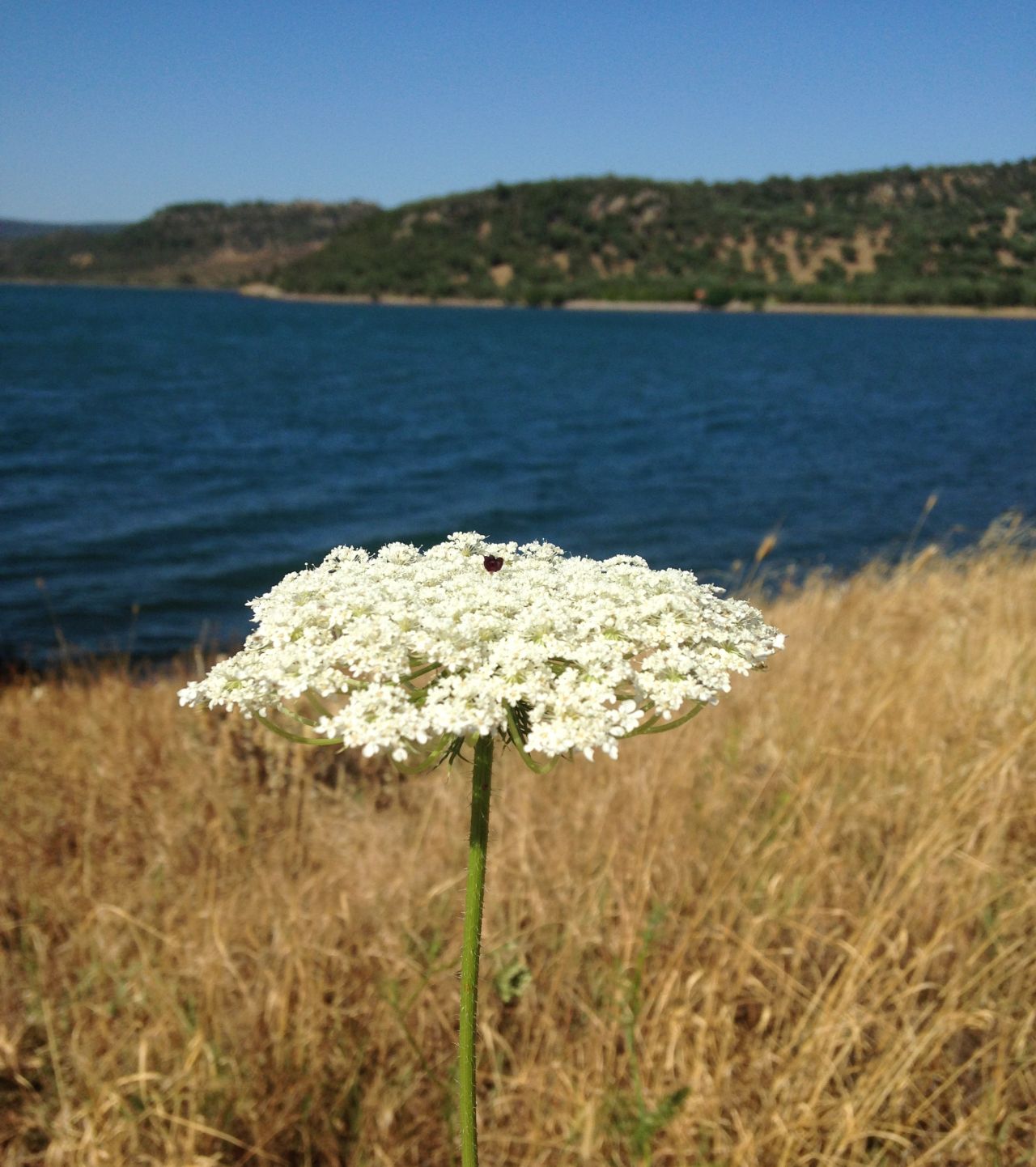
The function of the dark central floret (DCF) in the wild carrot, Daucus carota L. (Apiaceae), is uncertain. It has been suggested that it is a vestigial structure without a function, that it serves as a long or short distance signal to attract pollinators, or that it might function as a defense mechanism against herbivores. We experimentally assessed the role of the umbel size and height in the attractiveness of the DCF to insects in a coastal population of D. carota in western Turkey. We did not find differences in the number of insect visits between umbels with a DCF and umbels in which the DCF was removed when they were of average diameter (10 cm) and were placed either at the average inflorescence height (120 cm) or at 147 cm above ground. Similarly, we did not find differences in the number of insect visits before and after the removal of the DCF from an umbel or between umbels of small (5–7 cm) and large (11–13 cm) diameters. However, umbels of average diameter with DCF received more insect visits than those without it when we placed them at 81 cm above ground. These results suggest that umbel height, not diameter per se, influences the attractiveness of the DCF in the studied population. Thus, our study supports the hypothesis that DCF function depends on ecological context, reliant on both the visitor community and the predominant flower phenotype.References
Bohart GE, Nye WP (1960) Insect Pollinators of Carrots in Utah. Utah Agricultural Experimental Station Bulletin 419:1‒16.
Cane JH, Minckley RL, Kervin LJ (2000) Sampling bees (Hymenoptera: Apiformes) for pol¬linator community studies: pitfalls of pan-trapping. Journal of the Kansas Entomological Society 73: 225–231.
Darwin C (1888) The different forms of flowers on plants of the same species, 3rd edn. John Murray, London, UK.
Eisikowitch D (1980) The role of dark flowers in the pollination of certain umbelliferae. Journal of Natural History 14:737–742.
Frankie GW, Haber WA, Opler PA, Bawa KS (1983) Characteristics and organization of the large bee pollination system in the Costa Rican dry forest. In: Jones CE, Little RJ (eds) Handbook of Experimental Pollination Biology. Van Nostrand-Reinhold Company Inc., New York, pp 411‒447.
Gonzáles WL, Suarez LH, Gianoli E (2016) Genetic variation in the reduction of attractive floral traits of an annual tarweed in response to drought and apical damage. Journal of Plant Ecology 9:629–635.
Gonzalez VH, Park KE, Çakmak I, Hranitz JM, Barthell JF (2016) Pan traps and bee size in unmanaged urban habitats. Journal of Hymenoptera Research 51:241–247.
Goulson D, McGuire K, Munro EE, Adamson S, Colliar L, Park KJ, Tinsley MC, Gilburn AS (2009) Functional significance of the dark central floret of Daucus carota (Apiaceae) L.; is it an insect mimic? Plant Species Biology 24:77–82.
Gumbert A, Kunze J (1999) Inflorescence height affects visitation behavior of bees–A case study of an aquatic plant community in Bolivia. Biotropica 31:466–477.
Lamborn E, Ollerton J (2000) Experimental assessment of the functional morphology of inflorescences of Daucus carota (Apiaceae): testing the ‘fly catcher effect’. Functional Ecology 14:445–454.
Lortie CJ, Aarssen LW (1999) The advantage of being tall: higher flowers receive more pollen in Verbascum thapsus L. (Scrophulariaceae). Ecoscience 6:68–71.
Ollerton J, Killick A, Lamborn E, Watts S, Whiston M (2007) Multiple meanings and modes: on the many ways to be a generalist flower. Taxon 56:717–728.
Polte S, Reinhold K (2013) The function of the wild carrot’s dark central floret: attract, guide or deter? Plant Species Biology 28:81–86.
Schaffer WM, Jensen DB, Hobbs DE, Gurevitch J, Todd JR, Schaffer VM (1979) Competition, foraging energetics, and the cost of sociality in three species of bees. Ecology 60:976‒987.
Thomson JD (1988) Effects of variation in inflorescence size and floral rewards on the visitation rates of traplining pollinators of Aralia hispida. Evolutionary Ecology 2:65–76.
Westmoreland D, Muntan C (1996) The influence of dark central florets on insect attraction and fruit production in Queen Anne’s Lace (Daucus carota L.). American Midland Naturalist 135:122–129.
Downloads
Published
How to Cite
Issue
Section
License
Copyright (c) 2018 Victor Hugo Gonzalez, Peter Cruz, Nadiyah Folks, Sarah Sarah Anderson, Dillon Travis, John Hranitz, John Barthell

This work is licensed under a Creative Commons Attribution 4.0 International License.