
Pollen transfer efficiency of Apocynum cannabinum (Apocynaceae): a comparative perspective
DOI:
https://doi.org/10.26786/1920-7603(2018)fourAbstract
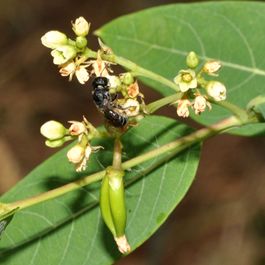
Pollen transfer efficiency (PTE), the percentage of removed pollen delivered to conspecific stigmas, has been implicated in the morphological evolution, population dynamics, and lineage diversification of flowering plants. Pollinia, the aggregated contents of pollen sacs, present in Apocynaceae subfamilies Asclepiadoideae (milkweeds), Secamonoideae, and Periplocoideae and orchids (Orchidaceae), are the pre-eminent example of a plant trait that elevates PTE (to ca. 25%). However comparison of species with pollinia to “average” flowers (PTE ca. 1%) may over-estimate the gains from pollinia. We hypothesize that elevated PTE evolved in Apocynaceae prior to pollinia. We measured PTE and pollen to ovule ratio, a possible correlate of PTE, in Apocynum cannabinum, a milkweed relative with pollen tetrads (instead of pollinia) and simple bands of style head adhesive (instead of complex pollinium-carrying translators), comparing them to reports of other species collated from the literature. PTE of A. cannabinum is 7.9%, in the 24th percentile of reports for 35 milkweed species, but more than twice the highest PTE reported for a species with monads (3.4%). The bands of style head adhesive are functionally equivalent to the translators of milkweeds. The pollen to ovule ratio of A. cannabinum, at 19.8, is in the 94th percentile of ratios reported for milkweeds (mean 9.6). Our results are consistent with the hypothesis that floral novelties of Apocynaceae that evolved prior to pollinia also promote aggregated pollen transport and elevated PTE.
References
Aizen MA, Raffaele E (1996) Nectar production and pollination in Alstroemeria aurea: responses to level and pattern of flowering shoot defoliation. Oikos 76:312-322.
Ali T, Ali SI (1989) Pollination biology of Calotropis procera subsp. hamiltonii (Asclepiadaceae). Phyton-Annales Rei Botanicae 29:175-188.
Armbruster WS, Muchhala N (2009) Associations between floral specialization and species diversity: cause, effect, or correlation? Evolutionary Ecology 23:159-179.
Bailey WW (1874) Apocynum. Bulletin of the Torrey Botanical Club 5:9-10.
Broyles SB, Wyatt R (1995) A reexamination of the pollen-donation hypothesis in an experimental population of Asclepias exaltata. Evolution 49:89-99.
Castellanos MC, Wilson P, Thomson JD (2003) Pollen transfer by hummingbirds and bumblebees, and the divergence of pollination modes in Penstemon. Evolution 57:2742-2752.
Christ K-D, Dieterle A, Gottsberger G (2001) Pollinators, pollen ovule ratio and the extent of cross-versus self-fertilization in the groundlayer of a spring wildflower community in a central european forest. Phytomorphology 51:529-540.
Conner JK, Davis R, Rush S (1995) The effect of wild radish floral morphology on pollination efficiency by four taxa of pollinators. Oecologia 104:234-245.
Cruden RW (1977) Pollen-ovule ratios - conservative indicator of breeding systems in flowering plants. Evolution 31:32-46.
Cruden RW (2000) Pollen grains: why so many? Plant Systematics and Evolution 222:143-165.
Cruden RW, Jensen KG (1979) Viscin threads, pollination efficiency and low pollen-ovule ratios. American Journal of Botany 66:875-879.
Dafni A (1992) Pollination Ecology a Practical Approach. Oxford University Press, Oxford, United Kingdom.
Darrault RO, Schlindwein C (2005) Limited fruit production in Hancomia speciosa (Apocynaceae) and pollination by nocturnal and diurnal insects. Biotropica 37:381-388.
de Araujo LDA, Quirino ZGM, Machado IC (2011) Fenologia reprodutiva, biologia floral e polinização de Allamanda blanchetii, uma Apocynaceae endêmica da Caatinga. Revista Brasileira de Botânica 34:211-222.
de Moura TN, Webber AC, Torres LNM (2011) Floral biology and a pollinator effectiveness test of the diurnal floral visitors of Tabernaemontana undulata Vahl. (Apocynaceae) in the understory of Amazon rainforest, Brazil. Acta Botanica Brasilica 25:380-386.
Demeter K (1922) Vergleichende Asclepiadeenstudien. Flora 115:130-176.
Endress ME, Liede-Schumann S, Meve U (2014) An updated classification for Apocynaceae. Phytotaxa 159:175–194.
Erbar C, Langlotz M (2005) Pollen to ovule ratios: standard or variation - a compilation. Botanische Jahrbuecher fuer Systematik Pflanzengeschichte und Pflanzengeographie 126:71-132.
Fallen ME (1986) Floral structure in the Apocynaceae: morphology, functional, and evolutionary aspects. Botanische Jahrbuecher fuer Systematik, Pflanzengeschichte, und Pflanzengeographie 106:245-286.
Fishbein M (2001) Evolutionary innovation and diversification in the flowers of Asclepiadaceae. Annals of the Missouri Botanical Garden 88:603-623.
Flanagan RJ, Mitchell RJ, Karron JD (2011) Effects of multiple competitors for pollination on bumblebee foraging patterns and Mimulus ringens reproductive success. Oikos 120:200-207.
Freitas BM, Paxton RJ (1998) A comparison of two pollinators: the introduced honey bee Apis mellifera and an indigenous bee Centris tarsata on cashew Anacardium occidentale in its native range of NE Brazil. Journal of Applied Ecology 35:109-121.
Galen C, Stanton ML (1989) Bumble bee pollination and floral morphology: Factors influencing pollen dispersal in the Alpine Sky Pilot, Polemonium viscosum (Polemoniaceae). American Journal of Botany 76:419-426.
Gascoigne J, Berec L, Gregory S, Courchamp F (2009) Dangerously few liaisons: a review of mate-finding Allee effects. Population Ecology 51:355-372.
Ghazoul J (2005a) Implications of plant spatial distribution for pollination and seed production. In: Burslem D, Pinard M, Hartley S (eds) Biotic interactions in the tropics: their role in the maintenance of species diversity. Cambridge University Press, Cambridge, UK, pp 241-266.
Ghazoul J (2005b) Pollen and seed dispersal among dispersed plants. Biological Reviews 80:413-443. doi: doi:10.1017/
S1464793105006731.
Ghazoul J (2006) Floral diversity and the facilitation of pollination. Journal of Ecology 94:295-304.
Groom MJ (1998) Allee effects limit population viability of an annual plant. The American Naturalist 151:487-496. doi: doi:10.1086/286135.
Harder LD (2000) Pollen dispersal and the floral diversity of Monocotyledons. In: Wilson K.L. MD (ed) Monocots: systematics and evolution. CSIRO Publishing, Melbourne, pp 243–257.
Harder LD, Aizen MA (2010) Floral adaptation and diversification under pollen limitation. Philosophical Transactions of the Royal Society B: Biological Sciences 365:529-543. doi: 10.1098/rstb.2009.0226.
Harder LD, Johnson SD (2008) Function and evolution of aggregated pollen in angiosperms. International Journal of Plant Sciences 169:59-78.
Harder LD, Thomson JD (1989) Evolutionary options for maximizing pollen dispersal of animal-pollinated plants. The American Naturalist 133:323-344.
Herrera J (1991) The reproductive biology of a riparian Mediterranean shrub, Nerium oleander L. (Apocynaceae). Botanical Journal of the Linnean Society 106:147-172.
Hiei K, Suzuki K (2001) Visitation frequency of Melampyrum roseum var. japonicum (Scrophulariaceae) by three bumblebee species and its relation to pollination efficiency. Canadian Journal of Botany 79:1167–1174. doi: doi:10.1139/cjb-79-10-1167.
Ionta GM, Judd WS (2007) Phylogenetic relationships in Periplocoideae (Apocynaceae s.l.) and insights into the origin of pollinia. Annals of the Missouri Botanical Garden 94:360-375.
Johnson SA, Bruederle LP, Tomback DF (1998) A mating system conundrum: hybridization in Apocynum (Apocynaceae). American Journal of Botany 85:1316-1323.
Johnson SD, Neal PR, Harder LD (2005) Pollen fates and the limits on male reproductive success in an orchid population. Biological Journal of the Linnean Society 86:175-190.
Kobayashi S, Inoue K, Kato M (1997) Evidence of pollen transfer efficiency as the natural selection factor favoring a large corolla of Campanula punctata pollinated by Bombus diversus. Oecologia 111:535-542.
Kunin WE (1997) Population size and density effects in pollination: pollinator foraging and plant reproductive success in experimental arrays of Brassica kaber. Journal of Ecology 85:225-234.
Kunze H (1991) Structure and function in asclepiad pollination. Plant Systematics and Evolution 176:227-253.
Kunze H (1993) Evolution of the translator in Periplocaceae and Asclepiadaceae. Plant Systematics and Evolution 185:99-122.
Kunze H (1994) Ontogeny of the translator in Asclepiadaceae S-Str. Plant Systematics and Evolution 193:223-242.
Kunze H, Liede S (1991) Observations on pollination in Sarcostemma (Asclepiadaceae). Plant Systematics and Evolution 178:95-106.
Leggett WH (1872) Apocynum. Bulletin of the Torrey Botanical Club 3:53-55.
Lin S, Bernardello G (1999) Flower structure and reproductive biology in Aspidosperma quebracho-blanco (Apocynaceae), a tree pollinated by deceit. International Journal of Plant Sciences 160:869-878.
Lipow SR, Wyatt R (1998) Reproductive biology and breeding system of Gonolobus suberosus (Asclepiadaceae). Journal of the Torrey Botanical Society 125:183-193.
Lipow SR, Wyatt R (1999) Floral morphology and late-acting self-incompatibility in Apocynum cannabinum (Apocynaceae). Plant Systematics and Evolution 219:99-109.
Livshultz T (2010) The phylogenetic position of milkweeds (Apocynaceae subfamilies Secamonoideae and Asclepiadoideae): Evidence from the nucleus and chloroplast. Taxon 59:1016-1030.
Livshultz T, Mead JV, Goyder DJ, Brannin M (2011) Climate niches of milkweeds with plesiomorphic traits (Secamonoideae; Apocynaceae) and the milkweed sister group link ancient African climates and floral evolution. American Journal of Botany 98:1978-1988. doi: 10.3732/ajb.1100202.
Livshultz T, Middleton DJ, Endress ME, Williams JK (2007) Phylogeny of Apocynoideae and the APSA clade (Apocynaceae s.l.). Annals of the Missouri Botanical Garden 94:324-359.
Lohne C, Machado IC, Porembski S, Erbar C, Leins P (2004) Pollination biology of a Mandevilla species (Apocynaceae), characteristic of NE-Brazilian inselberg vegetation. Botanische Jahrbuecher fuer Systematik Pflanzengeschichte und Pflanzengeographie 125:229-243.
Middleton DJ (2007) Flora Malesiana Series I: Apocynaceae (subfamilies Rauvolfioideae and Apocynoideae)- volume 18. Foundation Flora Malesiana, Leiden.
Middleton DJ, Livshultz T (2012) Streptoechites gen. nov., a new genus of Asian Apocynaceae. Adansonia 34:365-375.
Nilsson S, Endress ME, Grafstrom E (1993) On the relationship of the Apocynaceae and Periplocaceae. Grana Supplement 2:3-20.
Ollerton J, Johnson SD, Cranmer L, Kellie S (2003) The pollination ecology of an assemblage of grassland asclepiads in South Africa. Annals of Botany 92:807-834.
Omlor R (1996) Do Menabea venenata and Secamonopsis madagascariensis represent missing links between Periplocaceae, Secamonoideae and Marsdenieae (Asclepiadaceae)? Kew Bulletin 51:695-715.
Pauw A (1998) Pollen transfer on bird’s tongues. Nature 394:731–732.
Queller DC (1984) Pollen-ovule ratios and hermaphrodite sexual allocation strategies. Evolution 38:1148-1151.
Raju AJS, Ramana KV (2009) Pollination and seedling ecology of Decalepis hamiltonii Wight & Arn. (Periplocaceae), a commercially important, endemic and endangered species. Journal of Threatened Taxa 1:497-506.
Raju AJS, Zafar R, Rao SP (2005) Floral device for obligate selfing by remote insect activity and anemochory in Wrightia tinctoria (Roxb.) R.Br. (Apocynaceae). Current Science 88:1378-1380.
Ren M-X, Tang J-Y (2010) Anther fusion enhances pollen removal in Campsis grandiflora, a hermaphroditic flower with didynamous stamens. International Journal of Plant Sciences 171:275-282. doi: doi:10.1086/650157.
Rosatti TJ (1989) The genera of suborder Apocynineae (Apocynaceae and Asclepiadaceae) in the Southeastern United States. Journal of the Arnold Arboretum 70:443-514.
Safwat FM (1962) The floral morphology of Secamone and the evolution of the pollinating apparatus in Asclepiadaceae. Annals of the Missouri Botanical Garden 49:95-129.
Schick B (1982) Zur Morphologie, Entwicklung, Feinstruktur und Funktion des Translators von Periploca L. (Asclepiadaceae). Tropische und Subtropische Pflanzenwelt 40:7-45.
Schultz ME, Burnside OC (1979) Distribution, competition, and phenology of hemp dogbane (Apocynum cannabinum) in Nebraska. Weed Science 27:565-570.
Sennblad B, Endress ME, Bremer B (1998) Morphology and molecular data in phylogenetic fraternity: The tribe Wrightieae (Apocynaceae) revisited. American Journal of Botany 85:1143-1158.
Shuttleworth A, Johnson SD (2006) Specialized pollination by large spider-hunting wasps and self-incompatibility in the African milkweed Pachycarpus asperifolius. International Journal of Plant Sciences 167:1177-1186.
Shuttleworth A, Johnson SD (2008) Bimodal pollination by wasps and beetles in the African milkweed Xysmalobium undulatum. Biotropica 40:568–574.
Shuttleworth A, Johnson SD (2009) Palp-faction: An African milkweed dismembers its wasp pollinators. Environmental Entomology 38:741-747.
Simões AO, Endress ME, Conti E (2010) Systematics and character evolution of Tabernaemontaneae (Apocynaceae, Rauvolfioideae) based on molecular and morphological evidence. Taxon 59:772-790.
Simões AO, Livshultz T, Conti E, Endress ME (2007) Phylogeny and systematics of the Rauvolfioideae (Apocynaceae) based on molecular and morphological evidence. Annals of the Missouri Botanical Garden 94:268-297.
Snow AA, Roubik DW (1987) Pollen deposition and removal by bees visiting two tree species in Panama. Biotropica 19:57-63.
Straub SCK, Moore MJ, Soltis PS, Soltis DE, Liston A, Livshultz T (2014) Phylogenetic signal detection from an ancient rapid radiation: Effects of noise reduction, long-branch attraction, and model selection in crown clade Apocynaceae. Molecular Phylogenetics and Evolution 80:169-185. doi: 10.1016/
j.ympev.2014.07.020.
Tanaka H et al. (2006) Andromonoecious sex expression of flowers and pollinia delivery by insects in a Japanese milkweed Metaplexis japonica (Asclepiadaceae), with special reference to its floral morphology. Plant Species Biology 21:193-199.
Thomson JD (2006) Tactics for male reproductive success in plants: contrasting insights of sex allocation theory and pollen presentation theory. Integrative and Comparative Biology 46:390-397.
Thostesen AM, Olesen JM (1996) Pollen removal and deposition by specialist and generalist bumblebees in Aconitum septentrionale. Oikos 77:77-84.
Torres C, Galetto L (1999) Factors constraining fruit set in Mandevilla pentlandiana (Apocynaceae). Botanical Journal of the Linnean Society 129:187-205.
Van De Ven EA, Van Der Ham R (2006) Pollen of Melodinus (Apocynaceae): Monads and tetrads. Grana 45:1-8.
van der Ham R, Zimmermann YM, Nilsson S, Igersheim A (2001) Pollen morphology and phylogeny of the Alyxieae (Apocynaceae). Grana 40:169-191.
van der Weide JC, van der Ham RWJM (2012) Pollen morphology and phylogeny of the tribe Tabernaemontaneae (Apocynaceae, subfamily Rauvolfioideae). Taxon 61:131-145.
Verhoeven RL, Venter HJT (1998) Pollinium structure in Periplocoideae (Apocynaceae). Grana 37:1-14.
Verhoeven RL, Venter HJT (2001) Pollen morphology of the Periplocoideae, Secamonoideae, and Asclepiadoideae (Apocynaceae). Annals of the Missouri Botanical Garden 88:569-582.
Vieira M, Shepherd G (2002) Removal and insertion of pollinia in flowers of Oxypetalum (Asclepiadaceae) in southeastern Brazil. Rev. Biol. Trop. 50:37–43.
Waddington KD (1976) Pollination of Apocynum sibiricum (Apocynaceae) by Lepidoptera. The Southwestern Naturalist 21:31-36.
Webb CJ, Bawa KS (1983) Pollen dispersal by hummingbirds and butterflies: A comparative study of two lowland tropical plants. Evolution 37:1258-1270.
Wilson P (1995) Variation in the intensity of pollination in Drosera tracyi - selection is strongest when resources are intermediate. Evolutionary Ecology 9:382-396.
Wilson P, Thomson JD (1991) Heterogeneity among floral visitors leads to discordance between removal and deposition of pollen. Ecology 72:1503-1507.
Wolff D, Meve U, Liede-Schumann S (2008) Pollination ecology of Ecuadorian Asclepiadoideae (Apocynaceae): How generalized are morphologically specialized flowers? Basic and Applied Ecology 9:24-34.
Woodson RE, Jr. (1930) Studies in the Apocynaceae. I. A critical study of the Apocynoideae (with special reference to the genus Apocynum). Annals of the Missouri Botanical Garden 17:1-172+174-212.
Wyatt R (1976) Pollination and fruit-set in Asclepias - reappraisal. American Journal of Botany 63:845-851.
Wyatt R, Broyles SB, Lipow SR (2000) Pollen-ovule ratios in milkweeds (Asclepiadaceae): an exception that probes the rule. Systematic Botany 25:171-180.
Young HJ, Dunning DW, Hasseln KWv (2007) Foraging behavior affects pollen removal and deposition in Impatiens capensis (Balsaminaceae). American Journal of Botany 94:1267-1271. doi: 10.3732/ajb.94.7.1267.
Young HJ, Stanton ML (1990) Influences of floral variation on pollen removal and seed production in wild radish. Ecology 71:536-547
Downloads
Additional Files
Published
How to Cite
Issue
Section
License
Copyright (c) 2018 Tatyana Livshultz, Sonja Hochleitner, Elizabeth Lakata

This work is licensed under a Creative Commons Attribution 4.0 International License.