
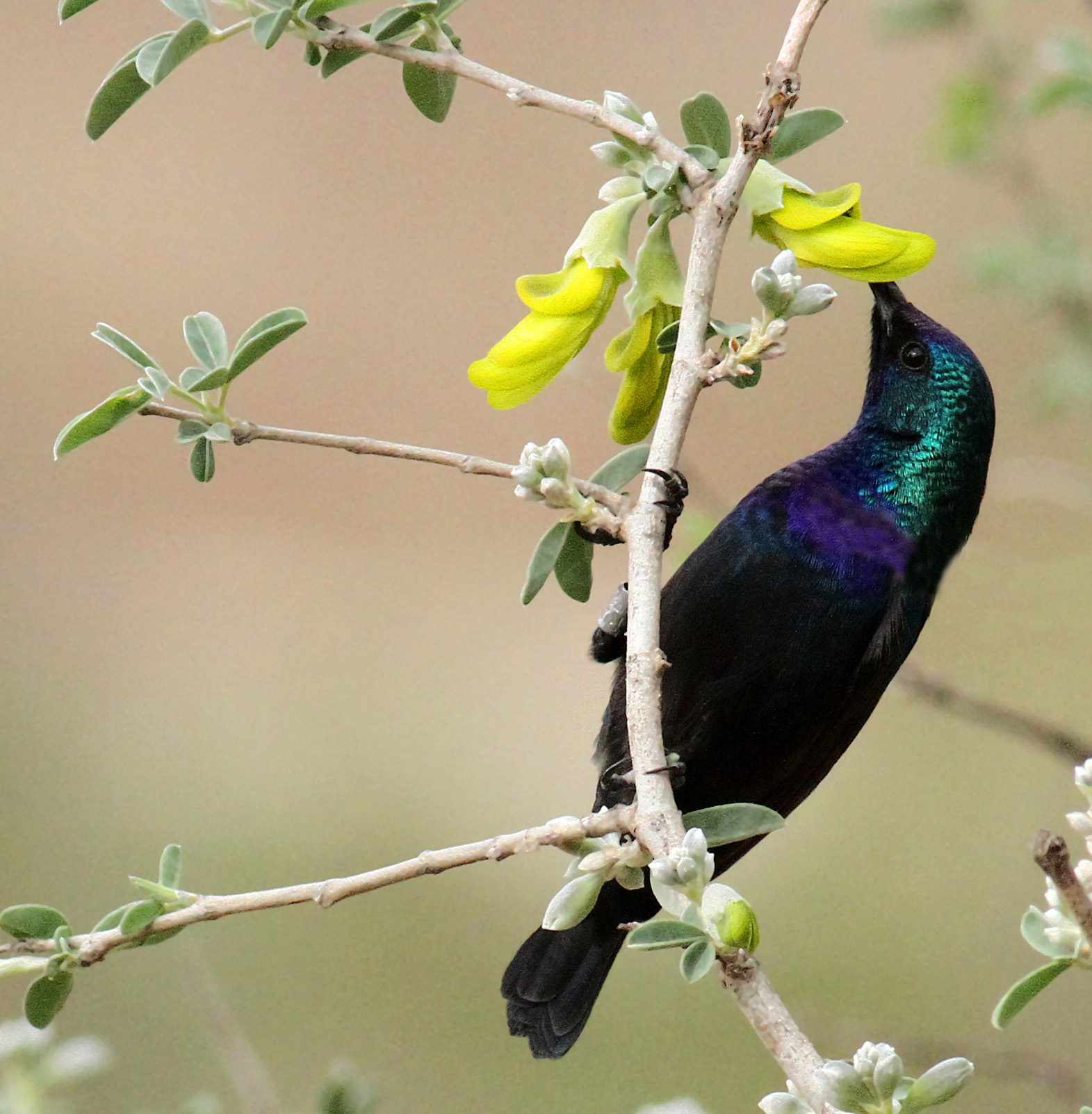
Specialist nectarivorous birds (Cinnyris osea) steal nectar whereas omnivorous birds are pollen transfer vectors of Anagyris foetida
DOI:
https://doi.org/10.26786/1920-7603(2018)9Abstract
The ornithophilous Anagyris foetida is almost the only shrub in the eastern Mediterranean region that flowers in winter. We assessed the pollination potential of flower visitors by observing pollen loads on trapped animals and contacts with floral parts. Resident and wintering omnivorous bird species, together with honey bees (Apis mellifera), were found to carry the shrub’s pollen throughout its long flowering period in Israel and thus might be legitimate pollinators. Spring-migrating omnivorous birds passing through Israel carried pollen. The Palestine Sunbird (Cinnyris osea) is the only specialist nectarivorous bird in the Middle East. It carries little pollen and is therefore primarily a nectar thief of A. foetida.
References
Abou-Shaara HF, Al-Ghamdi AA & Mohamed AA (2012) Tolerance of two honey bee races to various temperature and relative humidity gradients. Environmental and Experimental Biology 10: 133-138.
Arroyo, K (1981) Breeding systems and pollination biology. Advances in Legume Systematics. Part 2: 723-769.
Cecere JG, Spina F, Jenni-Eiermann S & Boitani L (2011) Nectar: an energy drink used by European songbirds during spring migration. Journal of Ornithology 152:923-931.
Cheke RA & Mann CF (2010) Sunbirds: A Guide to the Sunbirds, Flowerpeckers, Spiderhunters and Flowerpeckers of the World. Bloomsbury Publishing.
Collins BG & Paton DC (1989) Consequences of differences in body size, wing length and leg morphology for nectar-feeding birds. Australian Journal of Ecology 14: 269-289.
Coombs G, Mitchell S & Peter C (2007). Pollen as a reward for birds. The unique case of weaver bird pollination in Strelitzia reginae. South African Journal of Botany 73: 283.
Coombs V & Peter CI (2009) Do floral traits of Strelitzia reginae limit nectar theft by sunbirds? South African Journal of Botany 75: 751-756.
Cronk Q & Ojeda I (2008) Bird-pollinated flowers in an evolutionary and molecular context. Journal of Experimental Botany 59: 715-727.
Da Silva LP, Ramos JA, Olesen JM, Traveset A & Heleno RH (2014) Flower visitation by birds in Europe. Oikos 123: 1377-1383.
Dafni A (1996) Autumnal and winter pollination adaptations under Mediterranean conditions. Bocconea 5: 171-181.
Eisikowitch D & Nahari N (1982) The discrimination of Malvaviscus Arboreus flowers by the Sunbird, Nectarinia osea. Plant Biology 31: 55-58.
Faegri K & Pijl LV (1979) The Principles of Pollination Ecology, 3rd edition. Pergamon, Oxford.
Fang Q, Chen YZ & Huang SQ (2012) Generalist passerine pollination of a winter-flowering fruit tree in central China. Annals of Botany 109: 379-384.
Galloni M, Podda L, Vivarelli D, Quaranta M. & Cristofolini G (2008) Visitor diversity and pollinator specialization in Mediterranean legumes. Flora-Morphology, Distribution, Functional Ecology of Plants 203, 94-102.
Geerts S, & Pauw A (2009) African sunbirds hover to pollinate an invasive hummingbird-pollinated plant. Oikos 118:573-579.
Hadoram S (1996) The Birds of Israel. Academic Press.
Hadoram S, Gargallo G & Helbig AJ (2001) Sylvia warblers: Identification, Taxonomy and Phylogeny of the Genus Sylvia. Princeton University Press.
Herrera CM (1995) Dispersal systems in the Mediterranean: ecological, evolutionary, and historical determinants. Annual Review of Ecology and Systematics 26: 705-727.
Inouye DW (1983) The ecology of nectar robbing. The Biology of Nectaries. Columbia University Press 153-173.
Irwin RE, Bronstein JL, Manson JS & Richardson L (2010) Nectar Robbing: Ecological and Evolutionary Perspectives. Annual Review of Ecology, Evolution, and Systematics 41: 271-292.
Izhaki I (2002) The role of fruit traits in determining fruit removal in East Mediterranean ecosystems. In: Levey DJ, Silva WR, Galetti M (eds) Dispersal and Frugivory: Ecology, Evolution and Conservation. CAB International Publishing, Wallingford, Oxfordshire, UK, pp 161-175.
Joshi NC & Joshi PC (2010) Foraging behaviour of Apis spp. On apple flowers in a subtropical environment. New York Science Journal 3: 71-76.
Johnson SD & Nicolson SW (2008) Evolutionary associations between nectar properties and specificity in bird pollination systems. Biology Letters 4: 49-52.
Keasar T & Shmida A (2009) An evaluation of Israeli forestry trees and shrubs as potential forage plants for bees. Israel Journal of Plant Sciences 57: 49-64.
Kunitake YK, Hasegawa M, Miyashita T & Higuchi H. (2004) Role of a seasonally specialist bird Zosterops japonica on pollen transfer and reproductive success of Camellia japonica in a temperate area. Plant Species Biology 19: 197-201.
Myers S, Brown G & Kleindorfer S (2010) Divergence in New Holland Honeyeaters (Phylidonyris novaehollandiae): evidence from morphology and feeding behavior. Journal of Ornithology 151: 287-296.
Olesen JM, Rønsted N, Tolderlund U, Cornett C, Mølgaard P, Madsen J & Olsen CE (1998) Mauritian red nectar remains a mystery. Nature 393: 529-529.
Olesen, JM & Jordano, P (2002) Geographic patterns in plant– pollinator mutualistic networks. Ecology 83: 2416-2424.
Ortega-Olivencia A, Rodríguez-Riaño T, Valtueña FJ, López J & Devesa JA (2005) First confirmation of a native bird-pollinated plant in Europe. Oikos 110: 578-590.
Ortega-Olivencia A., Rodríguez-Riaño T, Pérez-Bote JL, López J, Mayo C, Valtueña FJ, & Navarro-Pérez M (2011) Insects, birds and lizards as pollinators of the largest-flowered Scrophularia of Europe and Macaronesia. Annals of Botany 109: 153-167.
Padyšáková E, Bartoš M, Tropek R & Janeček Š (2013) Generalization versus specialization in pollination systems: visitors, thieves, and pollinators of Hypoestes aristata (Acanthaceae). PLOS One 8.4 e59299.
Paton DC & Collins BG (1989) Bills and tongues of nectar-feeding birds: A review of morphology, function and performance, with intercontinental comparisons. Austral Ecology 14: 473-506.
Proctor M, Yeo P & Lack A (1996) The Natural History of Pollination. Harper Collins Publishers.
Ragusa-Netto J (2002). Exploitation of Erythrina dominguezii Hassl. (Fabaceae) nectar by perching birds in a dry forest in western Brazil. Brazilian Journal of Biology 62: 877-883.
Rodríguez-Rodríguez MC & Valido A (2008) Opportunistic nectar-feeding birds are effective pollinators of bird-flowers from Canary Islands: experimental evidence from Isoplexis canariensis (Scrophulariaceae). American Journal of Botany 95: 1408–1415.
Salewski V, Almasi B & Schlageter A (2006) Nectarivory of Palearctic migrants at a stopover site in the Sahara. British Birds 99: 299–305.
Schwilch R, Mantovani R, Spina F & Jenni L (2001) Nectar consumption of warblers after long distance flights during spring migration. Ibis 143: 24-32.
Stone GN, Raine NE, Prescott M & Willmer PG (2003) Pollination ecology of acacias (Fabaceae, Mimosoideae). Australian Systematic Botany 16: 103-118.
Tadmor-Melamed H, Markman S, Arieli A, Distl M, Wink M & Izhaki I (2004) Limited ability of Palestine Sunbirds Nectarinia osea to cope with pyridine alkaloids in nectar of Tree Tobacco Nicotiana glauca. Functional Ecology 18: 844–850.
Tandon R, Shivanna KR & Mohan Ram HY (2003). Reproductive biology of Butea monosperma (Fabaceae). Annals of Botany 92: 715-723.
Vaknin Y, Tov YY & Eisikowitch D (1996) Flowering seasonality and flower characteristics of Loranthus acacia Zucc. (Loranthaceae): implications for advertisement and bird pollination. Sexual Plant Reproduction 9: 279–285.
Valido A, Yoko LD, & Olesen JM (2004) Bird–flower interactions in the Macaronesian islands. Journal of Biogeography 31: 1945-1953.
Valtueña FJ, Ortega-Olivencia A & Rodríguez-Riaño T (2007) Nectar production in Anagyris foetida (Fabaceae): two types of concentration in flowers with hanging droplet. International Journal of Plant Science 168: 627-638.
Valtueña FJ, Ortega-Olivencia A, Rodríguez-Riaño T & Lopez J (2008) Reproductive biology in Anagyris foetida L.(Leguminosae), an autumn–winter flowering and ornithophilous Mediterranean shrub. Botanical Journal of the Linnaean Society 157: 519-532.
Willmer P (2011) Pollination and Floral Ecology. Princeton University Press.
Wolf LL, Hainsworth FR & Gill FB (1975) Foraging Efficiencies and Time Budgets in Nectar – Feeding Birds. Ecology 56: 117-128.
Yom-Tov Y (2014) The Orange-tufted (Palestine) sunbird (in Hebrew). Carta-Jerusalem, Israel.
Downloads
Published
How to Cite
Issue
Section
License
Copyright (c) 2018 Ron Haran, Ido Izhaki, Amots Dafni

This work is licensed under a Creative Commons Attribution 4.0 International License.