
Bumble bee forager abundance on lowland heaths is predicated by specific floral availability rather than the presence of honey bee foragers: evidence for forage resource partitioning
DOI:
https://doi.org/10.26786/1920-7603(2018)18Abstract
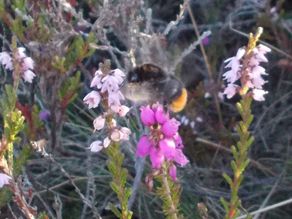
Honey bees are being scrutinized for their potential impact upon wild bees. In lowland heath mosaics, a simple but resource rich habitat for pollinators, there is a higher probability of niche overlap for bumble bees and honey bees due to the requirement of similar resources and limited floral diversity. This study assesses i) if there is any evidence of forage competition between bumble bees and honey bees and ii) asks to what extent the number of bumble bee foragers in a lowland heath mosaic over the summer months is affected by floral resource availability in different heath types (wet/dry). Bumble bee and honey bee counts were conducted at 30 wet heath and 30 dry heath 20 m × 20 m sites, in the Poole Basin, UK. The relationships between bumble bee and honey bee forager observations and ericaceous forage availability throughout the summer were evaluated using GLMMs considering presence and abundance of honey bees and specific floral availability as factors.
Only weak correlations of honey bee forager abundance on bumble bee forager abundance were detected. Instead, the most important factors relating to bumble bee numbers were the abundance of specific floral resources within the heath type (wet/dry). Bumble bees and honey bees showed resource use consistent with resource partitioning with bumble bees predominantly using wet heaths and honey bees using dry heaths. These findings provide evidence of the importance of maintaining complex habitat mosaics within broader habitats to promote coexistence between bumble bees and honey bees.References
Ahrne K, Bengtsson J, Elmqvist T (2009) Bumble bees (Bombus spp) along a gradient of increasing urbanization. PLoS One 15:4:e5574.
Albrecht M, Duelli P, Müller C, Kleijn D, Schmid B (2007) The Swiss agri‐environment scheme enhances pollinator diversity and plant reproductive success in nearby intensively managed farmland. Journal of Applied Ecology 44:813-22.
Bates AJ, Sadler JP, Fairbrass AJ, Falk SJ, Hale JD, Matthews TJ (2011) Changing bee and hoverfly pollinator assemblages along an urban-rural gradient. PloS one 12:6:e23459.
Baude M, Kunin WE, Boatman ND, Conyers S, Davies N, Gillespie MA, Morton RD, Smart SM Memmott J (2016) Historical nectar assessment reveals the fall and rise of floral resources in Britain. Nature 530:85-88.
Biesmeijer JC, Roberts SP, Reemer M, Ohlemüller R, Edwards M, Peeters T, Schaffers AP, Potts SG, Kleukers R, Thomas CD, Settele J (2006). Parallel declines in pollinators and insect-pollinated plants in Britain and the Netherlands. Science 313:351-354.
Descamps C, Moquet L, Migon M, Jacquemart A-L. (2015) Diversity of the Insect Visitors on Calluna vulgaris (Ericaceae) in Southern France Heathlands. Journal of Insect Science 15:130.
Dicks LV, Abrahams A, Atkinson J, Biesmeijer J, Bourn N, Brown C, Brown MJ, Carvell C, Connolly C, Cresswell JE, Croft P (2013) Identifying key knowledge needs for evidence‐based conservation of wild insect pollinators: a collaborative cross‐sectoral exercise. Insect Conservation and Diversity 6:435-46.
Forup ML, Memmott J (2005) The relationship between the abundances of bumble bees and honey bees in a native habitat. Ecological Entomology 30:47-57.
Gathmann A, Tscharntke T (2002) Foraging ranges of solitary bees. Journal of Animal Ecology 71:757-764.
Ghazoul J (2005) Buzziness as usual? Questioning the global pollination crisis. Trends in Ecology and Evolution 31:367-373.
Goulson D (2003a) Bumble bees: Their Behaviour and Ecology. Oxford University Press, Oxford, UK.
Goulson D (2003b) Effects of introduced bees on native ecosystems. Annual Review of Ecology Evolution and Systematics. 34:1-26.
Goulson D, Lye GC, Darvill B (2008) Diet breadth, coexistence and rarity in bumble bees. Biodiversity Conservation 17:3269-3288.
Gross CL (2001) The effect of introduced honey bees on native bee visitation and fruit-set in Dillwynia juniperina (Fabaceae) in a fragmented ecosystem. Biodiversity Conservation 102:89-95.
Hawkins RP (1969) Length of tongue in a honey bee in relation to the pollination of red clover. Journal of Agricultural Science 73:489-493.
Herbertsson L, Lindström SA, Rundlöf M, Bommarco R, Smith HG (2016) Competition between managed honey bees and wild bumble bees depends on landscape context. Basic and Applied Ecology 17:609-616.
Horskins K, Turner VB (1999) Resource use and foraging patterns of honey bees, Apis mellifera, and native insects on flowers of Eucalyptus costata. Austral Ecology 24:221-227.
Huryn VM (1997) Ecological impacts of introduced honey bees. The Quarterly Review of Biology 72:275-297.
Ishii HS, Kadoya T, Kikuchi R, Suda SI, Washitani I (2008) Habitat and flower resource partitioning by an exotic and three native bumble bees in central Hokkaido, Japan. Biological Conservation 141:2597-607.
JNCC (1990) Unit EF. Handbook for Phase 1 habitat survey a technique for environmental audit
Kato M, Shibata A, Yasui T, Nagamasu H (1999) Impact of introduced honey bees, Apis mellifera, upon native bee communities in the Bonin (Ogasawara) Islands. Researches on Population Ecology 41:217-228.
Klemens E, Volkmar W (2006) Increased density of honey bee colonies affects foraging bumble bees. Apidologie 37:517-532.
Knight ME, Martin AP, Bishop S, Osborne JL, Hale RJ, Sanderson RA, Goulson D (2005) An interspecific comparison of foraging range and nest density of four bumble bee (Bombus) species. Molecular Ecology 14:1811-1820.
Knight ME, Osborne JL, Sanderson RA, Hale RJ, Martin AP, Goulson D (2009) Bumble bee nest density and the scale of available forage in arable landscapes. Insect Conservation and Diversity 2:116-124.
Lindström SA, Herbertsson L, Rundlöf M, Bommarco R, Smith HG (2016) Experimental evidence that honey bees depress wild insect densities in a flowering crop. Proceedings of the Royal Society B 283:20161641.
Magnussun et al. (2018) glmmTMB: Generalized Linear Mixed Models using Template Model Builder. [online] URL https://CRAN.R-project.org/package=glmmTMB
Magrach A, González-Varo JP, Boiffier M, Vilà M, Bartomeus I (2017) Honey bee spillover reshuffles pollinator diets and affects plant reproductive success. Nature Ecology & Evolution 1:1299–1307. doi:10.1038/s41559-017-0249-9.
Mallinger RE, Gaines-Day HR, Gratton C. (2017) Do managed bees have negative effects on wild bees? A systematic review of the literature. PloS one 12:e0189268.
McFrederick QS, LeBuhn G (2006) Are urban parks refuges for bumble bees Bombus spp. (Hymenoptera: Apidae)? Biological Conservation 129:372-382.
Montero‐Castaño A, Vila M (2012) Impact of landscape alteration and invasions on pollinators: a meta‐analysis. Journal of Ecology 100:884-893.
Moquet L, Mayer C, Michez D, Wathelet B, Jacquemart AL (2015) Early spring floral foraging resources for pollinators in wet heathlands in Belgium. Journal of Insect Conservation 19:837-848.
Moron D, Skorka P, Lenda M, Rozej-Pabijan E, Wantuch M, Kajzer-Bonk J, Waldemar C. et al. (2014) Railway Embankments as New Habitat for Pollinators in an Agricultural Landscape. PloS one 9:7: e101297.
Osborne JL, Martin AP, Shortall CR, Todd AD, Goulson D, Knight ME, Hale RJ, Sanderson RA (2008) Quantifying and comparing bumble bee nest densities in gardens and countryside habitats. Journal of Applied Ecology 45:784-792.
Paini DR (2004) Impact of the introduced honey bee (Apis mellifera)(Hymenoptera: Apidae) on native bees: a review. Austral Ecology 29:399-407.
Potts SG, Biesmeijer JC, Kremen C, Neumann P, Schweiger O, Kunin WE (2010) Global pollinator declines: trends, impacts and drivers. Trends in Ecology and Evolution 25:345-353.
Prys-Jones OE, Corbet SA (1987) Bumble bees. Cambridge University Press.
R Core Team (2017). R: A language and environment for statistical computing. R Foundation for Statistical Computing, Vienna, Austria. [online] URL https://www.R-project.org/.
Rodwell JS (1998) British Plant Communities: Volume 2, Mires and Heaths. Vol. 2. Cambridge University Press.
Roubik DW (1983) Experimental Community Studies: Time‐Series Tests of Competition between African and Neotropical Bees. Ecology 64:971-978.
Schaffer WM, Zeh DW, Buchmann SL, Kleinhans S, Schaffer MV, Antrim J (1983) Competition for nectar between introduced honey bees and native North American bees and ants. Ecology 64:564-577.
Steffan-Dewenter I, Kuhn A (2003) Honey bee foraging in differentially structured landscapes. Proceedings of the Royal Society London B 270:569-575.
Steffan-Dewenter I, Tscharntke T (2000) Resource overlap and possible competition between honey bees and wild bees in central Europe. Oecologia 122:288-296.
Vanbergen AJ (2013) Threats to an ecosystem service: pressures on pollinators. Frontiers in Ecology and the Environment 11:251-259.
Walther‐Hellwig K, Frankl R. (2000) Foraging habitats and foraging distances of bumble bees, Bombus spp. (Hym., Apidae), in an agricultural landscape. Journal of Applied Entomology 124:299-306.
Downloads
Published
How to Cite
Issue
Section
License
Copyright (c) 2018 Elizabeth Franklin, Tadhg Carroll, Debborah Blake, Kate Rickard, Anita Diaz

This work is licensed under a Creative Commons Attribution 4.0 International License.