
Variation in pollinator potential to carry a blueberry fungal pathogen and assessment of transfer efficiency in two managed bee species
DOI:
https://doi.org/10.26786/1920-7603(2019)529Abstract
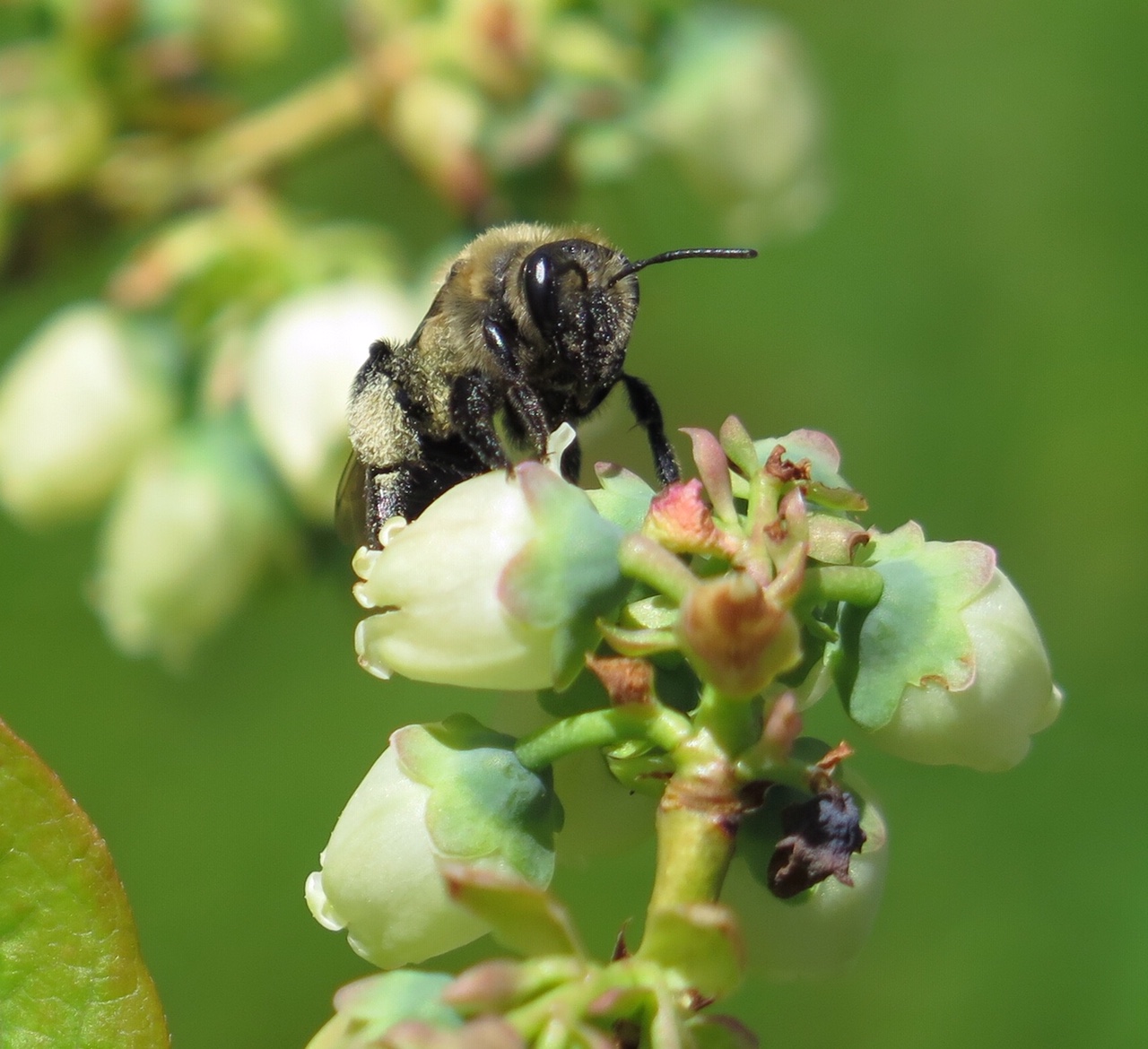
Plant diseases are ubiquitous in agricultural systems and are major sources of economic loss. Vaccinium corymbosum, or highbush blueberry, is an economically important crop affected by an insect-vectored, fungal pathogen, Monilinia vaccinii-corymbosi, or mummy berry disease. Highbush blueberry yield is maximized through outcrossed pollination; however, the pathogen is vectored by pollinators. We used field collections and molecular techniques to identify floral visitors to highbush blueberry and quantify levels of pathogen spores carried by each visiting species. We also conducted a cage trial using single flower visits to determine differences in vectoring efficiency between two managed pollinators, Apis mellifera and Bombus impatiens. We found that bees, flies, and wasps were all common visitors, and that all bee species and several fly and wasp species carried the pathogen. Of the bee species, A. mellifera most often tested positive for the pathogen, while Dolichovespula maculata (Bald-faced Hornet) tested positive most among wasps and Mallota posticata among flies. Considering only individuals that tested positive, mummyberry levels per individual were highest in D. maculata and Andrena bees, and relatively low in flies. In cage trials, we found no differences between A. mellifera and B. impatiens in pathogen load or transfer efficiency, suggesting that these managed species are equally capable of vectoring mummyberry during a single visit to a blighted stem and then a flower. This research demonstrates the variety of floral visitors that carry mummyberry and that two common commercial pollinator species have similar potential to vector mummyberry to blueberry flowers during a single visit.
References
Adler LS, Irwin RE (2006) Comparison of pollen transfer dynamics by multiple floral visitors: Experiments with pollen and fluorescent dye. Annals of Botany 97:141–150.
Batra LR (1983) Monilinia vaccinii-corymbosi (Sclerotiniaceae) - Its biology on blueberry and comparison with related species. Mycologia 75:131–152.
Batra LR, Batra SWT (1985) Floral mimicry induced by mummy-berry fungus exploits host’s pollinators as vectors. Science 228:1011–1013.
Cameron SA, Lozier JD, Strange JP, Koch JB, Cordes N, Solter LF, Griswold TL (2011) Patterns of widespread decline in North American bumble bees. Proceedings of the National Academy of Sciences 108:662 LP-667.
Chambers VH (1946) An examination of the pollen loads of Andrena: The species that visit fruit trees. Journal of Animal Ecology 15:9–21. [online] URL: http://www.jstor.org/stable/
Delaplane KS, Mayer DF (2000) Crop pollination by bees. CABI Publishing. [online] URL: www.cabi-publishing.org
Dobson A, Crawley W (1994) Pathogens and the structure of plant-communities. Trends in Ecology & Evolution 9:393–398.
Ehlenfeldt MK (2001) Self- and cross-fertility in recently released highbush blueberry cultivars. Hortscience 36:133–135.
Elbrecht V, Leese F (2017) Validation and development of COI metabarcoding primers for freshwater macroinvertebrate bioassessment. Frontiers in Environmental Science 5:11.
Garibaldi LA, Steffan-Dewenter I, Winfree R, Aizen MA, Bommarco R, Cunningham SA, Kremen C, Carvalheiro LG, Harder LD, Afik O, Bartomeus I, Benjamin F, Boreux V, Cariveau D, Chacoff NP, Dudenhöffer JH, Freitas BM, Ghazoul J, Greenleaf S, Hipólito J, Holzschuh A, Howlett B, Isaacs R, Javorek SK, Kennedy CM, Krewenka KM, Krishnan S, Mandelik Y, Mayfield MM, Motzke I, Munyuli T, Nault BA, Otieno M, Petersen J, Pisanty G, Potts SG, Rader R, Ricketts TH, Rundlöf M, Seymour CL, Schüepp C, Szentgyörgyi H, Taki H, Tscharntke T, Vergara CH, Viana BF, Wanger TC, Westphal C, Williams N, Klein AM (2013) Wild pollinators enhance fruit set of crops regardless of honey bee abundance. Science 339:1608 LP-1611.
Gibbs J, Elle E, Bobiwash K, Haapalainen T, Isaacs R (2016) Contrasting pollinators and pollination in native and non-native regions of highbush blueberry production. PLOS ONE 11:e0158937.
Herrera CM (1987) Components of pollinator quality - Comparative analysis of a diverse insect assemblage. Oikos 50:79–90.
Isaacs R, Kirk A (2010) Pollination services provided to small and large highbush blueberry fields by wild and managed bees. Journal of Applied Ecology 47:841–849.
Jacobs S (2015) Baldfaced Hornet Fact Sheet. PennState College of Agriculture Extension [online] URL: https://ento.psu.edu/
extension/factsheets/baldfaced-hornet
Javorek SK, Mackenzie KE, Kloet SP Vander (2002) Comparative pollination effectiveness among bees (Hymenoptera: Apoidea) on lowbush blueberry (Ericaceae: Vaccinium angustifolium). Annals of the Entomological Society of America 95:345–351.
Jennersten O (1988) Insect dispersal of fungal disease: Effects of Ustilago infection on pollinator attraction in Viscaria vulgaris. Oikos 51:163–170.
Karolyi F, Colville JF, Handschuh S, Metscher BD, Krenn HW (2014) One proboscis, two tasks: Adaptations to blood-feeding and nectar-extracting in long-proboscid horse flies (Tabanidae, Philoliche). Arthropod Structure & Development 43:403–413.
Klein AM, Vaissiere BE, Cane JH, Steffan-Dewenter I, Cunningham SA, Kremen C, Tscharntke T (2007) Importance of pollinators in changing landscapes for world crops. Proceedings of the Royal Society B-Biological Sciences 274:303–313.
Larson BMH, Kevan PG, Inouye DW (2001) Flies and flowers: taxonomic diversity of anthophiles and pollinators. The Canadian Entomologist 133:439–465.
Lehman JS, Igarashi S, Oudemans P V (2007) Host resistance to Monilinia vaccinii-corymbosi in flowers and fruits of highbush blueberry. Plant Disease 91:852–856.
MacKenzie KE, Eickwort GC (1996) Diversity and abundance of bees (Hymenoptera: Apoidea) foraging on highbush blueberry (Vaccinium corymbosum L.) in central New York. Journal of the Kansas Entomological Society 69:185–194. [online] URL: http://www.jstor.org/stable/25085716
Maier CT, Waldbauer GP (1979) Diurnal activity patterns of flower flies (Diptera: Syrphidae) in an Illinois sand area. Annals of the Entomological Society of America 72:237-45.
McArt SH, Koch H, Irwin RE, Adler LS (2014) Arranging the bouquet of disease: floral traits and the transmission of plant and animal pathogens. Ecology Letters 17:624-36.
McArt SH, Miles TD, Rodriguez-Saona C, Schilder A, Adler LS, Grieshop MJ (2016) Floral scent mimicry and vector-pathogen associations in a pseudoflower-inducing plant pathogen system. Plos One 11: e0165761.
Ngugi HK, Scherm H (2004) Pollen mimicry during infection of blueberry flowers by conidia of Monilinia vaccinii-corymbosi. Physiological and Molecular Plant Pathology 64:113–123.
Ngugi HK, Scherm H, Lehman JS (2002) Relationships between blueberry flower age, pollination, and conidial infection by Monilinia vaccinii-corymbosi. Phytopathology 92:1104–1109.
Nguyen-Dumont T, Pope BJ, Hammet F, Southey MC, Park DJ (2013) A high-plex PCR approach for massively parallel sequencing. BioTechniques 55:69–74.
Norelli JL, Jones AL, Aldwinckle HS (2003) Fire blight management in the twenty-first century: Using new technologies that enhance host resistance in apple. Plant Disease 87:756–765.
Olsen KM (1997) Pollination effectiveness and pollinator importance in a population of Heterotheca subaxillaris (Asteraceae). Oecologia 109:114–121.
Primack RB, Silander JA (1975) Measuring relative importance of different pollinators to plants. Nature 255:143–144.
R Development Core Team (2018) R: A language and environment for statistical computing.
Rao S, Stephen WP, White L (2009) Native bee pollinator diversity in Oregon blueberries. In: Acta Horticulturae. International Society for Horticultural Science (ISHS), Leuven, Belgium, pp 539–548.
Rathman ES, Lanza J, Wilson J (1990) Feeding preferences of flesh flies (Sarcophaga bullata) for sugar-only vs. sugar-amino acid nectars. The American Midland Naturalist 124:379–389. [online] URL: http://www.jstor.org/stable/2426188
Rogers SR, Tarpy DR, Burrack HJ (2013) Multiple criteria for evaluating pollinator performance in highbush blueberry (Ericales: Ericaceae) agroecosystems. Environmental Entomology 42:1201–1209.
Rogers SR, Tarpy DR, Burrack HJ (2014) Bee species diversity enhances productivity and stability in a perennial crop Blenau W (ed). PLoS ONE 9:e97307. [online] URL: http://www.ncbi.nlm.nih.gov/pmc/articles/PMC4016306/
Ross J, Foster D, Hillard P, Pendarvis S, Ray T (2017) Agricultural Statistics 2017. [online] URL: https://www.nass.usda.gov/
Publications/Ag_Statistics/2017/Complete Ag Stats 2017.pdf
Roy BA (1994) The use and abuse of pollinators by fungi. Trends in Ecology & Evolution 9:335–339.
Scott Z, Ginsberg H, Alm SR (2016) Native bee diversity and pollen foraging specificity in cultivated highbush blueberry (Ericaceae: Vaccinium corymbosum) in Rhode Island. Environmental Entomology 45:1432–1438.
Shykoff JA, Bucheli E (1995) Pollinator visitation patterns, floral rewards and the probability of transmission of Microbotryum violaceum, a veneral disease of plants. Journal of Ecology 83:189–198. [online] URL: http://www.jstor.org/stable/2261557
Smith KM, Loh EH, Rostal MK, Zambrana-Torrelio CM, Mendiola L, Daszak P (2013) Pathogens, pests, and economics: Drivers of honey bee colony declines and losses. EcoHealth 10:434–445.
Ssymank A, Kearns CA, Pape T, Thompson FC (2008) Pollinating flies (Diptera): A major contribution to plant diversity and agricultural production. Biodiversity 9:86–89.
Stretch AW, Ehlenfeldt MK, Brewster V, Vorsa N, Polashock J (2001) Resistance of diploid Vaccinium spp. to the fruit rot stage of mummy berry disease. Plant Disease 85:27–30.
Tuell JK, Ascher JS, Isaacs R (2009) Wild bees (Hymenoptera: Apoidea: Anthophila) of the Michigan highbush blueberry agroecosystem. Annals of the Entomological Society of America 102:275–287.
Vicens N (2009) Pollinating efficacy of Osmia cornuta and Apis mellifera (Hymenoptera: Megachilidae, Apidae) on “Red Delicious” Apple. Environmental Entomology 29:235-40.
West TP, McCutcheon TW (2009) Evaluating Osmia cornifrons as pollinators of highbush blueberry. International Journal of Fruit Science 9:115–125.
Wightwick A, Walters R, Allinson G, Reichman S, Menzies N (2010) Fungicides: Environmental risks of fungicides used in horticultural production systems Carisse O (ed). In-Tech.
Winfree R, Williams NM, Dushoff J, Kremen C (2007) Native bees provide insurance against ongoing honey bee losses. Ecology letters 10:1105–1113.
Downloads
Published
How to Cite
Issue
Section
License
Copyright (c) 2019 Matthew David Hank Boyer, Lynn S Adler

This work is licensed under a Creative Commons Attribution 4.0 International License.