
Exploitation of Strobilanthes ixiocephala (Acanthaceae) flower buds by bees
DOI:
https://doi.org/10.26786/1920-7603(2020)619Abstract
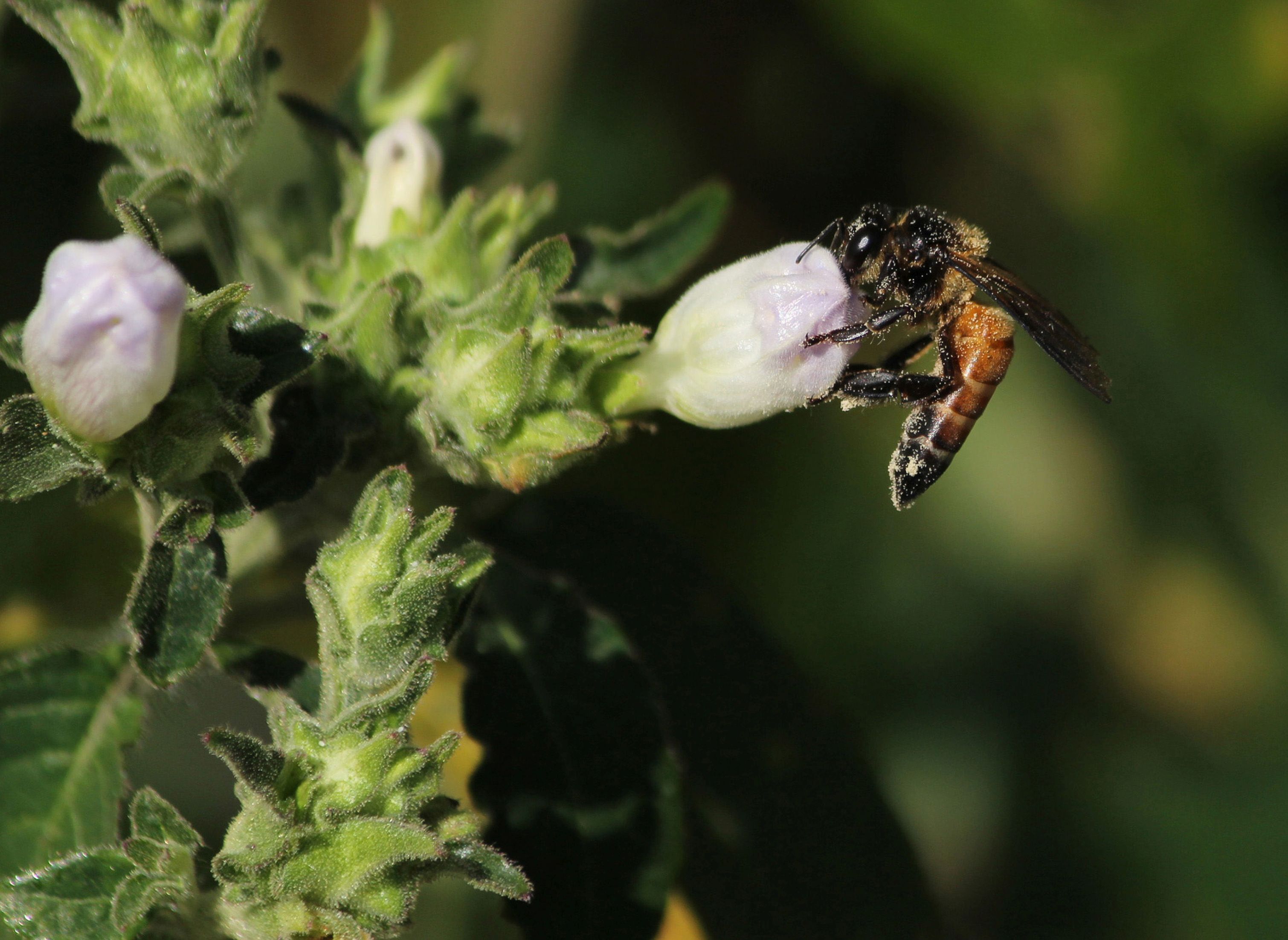
Floral larceny by bees has been studied mostly in open flowers although it is also experienced in buds. Until now, only few studies have recorded larceny of unopened flowers. In this study, we present behavioural observations of Apis and non-Apis bees exploiting Strobilanthes ixiocephala (Acanthaceae) buds for floral rewards. The bees pierce open the anterior end of the unopened buds to access pollen and nectar.
References
Barker JL, Dornhaus A, Bronstein JL, Muth F (2018) Learning about larceny: experience can bias bumble bees to rob nectar. Behavioural Ecology and Sociobiology 72:68. https://doi.org/10.1007/s00265-018-2478-6
Bauder JAS, Lieskonig NR, Krenn HW (2011) The extremely long-tongued Neotropical butterfly Eurybia lycisca (Riodinidae): Proboscis morphology and flower handling. Arthropod Structure & Development 40:122-127. https://doi.org/10.1016/j.asd.2010.11.002
Boucher DH, James S, Keeler KH (1982) The ecology of mutualism. Annual Review of Ecology and Systematics 13:315-347. https://doi.org/10.1146/annurev.es.13.110182.001531
Bronstein JL (1994) Our current understanding of mutualism. The Quarterly Review of Biology 69:31-51. https://doi.org/10.1086/418432
Dedej S, Delaplane KS (2005) Net energetic advantage drives honey bees (Apis mellifera L) to nectar larceny in Vaccinium ashei Reade. Behavioural Ecology and Sociobiology 57:398-403. https://doi.org/10.1007/s00265-004-0852-z
Faegri K, van der Pijl L (1979) The principles of pollination ecology. Pergamon Press, Oxford. https://doi.org/10.1016/B978-0-08-023160-0.50020-7
Goulson D, Park KJ, Tinsley MC, Bussière LF, Vallejo-Marin M (2013) Social learning drives handedness in nectar-robbing bumblebees. Behavioural Ecology and Sociobiology 67:1141-1150. https://doi.org/10.1007/s00265-013-1539-0
Gutiérrez-Chacón C, Pantoja-Santacruz J, Klein AM (2018) Floral larceny by the stingless bee Trigona almalhea on granadilla (Passiflora ligularis Juss). Journal of Pollination Ecology 22:75-81. https://doi.org/10.26786/1920-7603(2018)eight
Inouye DW (1980) The terminology of floral larceny. Ecology 61:1251-1253. https://doi.org/10.2307/1936841
Inouye DW (1983) The ecology of nectar robbing. The biology of nectaries. Columbia University Press, New York, pp 153-173.
Irwin RE, Bronstein JL, Manson JS, Richardson L (2010) Nectar robbing: Ecological and evolutionary perspectives. Annual Review of Ecology, Evolution, and Systematics 41:271-292. https://doi.org/10.1146/annurev.ecolsys.110308.120330
Irwin RE, Maloof JE (2002) Variation in nectar robbing over time, space, and species. Oecologia 133:525-533. https://doi.org/10.1007/s00442-002-1060-z
Leadbeater E, Chittka L (2008) Social transmission of nectar-robbing behaviour in bumble-bees. Proceedings of the Royal Society B: Biological Sciences 275:1669-1674. https://doi.org/10.1098/rspb.2008.0270
Lloyd DG, Webb CJ (1986) The avoidance of interference between the presentation of pollen and stigmas in angiosperms I. Dichogamy. New Zealand Journal of Botany 24:135-162. https://doi.org/10.1080/0028825X.1986.10409725
Nicholls E, de Ibarra NH (2014) Bees associate colour cues with differences in pollen rewards. Journal of Experimental Biology 217:2783-2788. https://doi.org/10.1242/jeb.106120
Newcombe FC (1922) Significance of the behaviour of sensitive stigmas. American Journal of Botany 9:99-120. https://doi.org/10.1002/j.1537-2197.1922.tb05659.x
Newcombe FC (1924) Significance of the behaviour of sensitive stigmas II. American Journal of Botany 11:85-93. https://doi.org/10.1002/j.1537-2197.1924.tb05763.x
Raguso RA (2008) Wake up and smell the roses: The ecology and evolution of floral scent. Annual Review of Ecology, Evolution, and Systematics 39:549-569. https://doi.org/10.1146/annurev.ecolsys.38.091206.095601
Richardson SC (2004) Are nectar-robbers mutualists or antagonists? Oecologia 139:246-254. https://doi.org/10.1007/s00442-004-1504-8
Saunders ME (2017) Bees visiting unopened flowers: bumbling burglars or sneaky pollinators? Ecology 98:1968-1969. https://doi.org/10.1002/ecy.1838
Sharma MV, Kuriakose G, Shivanna KR (2008) Reproductive strategies of Strobilanthes kunthianus, an endemic, semelparous species in southern Western Ghats, India. Botanical Journal of the Linnean Society 157:155-163. https://doi.org/10.1111/j.1095-8339.2008.00786.x
Shorthouse DP (2010) SimpleMappr, an online tool to produce publication-quality point maps. Available at http://www.simplemappr.net.
Stout JC, Goulson D (2001) The use of conspecific and interspecific scent marks by foraging bumblebees and honeybees. Animal Behaviour 62:183-189. https://doi.org/10.1006/anbe.2001.1729
Willmer P (2011) Pollination and floral ecology. Princeton University Press, Princeton, N.J. https://doi.org/10.23943/princeton/9780691128610.001.0001
Wright GA, Schiestl FP (2009) The evolution of floral scent: the influence of olfactory learning by insect pollinators on the honest signalling of floral rewards. Functional Ecology 23:841-851. https://doi.org/10.1111/j.1365-2435.2009.01627.x
Yamaji F, Ohsawa TA (2015) Breaking-bud pollination: a new pollination process in partially opened flowers by small bees. Journal of Plant Research 128:803-811. https://doi.org/10.1007/s10265-015-0741-8
Downloads
Published
How to Cite
Issue
Section
License
Copyright (c) 2021 Priyanka A Ambavane, Nikhil P More, Renee M. Borges

This work is licensed under a Creative Commons Attribution 4.0 International License.