
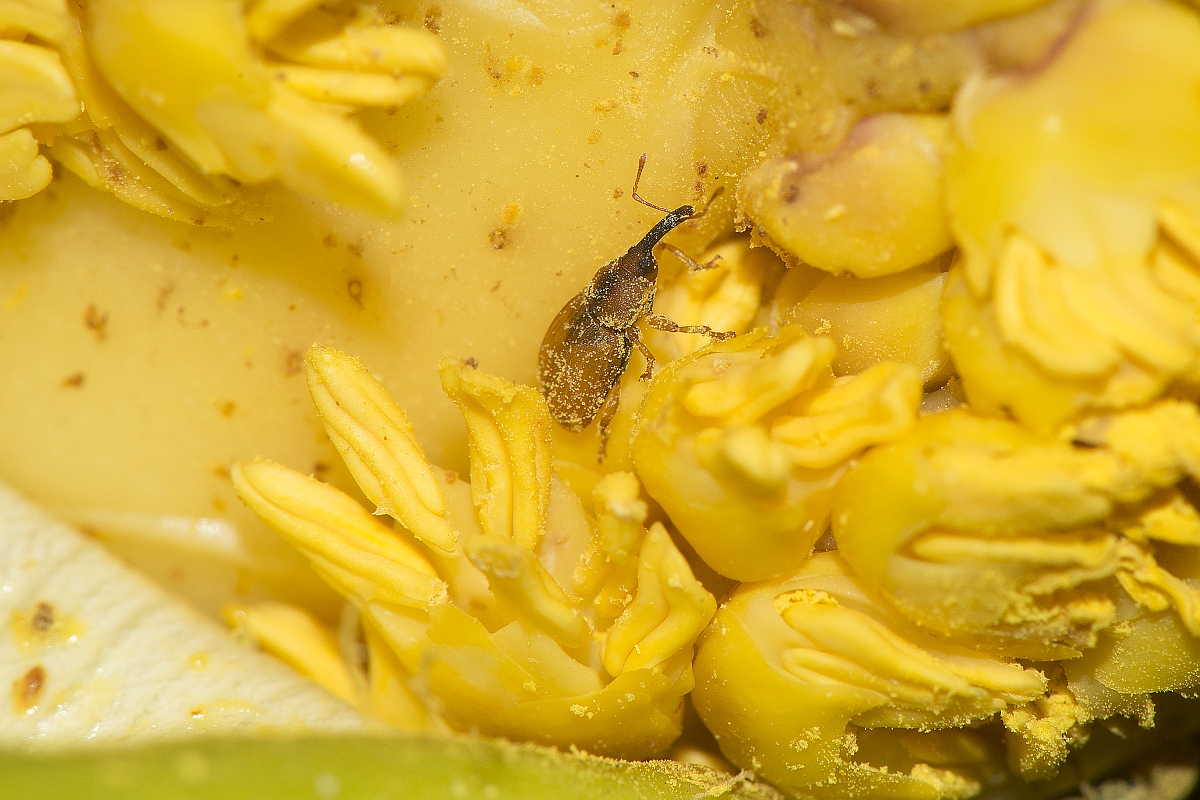
Spatial occupancy patterns of the nursery pollinator Derelomus chamaeropsis at its host plant, Chamaerops humilis (Arecaceae)
Occupancy patterns of Derelomus chamaeropsis on Chamaerops humilis
DOI:
https://doi.org/10.26786/1920-7603(2025)829Keywords:
nursery pollination, Beetle pollination, Arecaceae, Insect pollinatorsAbstract
Pollination success is influenced by factors such as density and distance from neighbouring conspecifics. However, the pure neighbourhood effects of spatial patterns of interaction on pollination success remains poorly understood. In this study, we used techniques of spatial point pattern analysis (SPPA) to investigate the relationship between the spatial distribution of a specialist pollinator, the weevil Derelomus chamaeropis, and the fruiting success of its host plant, the dwarf palm Chamaerops humilis, within a nursery pollination system. We georeferenced a dwarf palm population in a 22-hectare plot (96 individuals: 41 females/ 55 males), located at the Doñana National Park (SW Spain). We quantified the abundance and spatial pattern of adult weevil occupancy, and their correlation with the spatial distribution of dwarf palms. Additionally, we analysed the spatial pattern of fruiting success and how palm traits (number of inflorescences and flowers, and sex) influenced adult weevil abundance and fruiting success. Our findings revealed that presence/abundance of D. chamaeropis depended on plant sex, with female inflorescences showing significantly higher adult weevil abundances. We found a significant, negative density-dependent response, where higher neighbourhood density of palms led to reduced local weevil abundance. In contrast, we observed positive density and distance dependence for fruiting success at small spatial scales (2-5 m and 5-15 m), suggesting enhanced pollination success in dense patches. Our results indicate that weevil distribution is shaped by local resource availability and competitive interactions rather than broader palm arrangement. Additionally, pollination efficiency and fruit set benefit from positive distance-density dependence in dense patches.
References
Abramson G, Soto CAT, Oña L (2011) The role of asymmetric interactions on the effect of habitat destruction in mutualistic networks. PLoS One.
Aizen MA, Harder LD (2007) Expanding the limits of the pollen-limitation concept: Effects of pollen quantity and quality. Ecology 88:271–281.
Alonso-López MT, Garrote PJ, Fedriani JM (2022) Spatial isolation impacts pollinator visitation and reproductive success of a threatened self-incompatible Mediterranean tree. Acta Oecologica.
Anstett M-CC (1999) An experimental study of the interaction between the dwarf palm (Chamaerops humilis) and its floral visitor Derelomus chamaeropsis throughout the life cycle of the weevil. Acta Oecologica 20:551–558.
Audisio P, Cline AR, De Biase A, et al (2009) Preliminary re-examination of genus-level taxonomy of the pollen beetle subfamily Meligethinae (Coleoptera: Nitidulidae). Acta Entomologica Musei Nationalis Pragae 49:341–504.
Augspurger CK (1981) Reproductive Synchrony of a tropical shrub: Experimental studies on effects of pollinators and seed predators in Hybanthus prunifolius (Violaceae). Ecology 62:775–788.
Bailey D, Schmidt-Entling MH, Eberhart P, et al (2010) Effects of habitat amount and isolation on biodiversity in fragmented traditional orchards. Journal of Applied Ecology 47:1003–1013.
Baviera C, Audisio P (2014) The Nitidulidae and Kateretidae (Coleoptera: Cucujoidea) of Sicily: Recent records and updated checklist. Atti della Accademia Peloritana dei Pericolanti - Classe di Scienze Fisiche, Matematiche e Naturali 92:A1-1-A1-32.
Delmas CEL, Escaravage N, Cheptou PO, et al (2014) Relative impact of mate versus pollinator availability on pollen limitation and outcrossing rates in a mass-flowering species. Plant Biology 17:209–218.
Dufaÿ M (2010) Impact of plant flowering phenology on the cost/benefit balance in a nursery pollination mutualism, with honest males and cheating females. Journal of Evolutionary Biology 23:977–86.
Dufaÿ M, Anstett M-C (2003) Conflicts between plants and pollinators that reproduce within inflorescences: evolutionary variations on a theme. Oikos 1:3–14.
Dufaÿ M, Anstett M-C (2004) Cheating is not always punished: killer female plants and pollination by deceit in the dwarf palm Chamaerops humilis. Journal of Evolutionary Biology 17:862–868.
Dufaÿ M, Hossaert-McKey M, Anstett M-C (2003) When leaves act like flowers: how dwarf palms attract their pollinators. Ecological Letters 28–34.
Dufaÿ M, Hossaert-McKey M, Anstett M-C (2004) Temporal and sexual variation of leaf-produced pollinator-attracting odours in the dwarf palm. Oecologia 139:392–8.
Fahrig L (2003) Effects of Habitat Fragmentation on Biodiversity. Annual Review of Ecology, Evolution and Systematics 34:487–515.
Fedriani JM, Delibes M (2011) Dangerous liaisons disperse the Mediterranean dwarf palm: fleshy-pulp defensive role against seed predators. Ecology 92:304–15.
Fedriani JM, Wiegand T (2014) Hierarchical mechanisms of spatially contagious seed dispersal in complex seed-disperser networks. Ecology 95:514–526.
Fedriani JM, Wiegand T, Calvo G, et al (2015) Unraveling conflicting density and distance dependent effects on plant reproduction using a spatially explicit approach. Journal of Ecology 103:1344–1353.
Fontaine C, Collin CL, Dajoz I (2008) Generalist foraging of pollinators: Diet expansion at high density. Journal of Ecology 96:1002–1010.
Franz NM (2007) Reproductive trade-offs in a specialized plant/pollinator system involving Asplundia uncinata Harling (Cyclanthaceae) and a derelomine flower weevil (Coleoptera: Curculionidae). Plant Systematics and Evolution 269:183–201.
Fritz A-L, Nilsson LA (1994) How pollinator-mediated mating varies with population size in plants. Oecologia 100:451–462.
Gallant AL, Euliss NH, Browning Z (2014) Mapping large-area landscape suitability for honey bees to assess the influence of land-use change on sustainability of national pollination services. PLoS One.
García Y, Castellanos MC, Pausas JG (2018) Differential pollinator response underlies plant reproductive resilience after fire. Annuals of Botany 1–11.
Garrote PJ, Castilla AR, Fedriani JM (2019) The endemic Mediterranean dwarf palm boosts the recolonization of old-fields: Implications for restoration. Journal of Environmental Management 250:109478.
Gunton RM, Kunin WE (2009) Density-dependence at multiple scales in experimental and natural plant populations. Journal of Ecology 97:567–580.
Hadley AS, Betts MG (2012) The effects of landscape fragmentation on pollination dynamics: Absence of evidence not evidence of absence. Biological Reviews 87:526–544.
Hallett AC, Mitchell RJ, Chamberlain ER, Karron JD (2017) Pollination success following loss of a frequent pollinator: the role of compensatory visitation by other effective pollinators. AoB Plants.
Harris LF, Johnson SD (2004) The consequences of habitat fragmentation for plant-pollinator mutualisms. International Journal of Tropical Insect Science 24:29–43.
Harrison RD, Yamamura N (2003) A few more hypotheses for the evolution of dioecy in figs (Ficus, Moraceae). Oikos 100:628–635.
Hegland SJ, Boeke L (2006) Relationships between the density and diversity of floral resources and flower visitor activity in a temperate grassland community. Ecological Entomology 31:532–538.
Herrera J (1989) On the Reproductive Biology of the Dwarf Palm, Chamaerops humilis in Southern Spain. Principes 33:27–33.
Holland JN, Fleming TH (1999) Geographic and population variation in pollinating seed-consuming interactions between senita cacti (Lophocereus schottii) and senita moths (Upiga virescens). Oecologia 121:405–410.
Holland JN, Fleming TH (2002) Co-pollinators and specialization in the pollinating seed-consumer mutualism between senita cacti and senita moths. Oecologia 133:534–540.
Hossaert-McKey M, Soler C, Schatz B, Proffit M (2010) Floral scents: their roles in nursery pollination mutualisms. Chemoecology 20:75–88.
Illian DJ, Penttinen PA, Stoyan DH, Stoyan D (2008) Statistical Analysis and Modelling of Spatial Point Patterns. John Wiley & Sons, West Sussex, England
Jácome-Flores ME, Delibes M, Calvo G, Fedriani JM (2019) Effects of Plant Aggregation, Spatial Genetic Structure, and Pollen Origin on Pollination Success of a Nursery-Pollinated Palm (Chamaerops humilis). International Journal of Plant Science 180:000–000.
Jácome-Flores ME, Delibes M, Wiegand T, Fedriani JM (2016) Spatial pattern of an endemic Mediterranean palm at its colonization front. Ecology and Evolution 6: 8556-8568.
Jácome-Flores ME, Delibes M, Wiegand T, Fedriani JMJM (2018) Spatio-temporal arrangement of Chamaerops humilis inflorescences and occupancy patterns by its nursery pollinator, Derelomus chamaeropsis. Annals of Botany 1–12.
Jácome-Flores ME, Jordano P, Delibes M, Fedriani JM (2020) Interaction motifs variability in a Mediterranean palm under environmental disturbances: the mutualism–antagonism continuum. Oikos 129:367–379.
Johnson SD, Steiner KE (2000) Generalization versus specialization in plant pollination systems. Trends in Ecology and Evolution 15:140–143.
Jordano P (2016) Sampling networks of ecological interactions. Functional Ecology 30:1883–1893.
Jump AS, Peñuelas J (2006) Genetic effects of chronic habitat fragmentation in a wind-pollinated tree. Proceedings of the National Academic of Sciences USA 103:8096–8100.
Klank C, Pluess AR, Ghazoul J (2010) Effects of population size on plant reproduction and pollinator abundance in a specialized pollination system. Journal of Ecology 98:1389–1397.
Knight TM, Steets JA, Vamosi JC, et al (2005) Pollen limitation of plant reproduction: Pattern and Process. Annual Review of Ecology Evolution and Systematics 36:467–497.
Larson BMH, Barrett SCH (2000) A comparative analysis of pollen limitation in flowering plants. Biological Journal of the Linnean Society 69:503–520.
Melampy MN (1987) Flowering phenology, pollen flow and fruit production in the Andean shrub Befaria resinosa. Oecologia 73:293–300.
Merlo ME, Aleman MM, Cabello J, Penas J (1993) On the Mediterranean fan palm (Chamaerops humilis). Principes 37:151–158.
Moser D, Dullinger S, Mang T, et al (2015) Changes in plant life-form, pollination syndrome and breeding system at a regional scale promoted by land use intensity. Diversity and Distribution 21:1319–1328.
Muñoz-Gallego R, Fedriani JM, Serra PE, Traveset A (2022) Nonadditive effects of two contrasting introduced herbivores on the reproduction of a pollination-specialized palm. Ecology 103:1–12.
Muñoz-Gallego R, Fedriani JM, Traveset A (2019) Non-native Mammals Are the Main Seed Dispersers of the Ancient Mediterranean Palm Chamaerops humilis L. in the Balearic Islands: Rescuers of a Lost Seed Dispersal. Frontiers in Ecology and Evolution 7:1–16.
Mustajärvi K, Siikamäki P, Rytkönen S, Lammi A (2001) Consequences of plant population size and density for plant-pollinator interactions and plant performance. Journal of Ecology 89:80–87.
Nason JD, Herre EA, Hamrick JL (1998) The breeding structure of a tropical keystone plant resource. Nature 391:685–687.
Nattero J, Malerba R, Medel R, Cocucci A (2011) Factors affecting pollinator movement and plant fitness in a specialized pollination system. Plant Systematics and Evolution 296:77–85.
Raventós J, Wiegand T, De Luis M, Raventos J (2010) Evidence for the spatial segregation hypothesis: a test with nine-year survivorship data in a Mediterranean shrubland Evidence for the spatial segregation hypothesis: in a Mediterranean survivorship data a test with shrubland. Ecology 91:2110–2120.
Rodríguez-Rodríguez C, Jordano P, Valido A (2015) Hotspots of damage by antagonists shape the spatial structure of plant – pollinator interactions. Ecology 96:2181–2191.
Spigler RB, Chang S-M (2009) Pollen limitation and reproduction varies with population size in experimental populations of Sabatia angularis (Gentianaceae). Botany 87:330–338.
Thompson JN, Pellmyr O, Society E (1992) Mutualism with pollinating seed parasites amid co-pollinators: constraints on specialization. Ecology 73:1780–1791.
Valiente-Banuet A, Aizen MA, Alcántara JM, et al (2015) Beyond species loss: The extinction of ecological interactions in a changing world. Functional Ecology 29:299–307.
Vamosi JC, Knight TM, Steets JA, et al (2006) Pollination decays in biodiversity hotspots. Proceedings of the National Academy of Sciences USA 103:956–961.
Wiegand T, Gunatilleke S, Gunatilleke N (2007) Species associations in a heterogeneous Sri Lankan dipterocarp forest. American Naturalist 170:E77-95.
Wiegand T, He F, Hubbell SP (2013) A systematic comparison of summary characteristics for quantifying point patterns in ecology. Ecography (Cop) 36:92–103.
Wiegand T, Kissling WD, Cipriotti P a., Aguiar MR (2006) Extending point pattern analysis for objects of finite size and irregular shape. Journal of Ecology 94:825–837.
Wiegand T, Moloney KA (2014) Handbook of Spatial Point- Pattern Analysis in Ecology University of North Carolina, 1st edn. CRC Press, Boca Raton, FL
Wilson RD, Addicott JF (1998) Regulation of mutualism between yuccas and yucca moths: is oviposition behaviour responsive to selective abscission of flowers? Oikos, 109-118. Oikos 81:109–118.
Winfree R, Aguilar R, Vázquez DP, et al (2009) A meta-analysis of bees’ responses to anthropogenic disturbance. Ecology 90:2068–2076.
Xiao Y, Li X, Cao Y, Dong M (2016) The diverse effects of habitat fragmentation on plant–pollinator interactions. Plant Ecology 217:857–868.
Downloads
Published
How to Cite
Issue
Section
License
Copyright (c) 2025 Miguel Moreno, Miguel Jacome-Flores, Pedro Jordano, Gemma Calvo García, Jose Fedriani

This work is licensed under a Creative Commons Attribution 4.0 International License.