
The bee community and its relationship to canola productivity in homogenous agricultural areas
DOI:
https://doi.org/10.26786/1920-7603(2014)9Abstract
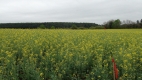
Canola crop productivity is benefited by bee pollination and it has been shown that bee communities can be affected by landscape composition. The aim of this study was to analyse the bee community and its relationship to canola seed production in agricultural areas. The density, abundance and richness of floral visitors of Brassica napus cultivar Hyola 61 in six commercial fields in southern Brazil were studied, and their relationships with seed production and the ratio of semi-natural, forested and agricultural areas surrounding the crops were examined. It was observed that canola fields of southern Brazil are surrounded by a homogeneous landscape dominated by agricultural areas. The survey of bees detected a low abundance and richness of native bees in contrast to the high abundance of Apis mellifera. Except for a negative correlation between the abundance of honey bees and the proportion of forested areas within a 2000 m radius from the field (R = -0.90; P = 0.012), no other correlations were found among bee abundance and richness and landscape composition. Although there was not a relationship between A. mellifera and seed set, there was a positive correlation between insect density and seed weight per plant (R = 0.87; P = 0.024). As honey bees were the most captured insect (79%), much of the pollination in this system was probably achieved by honey bees.References
Ali M, Saeed S, Sajjad A, Whittington A (2011) In search of the best pollinators (Brassica napus L.) production in Pakistan. Applied Entomology and Zoology 46: 353-361.
Biesmeijer JC, Roberts SPM, Reemer M, Ohlemuller R, Edwards M, Peeters T, Schaffers AP, Potts SG, Kleukers R, Thomas CD, Settele J, Kunin WE (2006) Parallel declines in pollinators and insect-pollinated plants in Britain and the Netherlands. Science 313: 351–354
Bommarco R, Marini L, Vaissière BE (2012) Insect pollination enhances seed yield, quality, and marked value in oilseed rape. Oecologia 169:1025-1032.
Brosi BJ, Dayli GC, Ehrlich PR (2007) Bee community shifts with landscape context in a tropical countryside. Ecological Applications 17:418-430.
Cameron SA, Lozier JD, Strange JP, Koch JB, Cordes N, Solter LF, Griswold TL (2011) Patterns of Widespread Decline in North American Bumble Bees. Proceedings of the National Academy of Science 108:662-667.
Carvalho MA (2011) Canola. [online] URL: http://
www.conab.gov.br/OlalaCMS/uploads/arquivos/11_08_03_11_27_46_canolajulho2011.pdf (accessed December 2012).
Durán XA, Ulloa RB, Carrillo JA, Contreras JL, Bastidas MT (2010) Evaluation of yield component traits of honeybee-pollinated (Apis mellifera L.) rapeseed canola (Brassica napus L.). Chilean Journal of Agricultural Research 70:309-314.
Gallai N, Salles JM, Settele J, Vaissière BE (2009) Economic valuation of the vulnerability of world agriculture confronted with pollinator decline. Ecological Economics 68:810–821.
Grixti JC, Wong LT, Cameron SA, Favret C (2009) Decline of bumble bees (Bombus) in the North American Midwest. Biological Conservation 142:75-84.
Hasenack H, Weber E (2007) Digital Mapping Layer of the Serra Gaúcha – escala 1:50.000 (Série Geoprocessamento). UFRGS, Porto Alegre. CD ROM.
Heymann Y, Steenmans CH, Croissille G, Bossard M (1994) Corine Land Cover – Technical guide, Office for Official Publications of the European Communities, Luxembourg.
Jauker F, Wolters V (2008) Hover flies are efficient pollinators of oilseed rape. Oecologia 156:819–823.
Jauker F, Bondarenko B, Becker HC, Steffan-Dewenter I (2012) Pollination efficiency of wild bees and hoverflies provided to oilseed rape. Agricultural and Forest Entomology 14:81–87.
Klein A, Vaissiere BE, Cane JH, Steffan-Dewenter I, Cunningham SA, Kremen C, Tscharntke T (2007) Importance of pollinators in changing landscapes for world crops. Proceedings of the Royal Society of London Series B, Biological Sciences 274:303–313.
Kennedy CM, Lonsdorf E, Neel MC, Williams NM, Ricketts TH, Winfree R, Bommarco R, Brittain C, Burley A, Cariveau D, Carvalheiro LG, Chacoff NP, Cunningham SA, Anforth BN, Dudenhoffer JH, Elle E, Gaines HR, Garibaldi LA, Gratton C, Holzschuh A, Isaacs R, Javorek SK, Jha S, Klein AM, Krewenka K, Mandelik Y, Mayfield MM, Morandin L, Neame LA, Otieno M, Park M, Potts SG, Rundlöf M, Saez A, Steffan-Dewenter I, Taki H, Viana BF, Westphal C, Wilson JK, Greenleaf SS, Kremen C (2013) A global quantitative synthesis of local and landscape effects on wild bee pollinators in agroecosystems. Ecology Letters. [online] URL: http://www.onlinelibrary.
wiley.com/doi/101111/ele.12082/pdf (Accessed March 2013).
Kevan PG, Eisikowitch D (1990) The effects of insect pollination on canola (Brassica napus L. cv.O.A.C. Triton) seed germinaton. Euphytica 45:39-41.
Kremen C (2005) Ecosystem services: What do we need to know about their Ecology? Ecology Letters 8:468-479.
Morandin LA, Winston ML (2005) Wild bee abundance and seed production in conventional, organic, and genetically modified canola. Ecological Applications 15:871–881.
Morandin LA, Winston ML, Abbott VA, Franklin MT (2007) Can pastureland increase wild bee abundance in agriculturally intense areas? Basic and Applied Ecology 8:117–124.
Potts S, Biesmeijer J, Kremen C, Neumann P, Schweiger O, Kunin W (2010) Global Pollinator Declines: Trends, Impacts and Drivers. Trend in Ecology & Evolution 25:345-353.
Rader R, Edwards W, Westcott DA, Cunningham SA, Howlett BG (2011) Pollen transport differs among bees and flies in a humanmodified landscape. Diversity and Distribution 17:519–529.
Richards AJ (2001) Does Low Biodiversity Resulting from Modern Agricultural Practice Affect Crop Pollination and Yield? Annals of Botany 88:165-172.
Ricketts TH (2004) Tropical forest fragments enhance pollinator activity in nearby coffee crops. Conservation Biology 18:1262–1271.
Sabbahi R, Oliveira D, Marceu J (2005) Influence of Honey Bee (Hymenoptera: Apidae) density on production of canola. Journal of Economic Entomology 98:367-372.
Steffan-Dewenter I, Munzenberg U, Burger C, Thies C, Tscharntke T (2002) Scale-dependent effects of landscape context on three pollinator guilds. Ecology 83:1421–1432.
Tomm GO (2007) Production systems online 5: indicative technologies for the production of canola no Rio Grande do Sul. Embrapa Trigo, Passo Fundo. [online] URL: http://www.cnpt.
embrapa.br/culturas/canola (acessed September 2010).
Vaissière BE, Freitas BM, Gemmill-Herren B (2011) Protocol to detect and assess pollination deficits in crops: a hand book for its use. FAO – Food and Agriculture Organisation of United Nations, Rome.
Vargas L, Tomm GO, Ruchel Q. Kaspary TE (2011) Herbicide selection for canola. PFB-2. Documento 130 [online] URL: http://www.cnpt.embrapa.br/biblio/do/p_do130.pdf (Accessed January 2013).
Watanabe ME (1994) Pollination worries rise as honeybees decline. Science 265:1170.
Downloads
Published
How to Cite
Issue
Section
License
Copyright (c) 2014 Sidia Witter, Betina Blochtein, Patrícia Nunes-Silva, Flavia Pereira Tirelli, Bruno Brito Lisboa, Carolina Bremm, Rosane Lanzer

This work is licensed under a Creative Commons Attribution 4.0 International License.