
Importance of bee pollination for cotton production in conventional and organic farms in Brazil
DOI:
https://doi.org/10.26786/1920-7603(2014)20Abstract
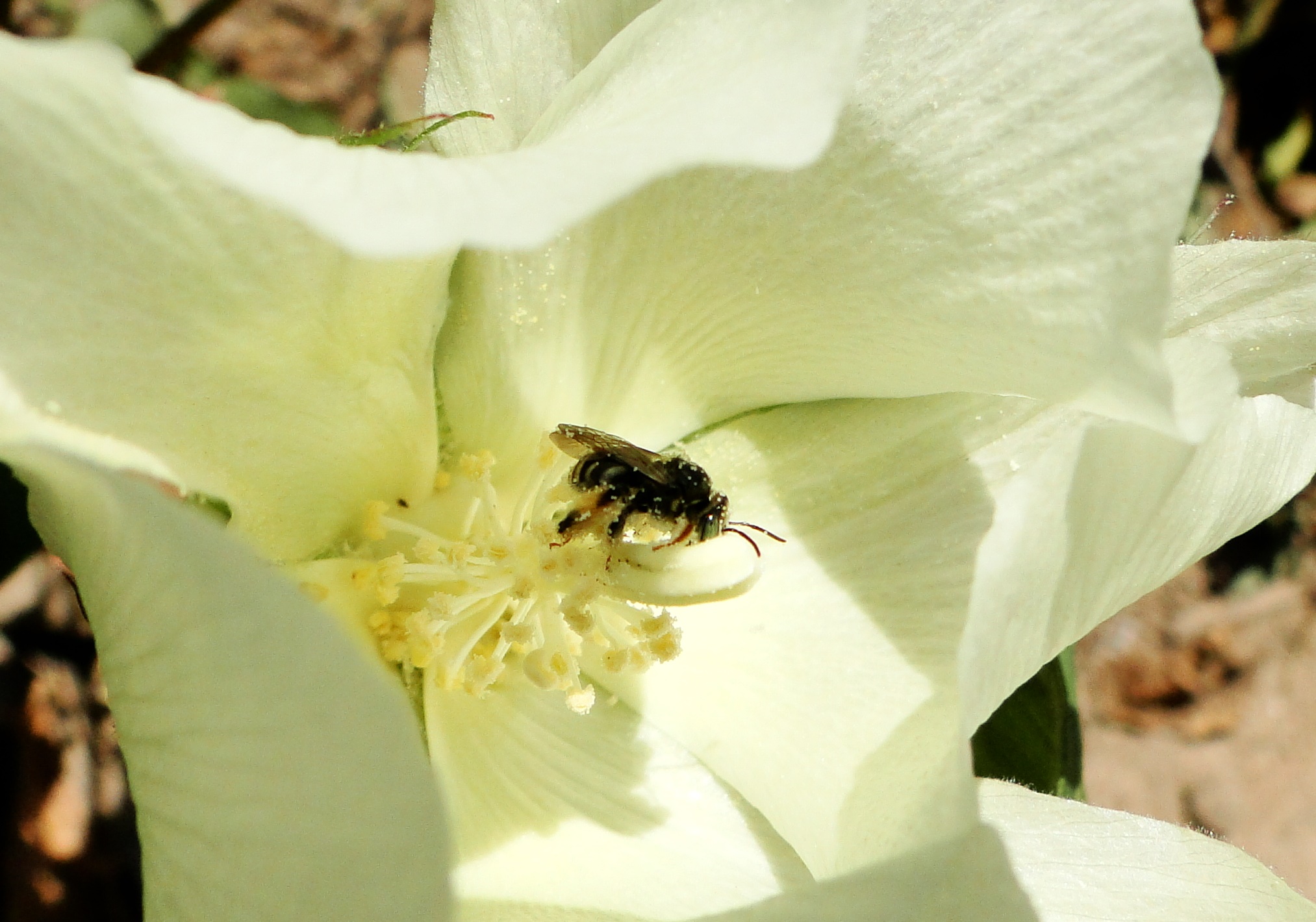
This study aimed to evaluate the importance of wild bee and feral honeybee visits for cotton production on conventional and organic farms. Experiments were conducted in Brazil, on a conventional cotton farm in Mato Grosso state in the Amazon biome and on an organic farm in Paraíba state in the Caatinga biome. On the conventional farm, bee assemblage and cotton production were measured near to and far from natural vegetation. Bee richness, fibre fraction, seed number and yield (Kg/ha) were higher by 57.14, 1.95, 17.77 and 18.44% respectively in plots near natural vegetation, but bee abundance did not vary with distance to natural vegetation. On the organic farm, because the cropping area is surrounded by natural vegetation, pollination deficit was evaluated using an exclusion experiment where cotton production of flowers bagged to prevent bee visitation (spontaneous self-pollination) was compared to production of flowers open to bee visitation (open pollination). Open pollinated flowers had higher average boll weight, fibre weight and seed number. Although cotton is not directly dependent on bee pollination, bees increased cotton production on the organic farm by more than 12% for fibre weight and over 17% for seed number. Our data confirm the importance of maintaining communities of pollinators on cotton farms, especially for organic production.
References
Blüthgen N, Klein AM (2011) Functional complementarity and specialisation: The role of biodiversity in plant-pollinator interactions. Basic and Applied Ecology 12: 282–291.
Bommarco R, Marini L, Vaissière BE (2012) Insect pollination enhances seed yield, quality, and market value in oilseed rape. Oecologia 169:1025-1032
Brittain C, Williams N, Kremen C, Klein AM (2013) Synergistic effects of non-Apis bees and honey bees for pollination services. Proceedings of The Royal Society B 2013 280, 20122767
Cardoso, CF (2008) Abelhas (Hymenoptera, Apoidea) nas flores do algodoeiro (Gossypium hirsutum latifolium cv. Delta Opal – Malvaceae) no Distrito Federal – contribuição aos estudos de biossegurança, no contexto da introdução de variedades transgênicas no Brasil. Dissertação (Mestrado) – Universidade Federal de Minas Gerais, Belo Horizonte. [on line] URL: http://www.icb.ufmg.br/pgecologia/dissertacoes/D193_carolina_yazsbeck.pdf (accessed September 2012).
Conab (2012) Companhia Nacional de Abastecimento. [on line] URL: http://consultaweb.conab.gov.br/consultas/consulta
Pgpm.do;jsessionid=D97162E8A426DFB582C19C37A510746C?method=acaoListarConsulta (accessed February 2014).
Dafni A (1992) Pollination Ecology: A practical approach. Oxford University Press, Oxford.
De Marco Jr. P, Coelho FM (2004) Services performed by the ecosystem: forest remnants influence agricultural cultures pollination and production. Biodiversity and Conservation 13: 1245–1255.
DOU (2012) Diário Oficial da União. [online] URL: http://www.in.gov.br/servlet/INPDFViewer?jornal=1&pagina=3&data=03/10/2012&captchafield=firistAccess (accessed November 2012).
Fontes EMG, Ramalho FS, Underwood E, Barroso PAV, Simon MF, Sujii ER, Pires CSS, Beltrão N, Lucena WA, Freire EC (2006) The cotton agricultural context in Brazil 2: 21-66. In: Environmental Risk Assessment of Genetically Modified Organisms Volume 2: Methodologies for Assessing Bt Cotton in Brazil. Wallingford, pp 21-66.
Fonseca PRB, Lima Jr. IS, Soria MF, Kodama C, Degrande PE (2011) Inseticidas neocotinoides no controle do bicudo do algodoeiro Anthonomus grandis (Coleoptera: Curculionidae) e a falha de controle do endosulfan. Arquivo do Instituto Biologico, São Paulo, 78(4): 545-551. [online] URL: http://www.biologico.sp.gov.br/docs/arq/v78_4/fonseca.pdf (accessed April 2013).
Free JB (1993) Insect pollination of crops. Academic Press, London.
Garibaldi LA, Steffan-Dewenter I, Winfree R, Aizen MA, Bommarco R, Cunningham AS, Kremen C, Carvalheiro LG, Harder LD, Afik O, Bartomeus I, Benjamin F, Boreux V, Cariveau D, Chacoff NP, Dudenhöffer JH, Freitas BM, Ghazoul J, Greenleaf, S, Hipólito J, Holzschuh A, Howlett B, Isaacs R, Javorek SK, Kennedy CM, Krewenka K, Krishnan S, Mandelik Y, Mayfield MM, Motzke I, Munyuli T, Nault BA, Otieno M, Petersen J, Pisanty G, Potts SG, Rader R, Ricketts TA, Rundlöf M, Seymour CL, Schüepp C, Szentgyörgyi H, Taki H, Tscharntke T, Vergara CH, Viana BF, Wanger TC, Westphal C, Williams N, Klein AM (2013) Wild pollinators enhance fruit set of crops regardless of honey bee abundance. Science 339: 1608-1611.
Godoy R, Abrahão JTM (1977) Teste de vigor em sementes de algodão (Gossypium hirsutum L.) deslintadas quimicamente. Anais Ecola Superior de Agricultura Luiz de Queiroz, Piracicaba. [online] URL: http://www.scielo.br/pdf/aesalq/v34/16.pdf (accessed July 2012).
Greenleaf SS, Williams NM, Winfree R, Kremen C (2007) Bee foraging ranges and their relationship to body size. Oecologia 153: 589–596.
IBGE (2012) Instituto Brasileiro de Geografia e Estatística. Manual técnico da vegetação brasileira. IBGE [online] URL: ftp://geoftp.ibge.gov.br/documentos/recursos_naturais/manuais_tecnicos/manual_tecnico_vegetacao_brasileira.pdf (accessed June 2012).
ISTA (2009) International Seed Testing Association. [on line] URL: http://www.seedtest.org/en/home.html (accessed August 2013).
Klein AM, Brittain C, Hendrix SD, Thorp R, Williams N, Kremen C (2012) Wild pollination services to California almond rely on semi-natural habitat. Journal of Applied Ecology 2012, 49, 723–732.
Kremen C, Williams NM, Aizen MA, Gemmill-Herren B, LeBuhn G, Minckley R, Packer L, Potts SG, Roulston T, Steffan-Dewenter I, Vásquez DP, Winfree R, Adams L, Crone EE, Greenleaf SS, Keitt TH, Klein AM, Regetz J, Ricketts TH (2007) Pollination and other ecosystem services produced by mobile organisms: a conceptual framework for the effects of land-use change. Ecology Letters 10: 299-314.
Kumar KTV, Bhat NS, Rani HV, Kiran ASS (2011) Role of honey bees and other pollinators in hybrid seed production of cotton. Mysore Journal of Agricultural Science 45(4): 810-814.
Lima Jr IS, Degrande PE, Miranda JE, Santos WJ (2013) Evaluation of the Boll Weevil AnthonomusgrandisBoheman (Coleoptera: Curculionidae) Suppression Program in the State of Goiás, Brazil. Neotropical Entomology 42: 82-88. [on line] URL: http://link.springer.com/article/10.1007%2Fs13744-012-0083-3#page-1
Malerbo-Souza DT, Halak AL (2011) Frequência e comportamento de abelhas e outros insetos nas flores do algodoeiro (Gossypium hirsutum L.). Zootecnia Tropical 29(4): 475-484.
Martins CF, Zanella FCV, Melo RR, Camarotti MF (2008) Visitantes florais e polinização do algodoeiro (Gossypium hirsutum L.) no semi-árido nordestino. Revista brasileira de oleaginosas e fibrosas, Campina Grande, 12(3): 107-117.
McGregor SE (1976) Insect Pollination of Cultivated Crop Plants. Agriculture Handbook 496: 171-190.
Michener CD (1979) Biogeography of the Bees. Annals of the Missouri Botanical Garden 66: 277-347.
Michener CD (2000) The Bees of theWorld. The Johns Hopkins University Press. 1ed. 913pp.
Milfont MO, Rocha EEM, Lima AON, Freitas BM (2013) Higher soybean production using honeybee and wild pollinators, a sustainable alternative to pesticides and autopollination. Environmental Chemistry Letters. [online] URL: http://link.springer.com/article/10.1007%2Fs10311-013-0412-8#page-1 (accessed April 2013).
Pinheiro JN, Freitas BM (2010) Efeitos letais dos pesticidas agrícolas sobre polinizadores e perspectivas de manejo para os agroecossistemas brasileiros. Oecologia Australis 14(1): 266-281.
Pires C, Silveira FA, Cardoso CF, Oliveira GM, Pereira FFO, Souza VV, Nakasu EYT, Paes JSO, Teles E, Silvie P, Rodrigues S, Miranda J, Scomparini A, Bastos C, Oliveira GS, Oliveira JE, Santos JB, Barroso PAV, Sujii E, Fontes E (2006) Visitantes florais em espécies cultivadas e não cultivadas de algodoeiro (Gossypium spp), em diferentes regiões do Brasil. Boletim de pesquisa e desenvolvimento/Embrapa Recursos Genéticos e Biotecnologia 148, Brasília-DF. [online] URL: http://www.cenargen.embrapa.br/clp/publicacoes/2006/bpd/bpd148.pdf (accessed May 2013).
Pires VC (2009) Biologia floral de Gossypium barbadense e abelhas potencialmente carreadoras de pólen de Gossypium hirsutum latifolium para Gossypium barbadense (Malvaceae) no Distrito Federal: Subsídios para a análise de risco de fluxo gênico de algodoeiros geneticamente modificados no Brasil. [online] URL: http://www.icb.ufmg.br/pgecologia/dissertacoes/
D222_Viviane_Pires.pdf (accessed November 2012).
R Core Team (2013). R: A language and environment for statistical computing. R Foundation for Statistical Computing, Vienna, Austria. URL http://www.R-project.org/.
Rhodes J (2002) Cotton pollination by honey bees. Australian Journal of Experimental Agriculture 42: 513–518.
Ricketts TH, Regetz J, Steffan-Dewenter I, Cunningham CK, Bogdanski A, Gemmil-Herren B, Greenleaf SS, Klein AM, Mayfield MM, Morandin LA, Ochieng A, Viana BF (2008) Landscape effects on crop pollination services: are there general patterns? Ecology Letters 11: 499–515.
Rocha MCLSA (2012) Efeitos dos agrotóxicos sobre abelhas silvestres no Brasil. IBAMA, Brasília.
Sanchez Junior JLB, Maberbo-Souza DT (2004) Freqüência dos insetos na polinização e produção de algodão. Acta Scientiarum. Agronomy, Maringá, 26(4): 461-465.
Santana DG,Ranal MA (2004) Medidas utilizadas para análise de germinação. In: Santana DG, Ranal MA (Ed.) Análise da germinação: umenfoque estatístico. Editora Universidade de Brasília, Brasília, 160 - 209.
Silva EMS (2007) Abelhas visitantes florais do algodoeiro (Gossypium hirsutum) em Quixeramobim e Quixeré, Estado do Ceará, e seus efeitos na qualidade da fibra e da semente. Tese de doutorado. [online] URL: http://www.zootecnia.ufc.br/
wa_files/tese2007_eva_20monica_20sarmento_20da_20silva.pdf (accessed January 2013).
Silveira, FA, Godínez, LM (1996) Systematic surveys of local bee faunas. Melissa, 9:1-4.
Silveira FA, Melo GAR, Almeida EAB (2002) Abelhas Brasileiras: Sistemática e identificação. Belo Horizonte.
Tanda AS (1984) Bee pollination increases yield of 2 interplanted varieties of Asiatic cotton (Gossypium arboretum L.). American Bee Journal. 124(7): 539-540.
Waller GD, Moffet JO, Loper GM, Martin JH (1985) An evaluation of honey bee foraging activity and pollination efficacy for male-sterile cotton. Crop Science volume 25, march-april.
Vaissiére BE, Freitas BM, Gemmill-Herren B (2011) Protocol to detect and assess pollination deficits in crops: A handbook for its use. Food and Agriculture Organization of the United Nations, Rome.
Veddeler D, Olschewski R, Tscharntke T, Klein AM (2008) The contribution of non-managed social bees to coffee production: new economic insights based on farm-scale yield data. Agroforest Systems 73: 109–114.
VERT (2013). VERT [online]. URL: http://project.vert-shoes.com.br/algodao/ (accessed February 2014).
Yamamoto M, Silva CI, Augusto SC, Barbosa AAA, Oliveira PE (2012) The role of bee diversity in pollination and fruit set of yellow passion fruit (Passiflora edulis forma flavicarpa, Passifloraceae) crop in Central Brazil. Apidologie 43: 515–526.
Zanella FCV (2000) The bees of the Caatinga (Hymenoptera, Apoidea, Apiformes): a species list and comparative notes regarding their distribution. Apidologie 31: 579-592.
Zanella FCV & Martins CF (2003) Abelhas da caatinga: Biogeografia, ecologia e conservação. Chapter 2 In: Leal IR, Tabarelli M, Silva JMC (2005) Ecologia e Conservação da Caatinga. 2ed. Recife Editora Universitária da UFPE: 75- 134
Downloads
Published
How to Cite
Issue
Section
License
Copyright (c) 2014 Viviane C. Pires, Fernando A. Silveira, Edison R. Sujii, Karoline R. S. Torezani, Wallyson A. Rodrigues, Fábio A. Albuquerque, Sandra M. M. Rodrigues, Antonieta N. Salomão, Carmen Sílvia Soares Pires

This work is licensed under a Creative Commons Attribution 4.0 International License.