
A tight relationship between the solitary bee Calliopsis (Ceroliopoeum) laeta (Andrenidae, Panurginae) and Prosopis pollen hosts (Fabaceae, Mimosoideae) in xeric South American woodlands
DOI:
https://doi.org/10.26786/1920-7603(2014)24Abstract
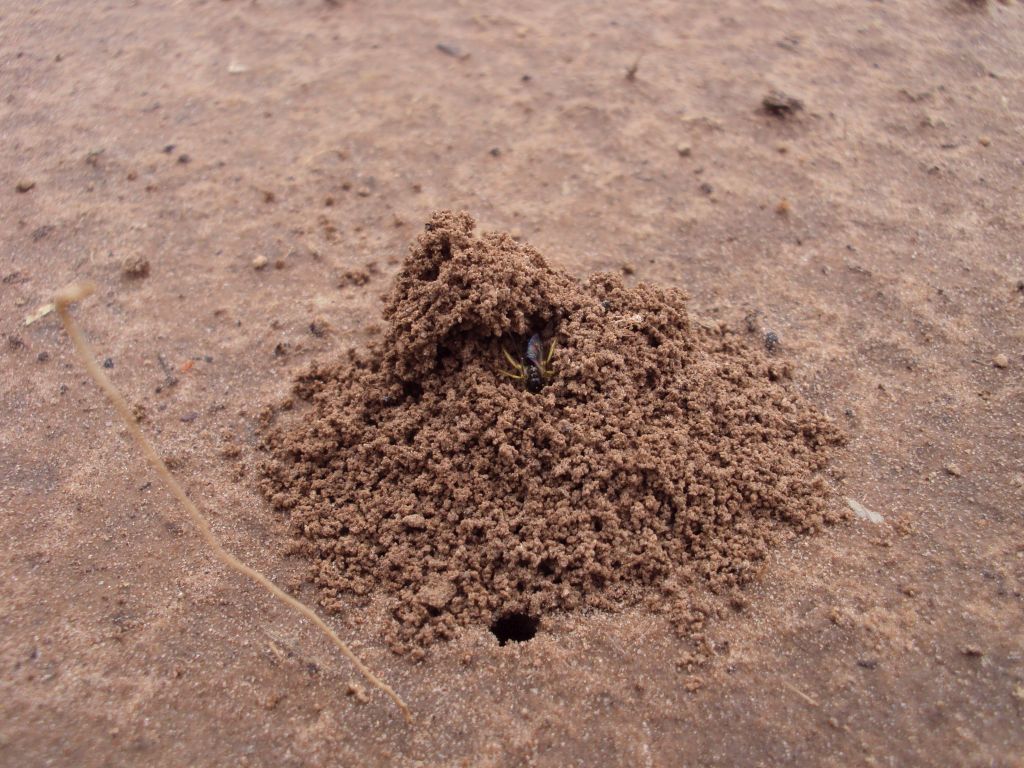
The large genus Calliopsis (Andrenidae, Panurginae) is composed of ten subgenera with polylectic and presumably oligolectic species. These categories have been mainly developed from floral visits of female bees collecting pollen. In the present study, pollen analyses of nest provisions and scopal loads from museum specimens of the monotypic subgenus Ceroliopoeum were carried out to assess its degree of specialization to pollen host-plants. Despite the great variability of floral resources close to two active nest aggregations in the Chaco sites (83 and 44 melittophilous taxa from 36 and 17 families, respectively), the only host-plant recorded in all nest pollen samples was Prosopis. This genus was represented by six species and their hybrids, all having similar pollen morphology. The nesting sites in Monte scrub also contained several Prosopis species, some of which had different pollen morphology from those of the Chaco forest. Two different Prosopis pollen types were identified in all samples. Since the whole geographic distribution of C. laeta matches with the range of Prosopis, its strong association with this pollen host seems to be well supported. However, the low number of study populations (four) could erroneously indicate oligolectism. A broader sampling is necessary to ensure the character of specialization. Most Calliopsis species have been identified as oligolectic. Yet, this categorization has mainly been based on floral visits and a large diversity of floral hosts has been recorded for each bee species. Further analyses are necessary to confirm the relationship of this genus with its pollen hosts. Moreover, as most of them have short to medium phenologies (up to 4 months) their presumably oligolecty can be due to a local specialization (i.e. variable according to location) typical of polylecty.
References
Arroyo MTK (1981) Breeding systems and pollination biology in Leguminosae. In: Polhill RM, Raven PH (eds) Advances in Legume Systematics. Royal Botanic Gardens, Kew, pp 723-769.
Burkart A (1937) Estudios morfológicos y etológicos en el género Prosopis. Darwiniana 3:27-47.
Burkart A (1976) A monograph of the genus Prosopis (Leguminosae Subfam. Mimosoideae). Journal of the Arnold Arboretum 57:219-249.
Cabrera AL (1976) Regiones fitogeográficas argentinas. In: Kugler WF (ed) Enciclopedia argentina de agricultura y jardinería. Tomo II, Acme, Buenos Aires, Argentina, pp 1-85.
Cabrera AL, Willink A (1973) Biogeografía de América Latina. Secretaría General de la Organización de los Estados Americanos, Washington D.C.
Caccavari MA (1972) Granos de polen de Leguminosas de la Argentina II. Subfam. Mimosoideae; Tribu Adenanthereae. Revista del Museo Argentino de Ciencias Naturales "Bernardino Rivadavia" 4:281-320.
Cane JH, Sipes S (2006) Characterizing floral specialization by bees: analytical methods and a revised lexicon for oligolecty. In: Waser NM, Ollerton J (eds) Plant-pollinator interactions from specialization to generalization. University of Chicago Press, Chicago, pp 99-122.
Catalano SA, Vilardi JC, Tosto D, Saidman BO (2008) Molecular phylogeny and diversification history of Prosopis (Fabaceae: Mimosoideae). Biological Journal of the Linnean Society 93:621-640.
Danforth BN (1990) Provisioning behavior and the estimation of investment ratios in a solitary bee, Calliopsis (Hypomacrotera) persimilis (Cockerell) (Hymenoptera: Andrenidae). Behavioral Ecology and Sociobiology 27:159-168.
Dumesh S, Packer L (2011) The Calliopsis (Hymenoptera; Andrenidae; Panurginae) of Chile with the description of a new species. Zootaxa 2908:64-68.
Erdtman G (1952) Pollen Morphology and Plant Taxonomy, Angiosperms. Almqvist and Wiksell, Stockholm.
Erdtman G (1960) The acetolysis method, a revised description. Svensk Botanisk Tidskrift 54:561-564.
Genise J, Palacios RA, Hoc PS, Carrizo R, Moffat L, Mom MP, Agulló MA, Picca P, Torregrosa S (1990) Observaciones sobre la biología floral de Prosopis (Leguminosae, Mimosoideae). II. Fases florales y visitantes en el Distrito Chaqueño Serrano. Darwiniana 30:71-85.
Genise J, Palacios RA, Hoc PS, Agulló MA, Picca P (1991) Some new aspects of the floral biology of Prosopis (Leguminosae, Mimosoideae): behaviour of the main insect visitors in West-Chaco (Argentina). Bulletin of the International Group for the Study of Mimosoideae 19:130-145.
Jörgensen P (1912) Revision der Apiden der Provinz Mendoza, Republica Argentina. Zoologische Jahrbücher, Abteilung für Systematik, Geographie und Biologie der Tiere 32:89-162.
Keys RN, Buchmann SL, Smith SE (1995) Pollination effectiveness and pollination efficiency of insects foraging Prosopis velutina in South-eastern Arizona. Journal of Applied Ecology 32:519-527.
Lieux MH (1980) Acetolysis applied to microscopical honey analysis. Grana 19:57-61.
Michelette ERF, Camargo JMF (2000) Bee-plant community in a xeric ecosystem in Argentina. Revista Brasileira de Zoologia 17:651-665.
Michener CD (1954) Bees of Panamá. Bulletin of the American Museum of Natural History 104:1-175.
Michener CD (2007) The bees of the world. The John Hopkins University Press, Baltimore.
Moldenke AR, Neff JL (1974) The bees of California, a catalogue with special reference to pollination and ecological research. Origin and Structure of Ecosystems, Technical Reports 74-1 to 74-6. Santa Cruz: University of California, p. -v + 245 pp.
Moure JS, Dal Molin A (2012) Calliopsini Robertson, 1922. In: Moure JS, Urban D, Melo GAR (orgs). Catalogue of Bees (Hymenoptera, Apoidea) in the Neotropical Region [online] URL: http://www.moure.cria.org.br/catalogue (accessed December 2013).
Müller A, Kuhlmann M (2008) Pollen hosts of western palaearctic bees of the genus Colletes (Hymenoptera: Colletidae): the Asteraceae paradox. Biological Journal of the Linnean Society 95:719-733.
Neff JL (1984) Observations on the biology of Eremapis parvula Ogloblin an anthophorid bee with a metasomal scopa (Hymenoptera: Anthophoridae). Pan-Pacific Entomologist 60:155-162.
Palacios R, Bravo L (1981) Hibridación natural en Prosopis (Leguminosae) en la región chaqueña argentina. Evidencias morfológicas y cromatográficas. Darwiniana 23:3-35.
Palacios R, Brizuela MM (2005) Prosopis. Flora Fanerogámica Argentina 92:1-25.
Peacock JT, McMillan C (1965) Ecotypic differentiation in Prosopis (mesquite). Ecology 46:35-51.
Robertson C (1929) Flowers and insects. Lists of visitors to four hundred and fifty-three flowers. Science Press Printing Company, Lancaster, Pennsylvania, USA.
Rozen JG Jr. (1963) Notes on the biology of Nomadopsis, with descriptions of four new species (Apoidea, Andrenidae). American Museum Novitates 2142:1-17.
Rozen JG Jr. (1967) Review of the biology of panurgine bees, with observations on North American forms (Hymenoptera, Andrenidae). American Museum Novitates 2297:1-44.
Rozen JG Jr. (1970) Biology and inmature stages of the panurgine bee genera Hypomacrotera and Psaenythia (Hymenoptera, Apoidea). American Museum Novitates 2416:1-16.
Rozen JG Jr. (2008) The solitary bee Calliopsis zebrata: Biological and distributional notes and description of its larva (Hymenoptera: Andrenidae: Panurginae). American Museum Novitates 3632:1-12.
Rozen JG Jr, Yanega D (1999) Nesting biology and inmature stages of the South American bee genus Acamptopoeum (Hymenoptera: Andrenidae: Panurginae). In: Byers GW, Hagen RH, Brooks RW (eds) Entomological contributions in memory of Byron A. Alexander. The University of Kansas Natural History Museum, special publication No. 24, Lawrence, Kansas, pp 59-67.
Ruz L (1991) Classification and phylogenetic relationships of the panurgine bees: The Calliopsini and allies. University of Kansas Science Bulletin 54:209-256.
Schlindwein C (2003) Panurginae (Hymenoptera, Andrenidae) in Northeastern Brazil. In: Melo GAR, Alves-dos-Santos I (eds) Apoidea Neotropica: Homenagem aos 90 Anos de Jesus Santiago Moure. Editora UNESC, Criciúma, pp 217-222.
Shinn AF (1967) A revision of the bee genus Calliopsis and the biology and ecology of C. andreniformis (Hymenoptera, Andrenidae). University of Kansas Science Bulletin 46:753-936
Simpson BB, Neff JL, Moldenke AR (1977) Prosopis flowers as a resource. In: Simpson BB (ed) Mesquite, its biology in two desert scrub ecosystems. Dowden, Hutchinson & Ross, Stroudsburg, Pennsylvania, pp 85-107.
Vossler FG (2013) The oligolecty status of a specialist bee of South American Prosopis (Fabaceae) supported by pollen analysis and floral visitation methods. Organisms Diversity and Evolution 13:513-519.
Wcislo WT (1999) Male territoriality and nesting behavior of Calliopsis hondurasicus Cockerell (Hymenoptera: Andrenidae). Journal of the Kansas Entomological Society 72:91-98.
Wcislo WT, Cane JH (1996) Floral resource utilization by solitary bees (Hymenoptera: Apoidea) and exploitation of their stored foods by natural enemies. Annual Review of Entomology 41:257-286.
Wodehouse RP (1935) Pollen grains. Mc. Graw-Hill, New York.
Downloads
Published
How to Cite
Issue
Section
License
Copyright (c) 2014 Favio Gerardo Vossler

This work is licensed under a Creative Commons Attribution 4.0 International License.