
False-colour photography: a novel digital approach to visualize the bee view of flowers
DOI:
https://doi.org/10.26786/1920-7603(2018)11Abstract
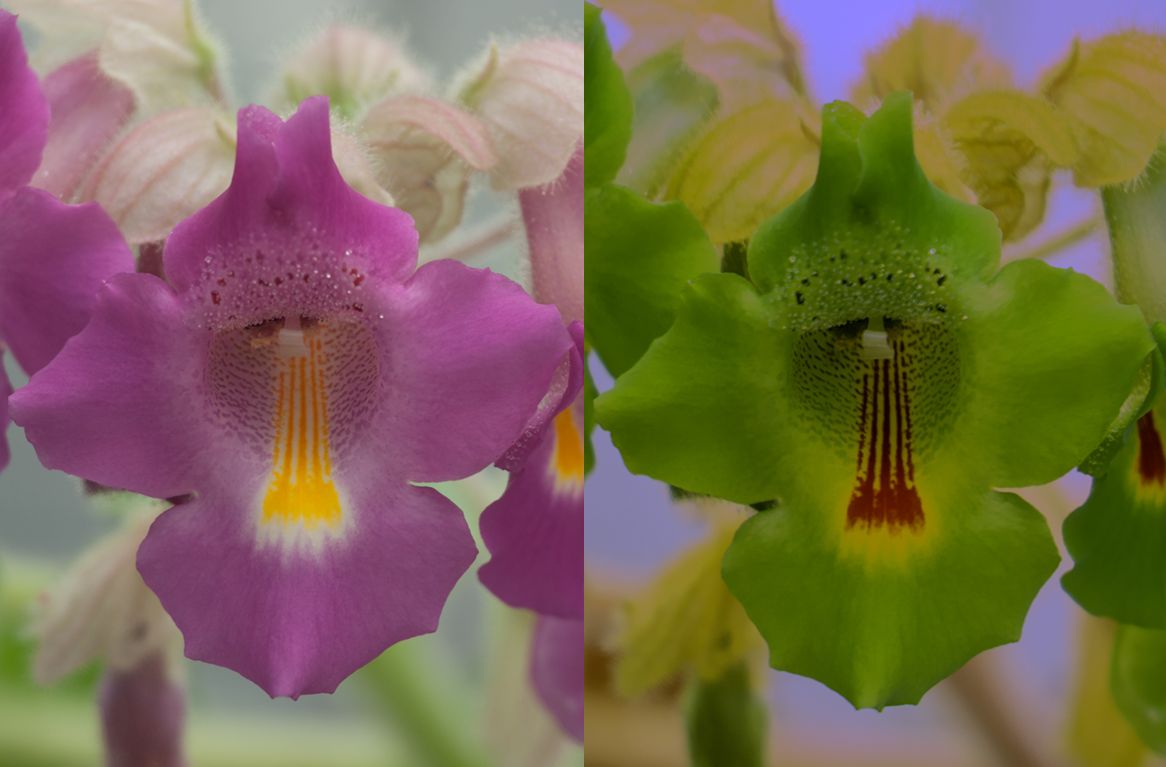
The colour vision system of bees and humans differs mainly in that, contrary to humans, bees are sensitive to ultraviolet light and insensitive to red light. The synopsis of a colour picture and a UV picture is inappropriate to illustrate the bee view of flowers, since the colour picture does not exclude red light. In this study false-colour pictures in bee view are assembled from digital photos taken through a UV, a blue, and a green filter matching the spectral sensitivity of the bees’ photoreceptors. False-colour pictures demonstrate small-sized colour patterns in flowers, e.g. based on pollen grains, anthers, filamental hairs, and other tiny structures that are inaccessible to spectrophotometry. Moreover, false-colour pictures are suited to demonstrate flowers and floral parts that are conspicuous or inconspicuous to bees. False-colour pictures also direct the attention to other ranges of wavelength besides ultraviolet demonstrating for example blue and yellow bulls’ eyes in addition to UV bulls’ eyes which previously have been overlooked. False-colour photography is a robust method that can be used under field conditions, with various equipment and with simple colour editing.References
Arikawa K (2003) Spectral organization of the eye of a butterfly, Papilio. Journal of Comparative Physiology A 189:791-800.
Arnold SEJ, Faruq S, Savolainen V, McOwan PW, Chittka L (2010) FReD: The Floral Reflectance Database — A web portal for analyses of flower colour. PLoS ONE 5(12): e14287.
Backhaus W (1991) Color opponent coding in the visual system of the honeybee. Vision Research 31:1381-1397.
Benitez-Vieyra S, Hempel de Ibarra N, Wertlen AM, Cocucci AA (2007) How to look like a mallow: evidence of floral mimicry between Turneraceae and Malvaceae. Proceedings of the Royal Society B Biological Sciences 274:2239-2248.
Bergamo PJ, Rech AR, Brito VLG, Sazima M (2016) Flower colour and visitation rates of Costus arabicus support the "bee avoidance" hypothesis for red-reflecting hummingbird-pollinated flowers. Functional Ecology 30:710-720.
Biedinger N, Barthlott W (1993) Untersuchungen zur Ultraviolettreflexion von Angiospermenblüten. I Monocotyledonae. Tropische und Subtropische Pflanzenwelt 86:1-122.
Bowmaker JK, Dartnall HJ (1980) Visual pigments of rods and cones in a human retina. The Journal of Physiology 298:501-511.
Briscoe AD (2008) Reconstructing the ancestral butterfly eye: focus on the opsins. Journal of Experimental Biology 211:1805-1813.
Brito VLG, Weynans K, Sazima M, Lunau K (2015) Trees as huge flowers and flowers as oversized floral guides: the role of floral color change and retention of old flowers in Tibouchina pulchra. Frontiers in Plant Science 6:362.
Burkhardt D (1997) Die Welt mit anderen Augen—Wie Insekten und Vögel die Welt und ihre Farben sehen. Biologie in unserer Zeit 19:37-46.
Burr B, Barthlott W (1993) Untersuchungen zur Ultraviolettreflexion von Angiospermenblüten II. Magnoliidae, Ranunculidae, Hamamelididae, Caryophyllidae, Rosidae. Tropische und Subtropische Pflanzenwelt 87:1-193.
Burr B, Rosen D, Barthlott W (1995) Untersuchungen zur Ultraviolettreflexion von Angiospermenblüten III. Dilleniidae und Asteridae s.l.. Tropische und Subtropische Pflanzenwelt 93:1-185.
Chen P-J, Awata H, Matsushita A, Yang E-C, Arikawa K (2016) Extreme spectral richness in the eye of the Common Bluebottle Butterfly, Graphium sarpedon. Frontiers in Ecology and Evolution 4:18.
Chittka L, Kevan PG (2005) Flower colour as advertisement. In: Dafni A, Kevan PG, Husband BC (eds) Practical Pollination Biology. Enviroquest Ltd., Cambridge, ON, Canada, pp 157-196.
Chittka L, Menzel R (1992) The evolutionary adaptation of flower colors and the insect pollinators' color vision systems. Journal of Comparative Physiology A 171:171-181.
Chittka L, Shmida A, Troje N, Menzel R (1994) Ultraviolet as a component of flower reflections, and the colour perception of Hymenoptera. Vision Research 34:1489-1508.
Chittka L, Waser NM (1997). Why red flowers are not invisible for bees. Israel Journal of Plant Sciences 45:169-183.
Clark C (1979) Ultraviolet absorption by flowers of the Eschscholzioideae (Papaveraceae). Madrono 26:22-25.
Cure JR, Wittmann D (1990) Callonychium petuniae, a new panurgine bee species (Apoidea, Andrenidae) oligolectic on Petunia (Solanaceae). Studies on Neotropical Fauna & Environment 25:153-156.
Daumer, K (1958) Blumenfarben, wie sie die Bienen sehen. Zeitschrift für vergleichende Physiologie 41:49-110.
Dyer AG, Boyd-Gerny S, Mcloughlin S, Rosa MGP, Simonov V, Wong BBM (2012) Parallel evolution of angiosperm colour signals: common evolutionary pressures linked to hymenopteran vision. Proceedings of the Royal Society B: Biological Sciences 279:3606-3615.
Dyer AG, Spaethe J, Prack S (2008) Comparative psychophysics of bumblebee and honeybee colour discrimination and object detection. Journal of Comparative Physiology A 194:617-627.
Eaton DAR, Fenster CB, Hereford J, Huang SQ, Ree RH (2012) Floral diversity and community structure in Pedicularis (Orobanchaceae). Ecology 93:182-194.
Eisner T, Silberglied RE, Aneshansley D, Carrel JE, Howland HC (1969) Ultraviolet video-viewing: the television camera as an insect eye. Science 166:1172-1174.
Garcia JE, Greentree AD, Shrestha M, Dorin A, Dyer AG (2014) Flower colours through the lens: Quantitative measurement with visible and ultraviolet digital photography. PLoS ONE 9(5):e96646.
Giurfa M, Núñez J, Chittka L, Menzel R (1995) Colour preferences of flower-naive honeybees. Journal of Comparative Physiology A 177:247-259.
Giurfa M, Vorobyev M, Kevan P, Menzel R (1996) Detection of coloured stimuli by honeybees: minimum visual angles and receptor specific contrasts. Journal of Comparative Physiology A 178:699-709.
Gronquist M, Bezzerides A, Attygalle A, Meinwald J, Eisner M, Eisner T (2001) Attractive and defensive functions of the ultraviolet pigments of a flower (Hypericum calycinum). Proceedings of the National Academy of Sciences USA 98:13745-13750.
Guldberg LD, Atsatt PR (1975) Frequency of reflection and absorption of ultraviolet light in flowering plants. The American Midland Naturalist 93:35-43.
Gumbert A (2000) Color choices by bumble bees (Bombus terrestris): innate preferences and generalization after learning. Behavioral Ecology and Sociobiology 48:36-43.
He Q, Shen Y, Wang M, Huang M, Yang R, Zhu S, Wang L, Wu R (2011) Natural variation in petal color in Lycoris longituba revealed by anthocyanin components. PLoS ONE 6(8): e22098.
Hempel de Ibarra N, Langridge KV, Vorobyev M (2015) More than colour attraction: behavioural functions of flower patterns. Current Opinion in Insect Science 12:64e70.
Hempel de Ibarra N, Vorobyev M (2009) Flower patterns are adapted for detection by bees. Journal of Comparative Physiology A 195:319-323.
Herrera G, Zagal JC, Diaz M, Fernández MJ Vielma A, Cure M, Martinez J, Bozinovic F, Palacios AG (2008) Spectral sensitivities of photoreceptors and their role in colour discrimination in the green-backed firecrown hummingbird (Sephanoides sephaniodes). Journal of Comparative Physiology A 194:785-794.
Hinton HE (1976) Possible significance of the red patches of the female crab-spider, Misumena vatia. Journal of Zoology 180:35-39.
Huang Y, Li N, Ren ZX, Chen G, Wu ZK, Ma YP (2015) Reproductive biology of Primula beesiana (Primulaceae), an alpine species endemic to Southwest China. Plant Ecology and Evolution 148:289-296.
Johnson SD, Midgley JJ. (2001) Pollination by monkey beetles (Scarabaeidae: Hopliini): do colour and dark centres of flowers influence alighting behavior? Environmental Entomology 30:861-868.
Junker RR, Blüthgen N (2010) Floral scents repel facultative flower visitors, but attract obligate ones. Annals of Botany 105:777-782.
Kevan PG, Chittka L, Dyer AG (2001) Limits to the salience of ultraviolet: Lessons from color vision in bees and birds. Journal of Experimental Biology 204:2571-2580.
Kelber A, Balkenius A, Warrant EJ (2002) Scotopic colour vision in nocturnal hawkmoths. Nature 419:922-925.
Kevan PG (1972) Floral colors in the high arctic with reference to insect-flower relations and pollination. Canadian Journal of Botany 50:2289-2316.
Kevan PG (1978) Floral coloration, its colorimetric and significance in anthecology. In: Richards AJ (ed.) The pollination of flowers by Insects. Linnean Society Symposium Series Vol. 6:51-78.
Kevan PG (1979) Vegetation and floral colours revealed by ultraviolet light: interpretational difficulties for functional significance. American Journal of Botany 66:749-751.
Kevan P (1983) Floral colours through the insect eye: what they are and what they mean. In: Jones CE, Little RJ (eds.) Handbook of Experimental Pollination Biology. Van Nostrand Reinhold, New York, pp 3-30.
Kevan PG, Backhaus WG (1998) Color vision: ecology and evolution in making the best of the photic environment. In: Backhaus W, Kliegl R, Werner J (eds.) Color vision: perspectives from different disciplines. Walter de Gruyter, Berlin, pp 163-183.
Kevan PG, Chittka L, Dyer AG (2001) Limits to the salience of ultraviolet: lessons from colour vision in bees and birds. Journal of Experimental Biology 204:2571-2580.
Kevan P G, Giurfa M, Chittka L (1996) Why are there so many and so few white flowers? Trends in Plant Sciences 1:280-284.
Koski MH, Ashman TL (2013) Quantitative variation, heritability, and trait correlations for ultraviolet floral traits in Argentina anserina (Rosaceae): implications for floral evolution. International Journal of Plant Sciences 174:1109-1120.
Koski MH, Ashman TL (2014) Dissecting pollinator responses to a ubiquitous ultraviolet floral pattern in the wild. Functional Ecology 28:868-877.
Koski MH, Ashman TL (2015a). Floral pigmentation patterns provide an example of Gloger’s rule in plants. Nature Plants 1:14007.
Koski MH, Ashman TL (2015b) An altitudinal cline in UV floral pattern corresponds with a behavioral change of a generalist pollinator assemblage. Ecology 96:3343-3353.
Liang H, Ren ZX, Tao ZB, Bernhardt B, Li DZ, Wang H. (2018) Impact of pre- and post-pollination barriers on pollen transfer and reproductive isolation among three sympatric Pedicularis (Orobanchaceae) species. Plant Biology; DOI:10.1111/plb.12833
Lübbe E (2010) Colours in the Mind - Colour Systems in Reality - A formula for colour saturation. [Book on Demand].
Lunau K (1992) Innate recognition of flowers by bumblebees – orientation of antennae to visual stamen signals. Canadian Journal of Zoology 70:2139-2144.
Lunau K (1995) Notes on the colour of pollen. Plant Systematics and Evolution 198:235-252.
Lunau K (1996) Unidirectionality of floral colour changes. Plant Systematics and Evolution 200:125-140.
Lunau K (2000) The ecology and evolution of visual pollen signals. Plant Systematics and Evolution 222:89-111.
Lunau K (2007) Stamens and mimic stamens as components of floral colour patterns. Botanische Jahrbücher für Systematik, Pflanzengeschichte und Pflanzengeographie 127:13-41.
Lunau K (2014) Visual ecology of flies with particular reference to colour vision and colour preferences. Journal of Comparative Physiology A 200:497-512.
Lunau K, Konzmann S, Bossems J, Harpke D (2016) A matter of contrast: Yellow flower colour constrains style length in Crocus species. PLoS ONE 11(4):e0154728.
Lunau K, Konzmann S, Winter L, Kamphausen V, Ren ZX (2017) Pollen and stamen mimicry: the alpine flora as a case study. Arthropod-Plant Interactions 11:427-447.
Lunau K, Maier EJ (1995) Innate colour preferences of flower visitors. Journal of Comparative Physiology A 177:1-19.
Lunau K, Papiorek S, Eltz T, Sazima M (2011) Avoidance of achromatic colours by bees provides a private niche for hummingbirds. Journal of Experimental Biology 214:1607-1612.
Lunau K, Verhoeven C (2017) Wie Bienen Blumen sehen - Falschfarbenaufnahmen von Blüten. Biologie in unserer Zeit 47:120-127.
Lunau K, Wacht S, Chittka L (1996) Colour choices of naive bumble bees and their implications for colour perception. Journal of Comparative Physiology A 178:477-489.
Lunau K, Wester P (2017) Mimicry and deception in pollination. In: Becard G (ed.) Advances in Botanical Research, Vol. 82, How Plants Communicate with their Biotic Environment; pp 259-279; Academic Press, Amsterdam.
Ma XK, Shi J, Bänziger H, Sun YN, Guo YY, Liu ZJ, Johnson SD, Luo YB (2015) The functional significance of complex floral colour pattern in a food-deceptive orchid. Functional Ecology 30:721-732.
Martínez-Harms J, Palacios AG, Márquez N, Estay P, Arroyo MTK, Mpodozis J (2010) Can red flowers be conspicuous to bees? Bombus dahlbomii and South American temperate forest flowers as a case in point. Journal of Experimental Biology 213:564-571.
Martínez-Harms J, Vorobyev M, Schorn J, Shmida A, Keasar T, Homberg U, Schmeling F, Menzel R (2012) Evidence of red sensitive photoreceptors in Pygopleurus israelitus (Glaphyridae: Coleoptera) and its implications for beetle pollination in the southeast Mediterranean. Journal of Comparative Physiology A 198:451-463.
Medel R, Botto-Mahan C, Kalin-Arroyo M (2003) Pollinator mediated selection on the nectar guide phenotype in the Andean monkeyflower, Mimulus luteus. Ecology 84:1721-1732.
Milet-Pinheiro P, Ayasse M, Dötterl S (2015) Visual and olfactory floral cues of Campanula (Campanulaceae) and their significance for host recognition by an oligolectic bee pollinator. PLoS ONE 10(6):e0128577.
Myers N, Mittermeier RA, Mittermeier CG, da Fonseca GAB, Kent J (2000) Biodiversity hotspots for conservation priorities. Nature 403:853-858.
Neumeyer C (1981) Chromatic adaptation in the honey bee: Successive color contrast and color constancy. Journal of Comparative Physiology 144:543-553.
Oberrath R, Böhning-Gaese K (1999) Floral color change and the attraction of insect pollinators in lungwort (Pulmonaria collina). Oecologia 121:383-391.
Ohashi K, Makino TT, Arikawa K (2015) Floral colour change in the eyes of pollinators: testing possible constraints and correlated evolution. Functional Ecology 29:1144-1155.
Orbán LL, Plowright CMS (2014) Getting to the start line: how bumblebees and honeybees are visually guided towards their first floral contact. Insectes Sociaux 61:325-336.
Papiorek S, Junker RR, Alves-dos-Santos I, Melo GAR, Amaral-Neto LP , Sazima M, Wolowski M, Freitas L, Lunau K (2016) Bees, birds and yellow flowers: Pollinator-dependent convergent evolution of UV-patterns. Plant Biology 18:46-55.
Peitsch D, Fietz A, Hertel H, de Souza J, Ventura DF, Menzel R (1992) The spectral input systems of hymenopteran insects and their receptor-based colour vision. Journal of Comparative Physiology A, 170:23-40.
Peterson ML, Miller TJ, Kay KM (2015) An ultraviolet floral polymorphism associated with life history drives pollinator discrimination in Mimulus guttatus. American Journal of Botany 102:396-406.
Primack RB (1982) Ultraviolet patterns in flowers, or flowers as viewed by insects. Arnoldia 42: 139-146.
Ren ZX, Wang H, Bernhardt P, Li DZ (2014) Insect pollination and self-incompatibility in edible and/or medicinal crops in southwestern China, a global hotspot of biodiversity. American Journal of Botany 101:1700-1710.
Rodríguez-Gironés MA, Ruiz A (2016) toBeeView: A program for simulating the retinal picture of visual scenes on nonhuman eyes. Ecology and Evolution 6:7892-7900.
Rodríguez-Gironés MA, Santamaría L (2004) Why are so many bird flowers red? PLoS Biology 2(10):e350.
Rosen D, Barthlott W (1991) Ökologische Aspekte der Ultraviolett-Reflexion von Blumen in Mitteleuropa, besonders in der Eifel. Decheniana 144:72-112.
Schlangen K, Miosic S, Castro A, Freudmann K, Luczkiewicz M, Vitzthum F, Schwab W, Gamsjäger S, Musso M, Halbwirth H (2009) Formation of UV-honey guides in Rudbeckia hirta. Phytochemistry 70:889-898.
Shi J, Luo YB, Bernhardt P, Ran JC, Liu ZJ, Zhou Q (2009) Pollination by deceit in Paphiopedilum barbigerum (Orchidaceae): a staminode exploits the innate colour preferences of hoverflies (Syrphidae). Plant Biology 11:17-28.
Silberglied RE (1976) Visualization and recording of longwave ultraviolet reflection from natural objects. Functional Photography 11:20-29; 30-33.
Silberglied RE (1979) Communication in the ultraviolet. Annual Review of Ecology and Systematics 10:373-398.
Stavenga DG, van der Kooi CJ (2016) Coloration of the Chilean Bellflower, Nolana paradoxa, interpreted with a scattering and absorbing layer stack model. Planta 243:171-181.
Stockman A, Macleod D, Johnson N (1993) Spectral sensitivities of the human cones. Journal of the Optical Society of America 10:2491-2521.
Tao ZB, Ren ZX, Bernhardt P, Liang H, Li HD, Zhao YH, Wang H, Li DZ (2018) Does reproductive isolation reflect the segregation of color forms in the Spiranthes sinensis (Pers.) Ames complex (Orchidaceae) in the Chinese Himalayas? Ecology and Evolution; DOI:10.1002/ece3.4067
Tong ZY, Huang SQ (2016) Pre- and post-pollination interaction between six co-flowering Pedicularis species via heterospecific pollen transfer. New Phytologist 211:1452-1461.
Tong ZY, Huang SQ (2018) Safe sites of pollen placement: a conflict of interest between plants and bees? Oecologia 186:163-171.
Troscianko J, Stevens M (2015) Picture calibration and analysis toolbox – a free software suite for objectively measuring reflectance, colour and pattern. Methods in Ecology and Evolution 6:1320-1331.
Vasas V, Hanley D, Kevan PG, Chittka L (2017) Multispectral images of flowers reveal the adaptive significance of using long-wavelength-sensitive receptors for edge detection in bees. Journal of Comparative Physiology A 203:301-311.
Von Frisch K (1915) Der Farbensinn und Formensinn der Biene. Zoologische Jahrbücher Abteilung für allgemeine Zoologie und Physiologie 37:1-187.
Vorobyev M, Kunze J, Gumbert A, Giurfa M, Menzel R (1997) Flowers through the insect eyes. Israel Journal of Plant Science 45:93-102.
Vorobyev M, Marshall J, Osorio D, Hempel de Ibarra N, Menzel R (1999) Colourful objects through animal eyes. Colour Research and Application 26: 214-217.
Wang H, Li DZ (2005) Pollination biology of four Pedicularis species (Scrophulariaceae) in northwestern Yunnan, China. Annals of the Missouri Botanical Garden 92:127-138.
Weiss MR, Lamont BB (1997) Floral color change and insect pollination: A dynamic relationship. Israel Journal of Plant Science 45:185-200.
White TE, Dalrymple RL, Noble DWA, O'Hanlon JC, Zurek DB, Umbers KDL (2015) Reproducible research in the study of biological coloration. Animal Behaviour 106:51-57.
Wikipedia (2. März 2017). CIE 1931 color space. Accessed 9 March 2017 from Wikipedia: en.wikipedia.org/wiki/CIE_1931_color_space
Williams S, Dyer A (2007) A photographic simulation of insect vision. The Journal of Ophthalmic Photography 29:10-14.
Williams P, Tang Y, Yao J, Cameron S (2009) The bumblebees of Sichuan (Hymenoptera: Apidae, Bombini). Systematics and Biodiversity 7:101-189.
Wilmsen S, Gottlieb R, Junker RR, Lunau K (2017) Bumblebees require visual pollen stimuli to initiate and multimodal stimuli to complete a full behavioral sequence in close-range flower orientation. Ecology and Evolution 7:1384-1393.
Winter Y, Lopez J, von Helversen O (2003) Ultraviolet vision in a bat. Nature 425:612-614.
Wu ZY, Raven PH, Hong DY (2013) Flora of China Vol. 1: Introduction. Science Press, Beijing, China and Missouri Botanical Garden Press, St. Louis, USA.
Yan J, Wang G, Sui Y, Wang ML, Zhang L (2016) Pollinator responses to floral colour change, nectar, and scent promote reproductive fitness in Quisqualis indica (Combretaceae). Scientific Reports 6:24408.
Yan J, Wang ML, Zhang L (2018) Light induces petal color change in Quisqualis indica (Combretaceae). Plant Diversity 40:28-34.
Yang HB, Holmgren NH, Mill RR (1998) Pedicularis. In: Wu ZY, Raven PH, Hong DY (2013) Flora of China, Vol 18: Science Press, Beijing, China and Missouri Botanical Garden Press, St. Louis, USA.
Zhang C, Vereecken NJ, Wang LL, Tian B, Dafni A, Yang YP, Duan YW (2017) Are nectar guide colour changes a reliable signal to pollinators that enhances reproductive success? Plant Ecology & Diversity 10:89-96
Published
How to Cite
Issue
Section
License
Copyright (c) 2018 Christian Verhoeven, Zong-Xin Ren, Klaus Lunau

This work is licensed under a Creative Commons Attribution 4.0 International License.