
Testing the efficacy of artificial flowers as a novel attractant for automated pollinator monitoring
DOI:
https://doi.org/10.26786/1920-7603(2026)893Keywords:
pollinator monitoring, insect pollinators, camera trap, attractant preference, artificial flowersAbstract
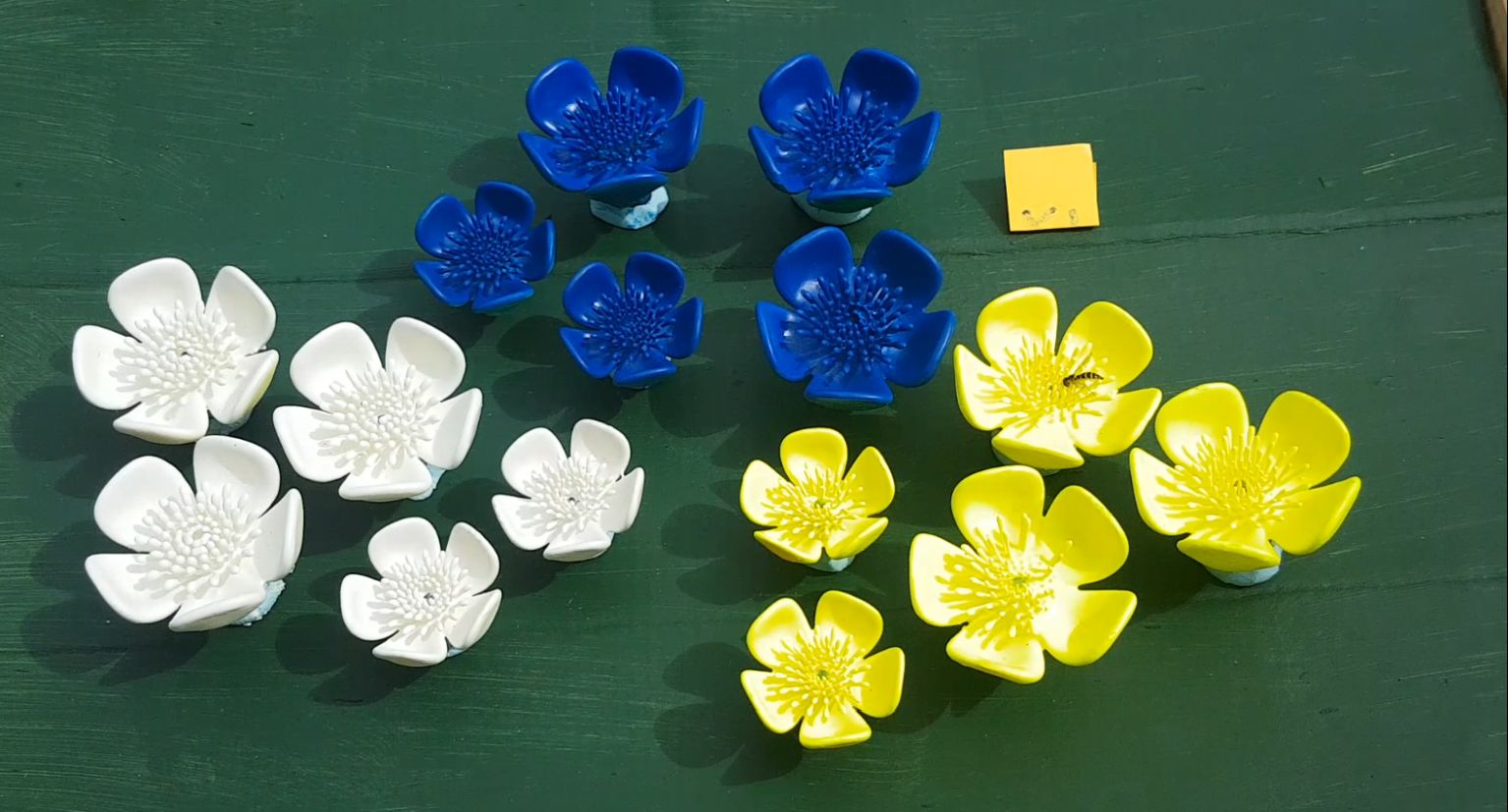
Insect camera traps are a rapidly developing technology for automated insect monitoring. However, little has been reported on improving the attractants used for daytime flying insects on such cameras. This study compares the attractiveness of 3D-printed artificial flowers with traditional attractants (pan traps and coloured paper squares). We hypothesised that artificial flowers would attract higher insect abundance and diversity by more accurately mimicking flowers, and additionally examined colour preference and landing duration. Artificial flowers, dry pan traps and paper squares, painted in UV-induced fluorescent yellow, white, or blue paint, were filmed simultaneously to observe wild insect behavioural responses (landings and approaches). The results indicate an overall preference for artificial flowers over traditional attractants, and colour preferences for blue and yellow. Analysed by group, hoverflies preferred landing on artificial flowers over the other attractants. Bumblebees preferred approaching artificial flowers, and 'small insects' preferred landing and approaching artificial flowers over the other attractants. 'Other flies' preferred landing on pan traps and paper over artificial flowers. Hoverflies, 'small insects', wasps, and 'solitary bees' responded more to yellow than the other colours, while bumblebees responded more to blue. Analysis of landing probability broadly mirrored these attractant preferences. Landing duration showed limited effects across groups, though 'small insects' spent longer on artificial flowers and pan traps than paper, and hoverflies spent longer on yellow than the other colours. These results suggest artificial flowers could offer an efficient attractant for insect camera traps as they attracted higher abundances of key pollinating insects (hoverflies and bumblebees) without reducing attraction rates for other insect groups (excluding 'other flies').
References
Acharya RS, Leslie T, Fitting E, Burke J, Loftin K, Joshi NK (2021) Color of Pan Trap Influences Sampling of Bees in Livestock Pasture Ecosystem. Biology 10:445.
An L, Neimann A, Eberling E, Algora H, Brings S, Lunau K (2018) The yellow specialist: dronefly Eristalis tenax prefers different yellow colours for landing and proboscis extension. Journal of Experimental Biology 221:jeb184788.
Baum KA, Wallen KE (2011) Potential Bias in Pan Trapping as a Function of Floral Abundance. Journal of the Kansas Entomological Society 84:155–159.
Besson M, Alison J, Bjerge K, Gorochowski TE, Høye TT, Jucker T, Mann HMR, Clements CF (2022) Towards the fully automated monitoring of ecological communities. Ecology Letters 25:2753–2775.
Bjerge K, Alison J, Dyrmann M, Frigaard CE, Mann HMR, Høye TT (2023) Accurate detection and identification of insects from camera trap images with deep learning Fang W-T (ed). PLOS Sustainability and Transformation 2:e0000051.
Bjerge K, Mann HMR, Høye TT (2022) Real-time insect tracking and monitoring with computer vision and deep learning. Remote Sensing in Ecology and Conservation 8:315–327.
Bjerge K, Nielsen JB, Sepstrup MV, Helsing-Nielsen F, Høye TT (2021) An Automated Light Trap to Monitor Moths (Lepidoptera) Using Computer Vision-Based Tracking and Deep Learning. Sensors 21:343.
Brooks ME, Kristensen K, Benthem KJ van, Magnusson A, Berg CW, Nielsen A, Skaug HJ, Mächler M, Bolker BM (2017) glmmTMB Balances Speed and Flexibility Among Packages for Zero-inflated Generalized Linear Mixed Modeling. The R Journal 9:378–400.
Burton FM (1877) Insects and Artificial Flowers. Nature 17:162–162.
Campos EO, Bradshaw HD, Daniel TL (2015) Shape matters: corolla curvature improves nectar discovery in the hawkmoth Manduca sexta Brody A (ed). Functional Ecology 29:462–468.
Chapman KM, Richardson FJ, Forster CY, Middleton EJT, White TE, Burke PF, Latty T (2023) Artificial flowers as a tool for investigating multimodal flower choice in wild insects. Ecology and Evolution 13:e10687.
Chitu Systems (2024). CHITUBOX. [online] URL: https://www.chitubox.com/
Clarke D, Whitney H, Sutton G, Robert D (2013) Detection and Learning of Floral Electric Fields by Bumblebees. Science 340:66–69.
Clements FE, Long FL (1923) Experimental pollination; an outline of the ecology of flowers and insects. Carnegie Institution of Washington, Washington.
Comont RF, Dickinson H (2024) BeeWalk Annual Report 2024. Bumblebee Conservation Trust, Stirling, UK.
Comont RF, Dickinson H (2025) BeeWalk Annual Report 2025. Bumblebee Conservation Trust, Stirling, UK.
DIOPSIS (2020) DIOPSIS [online] URL: https://diopsis.eu/ (accessed 7 May 2024).
Doyle T, Hawkes WLS, Massy R, Powney GD, Menz MHM, Wotton KR (2020) Pollination by hoverflies in the Anthropocene. Proceedings of the Royal Society B: Biological Sciences 287:20200508.
Droissart V, Azandi L, Onguene ER, Savignac M, Smith TB, Deblauwe V (2021) PICT: A low-cost, modular, open-source camera trap system to study plant–insect interactions. Methods in Ecology and Evolution 12:1389–1396.
European Parliament; the Council of the European Union (2024) REGULATION OF THE EUROPEAN PARLIAMENT AND OF THE COUNCIL on nature restoration and amending Regulation (EU) 2022/869. [online] URL: https://data.consilium.europa.eu/doc/document/PE-74-2023-INIT/en/pdf
European Union (2025) COMMISSION DELEGATED REGULATION (EU) …/… supplementing Regulation (EU) 2024/1991 of the European Parliament and of the Council by establishing a science-based method for monitoring pollinator diversity and pollinator populations. [online] URL: https://eur-lex.europa.eu/legal-content/EN/TXT/?uri=PI_COM:Ares(2025)4903266
Geissmann Q, Abram PK, Wu D, Haney CH, Carrillo J (2022) Sticky Pi is a high-frequency smart trap that enables the study of insect circadian activity under natural conditions. PLOS Biology 20:e3001689.
Ghisbain G, Thiery W, Massonnet F, Erazo D, Rasmont P, Michez D, Dellicour S (2024) Projected decline in European bumblebee populations in the twenty-first century. Nature 628:337–341.
Graves TA, Janousek WM, Gaulke SM, Nicholas AC, Keinath DA, Bell CM, Cannings S, Hatfield RG, Heron JM, Koch JB, Loffland HL, Richardson LL, Rohde AT, Rykken J, Strange JP, Tronstad LM, Sheffield CS (2020) Western bumble bee: declines in the continental United States and range-wide information gaps. Ecosphere 11:e03141.
Hailay Gebremariam G (2024) A Systematic Review of Insect Decline and Discovery: Trends, Drivers, and Conservation Strategies over the past Two Decades. Psyche: A Journal of Entomology 2024:5998962.
Harrap MJ, Rands SA, Hempel de Ibarra N, Whitney HM (2017) The diversity of floral temperature patterns, and their use by pollinators Dicke M (ed). eLife 6:e31262.
Harrap MJM, Hempel de Ibarra N, Whitney HM, Rands SA (2020) Floral temperature patterns can function as floral guides. Arthropod-Plant Interactions 14:193–206.
Hartig F (2024) DHARMa: Residual Diagnostics for Hierarchical (Multi-Level / Mixed) Regression Models. :0.4.7. [online] URL: https://CRAN.R-project.org/package=DHARMa (accessed 22 April 2026).
Hirota SK, Miki N, Yasumoto AA, Yahara T (2019) UV bullseye contrast of Hemerocallis flowers attracts hawkmoths but not swallowtail butterflies. Ecology and Evolution 9:52–64.
Hudson J, Horn S, Hanula JL (2020) Assessing the Efficiency of Pan Traps for Collecting Bees (Hymenoptera: Apoidea). Journal of Entomological Science 55:321–328.
Kevan PG, Baker HG (1983) Insects as Flower Visitors and Pollinators. Annual Review of Entomology 28:407–453.
Khalifa SAM, Elshafiey EH, Shetaia AA, El-Wahed AAA, Algethami AF, Musharraf SG, AlAjmi MF, Zhao C, Masry SHD, Abdel-Daim MM, Halabi MF, Kai G, Al Naggar Y, Bishr M, Diab MAM, El-Seedi HR (2021) Overview of Bee Pollination and Its Economic Value for Crop Production. Insects 12:688.
Klein A-M, Vaissière BE, Cane JH, Steffan-Dewenter I, Cunningham SA, Kremen C, Tscharntke T (2007) Importance of pollinators in changing landscapes for world crops. Proceedings of the Royal Society B: Biological Sciences 274:303–313.
Knauer AC, Schiestl FP (2015) Bees use honest floral signals as indicators of reward when visiting flowers Irwin R (ed). Ecology Letters 18:135–143.
Krahner A, Dietzsch AC, Jütte T, Pistorius J, Everaars J (2024) Standardising bee sampling: A systematic review of pan trapping and associated floral surveys. Ecology and Evolution 14:e11157.
Krishna S, Keasar T (2021) Generalization of Foraging Experience Biases Bees Toward Flowers With Complex Morphologies. Frontiers in Ecology and Evolution 9:655086.
Lenth RV, Piaskowski J, Banfai B, Bolker B, Buerkner P, Giné-Vázquez I, Hervé M, Jung M, Love J, Miguez F, Riebl H, Singmann H (2026) emmeans: Estimated Marginal Means, aka Least-Squares Means. [online] URL: https://cran.r-project.org/web/packages/emmeans/index.html (accessed 7 January 2026).
Leonard AS, Papaj DR (2011) ‘X’ marks the spot: The possible benefits of nectar guides to bees and plants: Nectar guides and bumblebee foraging. Functional Ecology 25:1293–1301.
Lortie CJ, Budden A, Reid A (2011) From birds to bees: applying video observation techniques to invertebrate pollinators. Journal of Pollination Ecology 6:125-128.
Lortie CJ, Budden A, Reid A (2011) From birds to bees: applying video observation techniques to invertebrate pollinators. Journal of Pollination Ecology 6.
Lunau K (2014) Visual ecology of flies with particular reference to colour vision and colour preferences. Journal of Comparative Physiology A 200:497–512.
Lunau K, Fieselmann G, Heuschen B, van de Loo A (2006) Visual targeting of components of floral colour patterns in flower-naïve bumblebees (Bombus terrestris; Apidae). Naturwissenschaften 93:325–328.
Maxon (2025) ZBrush. [online] URL: https://maxon.net/en/zbrush
Naqvi Q, Wolff PJ, Molano-Flores B, Sperry JH (2022) Camera traps are an effective tool for monitoring insect–plant interactions. Ecology and Evolution 12:e8962.
Nordström K, Dahlbom J, Pragadheesh VS, Ghosh S, Olsson A, Dyakova O, Suresh SK, Olsson SB (2017) In situ modeling of multimodal floral cues attracting wild pollinators across environments. Proceedings of the National Academy of Sciences 114:13218–13223.
O’Connor RS, Kunin WE, Garratt MPD, Potts SG, Roy HE, Andrews C, Jones CM, Peyton JM, Savage J, Harvey MC, Morris RKA, Roberts SPM, Wright I, Vanbergen AJ, Carvell C (2019) Monitoring insect pollinators and flower visitation: The effectiveness and feasibility of different survey methods. Methods in Ecology and Evolution 10:2129–2140.
Olesen JM, Dupont YL, Ehlers BK, Hansen DM (2007) The openness of a flower and its number of flower-visitor species. TAXON 56:729–736.
Outhwaite CL, Gregory RD, Chandler RE, Collen B, Isaac NJB (2020) Complex long-term biodiversity change among invertebrates, bryophytes and lichens. Nature Ecology & Evolution 4:384–392.
Outhwaite CL, McCann P, Newbold T (2022) Agriculture and climate change are reshaping insect biodiversity worldwide. Nature 605:97–102.
Papiorek S, Junker RR, Alves-dos-Santos I, Melo GAR, Amaral-Neto LP, Sazima M, Wolowski M, Freitas L, Lunau K (2016) Bees, birds and yellow flowers: pollinator-dependent convergent evolution of UV patterns Dafni A (ed). Plant Biology 18:46–55.
Posit Team (2026) RStudio: Integrated Development Environment for R. [online] URL: http://www.posit.co/
Potts SG, Bartomeus I, Biesmeijer K, Breeze T, Casino A, Dauber J, Dieker P, Hochkirch A, Høye T, Isaac N, Kleijn D, Laikre L, Mandelik Y, Montagna M, Montero CA, Öckinger E, Oteman B, Pardo VA, Polce C, Povellato A, Quaranta M, Roy D, Schweiger O, Settele J, Ståhls-Mäkelä G, Tamborra M, Troost G, Van DWR, Vujić A, Zhang J (2024) Refined proposal for an EU pollinator monitoring scheme. Publications Office of the European Union.
Powney GD, Carvell C, Edwards M, Morris RKA, Roy HE, Woodcock BA, Isaac NJB (2019) Widespread losses of pollinating insects in Britain. Nature Communications 10:1018.
R Core Team (2021) R: A Language and Environment for Statistical Computing. [online] URL: https://www.r-project.org/ (accessed 15 May 2025).
Raine NE, Chittka L (2007) The Adaptive Significance of Sensory Bias in a Foraging Context: Floral Colour Preferences in the Bumblebee Bombus terrestris Rands S (ed). PLoS ONE 2:e556.
Reddi CS, Bai GM (1984) Butterflies and pollination biology. Proceedings: Animal Sciences 93:391–396.
Rondeau S, Gervais A, Leboeuf A, Drapeau Picard A-P, Larrivée M, Fournier V (2023) Combining community science and taxonomist expertise for large-scale monitoring of insect pollinators: Perspective and insights from Abeilles citoyennes. Conservation Science and Practice 5:e13015.
Roquer-Beni L, Arnan X, Rodrigo A, Bosch J (2022) What makes a good pollinator? Relationship between pollinator traits and pollination effectiveness in apple flowers. Entomologia Generalis:875–882.
Roy DB, Alison J, August TA, Bélisle M, Bjerge K, Bowden JJ, Bunsen MJ, Cunha F, Geissmann Q, Goldmann K, Gomez-Segura A, Jain A, Huijbers C, Larrivée M, Lawson JL, Mann HM, Mazerolle MJ, McFarland KP, Pasi L, Peters S, Pinoy N, Rolnick D, Skinner GL, Strickson OT, Svenning A, Teagle S, Høye TT (2024) Towards a standardized framework for AI-assisted, image-based monitoring of nocturnal insects. Philosophical Transactions of the Royal Society B: Biological Sciences 379:20230108.
Roy DB, Bourn N, Collins S, Dennis EB, Schmucki R, Sevilleja CG, Van Swaay CAM, Wynhoff I (2020) Assessing Butterflies in Europe: Executive Summary. Butterfly Conservation Europe.
Shrestha M, Garcia JE, Chua JHJ, Howard SR, Tscheulin T, Dorin A, Nielsen A, Dyer AG (2019) Fluorescent Pan Traps Affect the Capture Rate of Insect Orders in Different Ways. Insects 10:40.
Sittinger M, Uhler J, Pink M, Herz A (2024) Insect detect: An open-source DIY camera trap for automated insect monitoring. PLOS ONE 19:e0295474.
Stout JC, Dicks LV (2022) From science to society: implementing effective strategies to improve wild pollinator health. Philosophical Transactions of the Royal Society B: Biological Sciences 377:20210165.
UK Pollinator Monitoring Scheme (2024) UK PoMS Annual Report 2023. UK Centre for Ecology and Hydrology and Joint Nature Conservation Committee.
UK Pollinator Monitoring Scheme (2025) UK PoMS Annual Report 2024. UK Centre for Ecology and Hydrology and Joint Nature Conservation Committee.
van Klink R, August T, Bas Y, Bodesheim P, Bonn A, Fossøy F, Høye TT, Jongejans E, Menz MHM, Miraldo A, Roslin T, Roy HE, Ruczyński I, Schigel D, Schäffler L, Sheard JK, Svenningsen C, Tschan GF, Wäldchen J, Zizka VMA, Åström J, Bowler DE (2022) Emerging technologies revolutionise insect ecology and monitoring. Trends in Ecology & Evolution 37:872–885.
van Klink R, Bowler DE, Gongalsky KB, Swengel AB, Gentile A, Chase JM (2020) Meta-analysis reveals declines in terrestrial but increases in freshwater insect abundances. Science 368:417-420.
Vrdoljak SM, Samways MJ (2012) Optimising coloured pan traps to survey flower visiting insects. Journal of Insect Conservation 16:345–354.
Wilmsen S, Gottlieb R, Junker RR, Lunau K (2017) Bumblebees require visual pollen stimuli to initiate and multimodal stimuli to complete a full behavioral sequence in close-range flower orientation. Ecology and Evolution 7:1384–1393.
Wilson JS, Jahner JP, Starley L, Calvin CL, Ikerd H, Griswold T (2016) Sampling bee communities using pan traps: alternative methods increase sample size. Journal of Insect Conservation 20:919–922.
Witjes S, Eltz T (2007) Influence of scent deposits on flower choice: experiments in an artificial flower array with bumblebees. Apidologie 38:12–18.
Woodcock TS, Larson BMH, Kevan PG, Inouye DW, Lunau K (2014) Flies and Flowers II: Floral Attractants and Rewards. Journal of Pollination Ecology 12:63–94.
Yoder JB, Gomez G, Carlson CJ (2020) Zygomorphic flowers have fewer potential pollinator species. Biology Letters 16:20200307.
Additional Files
Published
How to Cite
Issue
Section
License
Copyright (c) 2026 Abra Ash, Stephen Hallett, Claire Carvell, Leon Williams, Tom August

This work is licensed under a Creative Commons Attribution 4.0 International License.