
Build the EU Pollinator Monitoring Scheme on robust evidence
DOI:
https://doi.org/10.26786/1920-7603(2025)846Keywords:
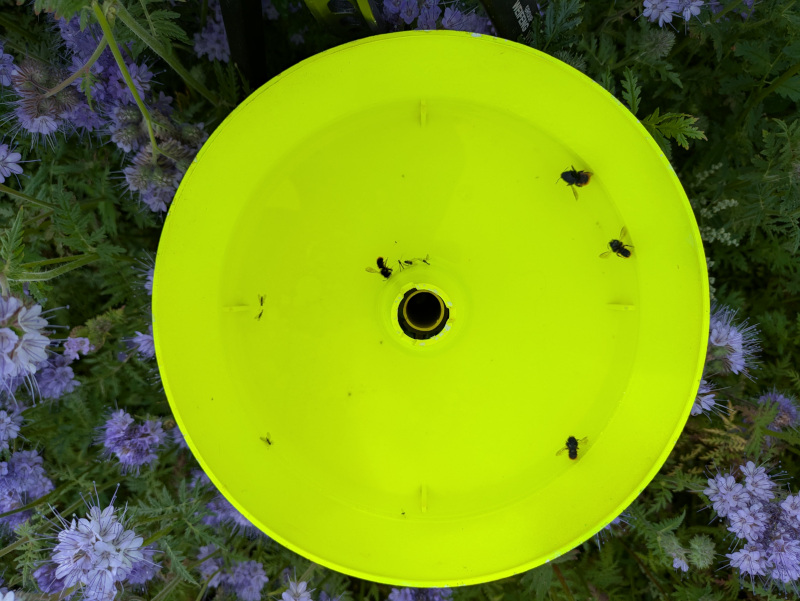
Apiformes, bees, Hymenoptera, insect sampling, methodology, pan trapsAbstract
Recently, the Proposal for an EU Pollinator Monitoring Scheme (EUPoMS) has been revised, presenting options for a standardised monitoring of insect pollinators across the EU. While we appreciate the overall EUPoMS approach, we argue that the adequacy of core methods in the revised EUPoMS is not substantiated by robust evidence. We consider it essential that the authors will make an effort in the near future to catch up on explaining the exclusion of pan traps from the EUPoMS Core Scheme to the scientific community. This will ultimately secure scientific and public trust in the EUPoMS.
References
European Commission, Joint Research Centre, Potts SG, Bartomeus I, Biesmeijer K, Breeze T et al. (2024) Refined proposal for an EU Pollinator Monitoring Scheme. Publications Office of the European Union, Luxembourg (JRC138660).
Hevia V, Bosch J, Azcárate FM, Fernández E, Rodrigo A, Barril-Graells H, González JA (2016) Bee diversity and abundance in a livestock drove road and its impact on pollination and seed set in adjacent sunflower fields. Agriculture, Ecosystems & Environment 232:336–344.
Hevia V, Carmona CP, Azcárate FM, Heredia R, González JA (2021) Role of floral strips and semi-natural habitats as enhancers of wild bee functional diversity in intensive agricultural landscapes. Agriculture, Ecosystems & Environment 319:107544.
Klaus F, Ayasse M, Classen A, Dauber J, Diekötter T, Everaars J et al. (2024) Improving wild bee monitoring, sampling methods, and conservation. Basic and Applied Ecology 75:2–11.
Kovács-Hostyánszki A, Földesi R, Mózes E, Szirák Á, Fischer J, Hanspach J, Báldi A (2017): Data from: Conservation of pollinators in traditional agricultural landscapes – new challenges in Transylvania (Romania) posed by EU accession and recommendations for future research.
Krahner A, Dietzsch AC, Jütte T, Pistorius J, Everaars J (2024) Standardising bee sampling: A systematic review of pan trapping and associated floral surveys. Ecology and Evolution 14(3):e11157.
Krahner A, Dietzsch AC, Klaus F (2025) The impact of pan trap diameter on sampled bee communities and bycatch weight. Journal of Insect Conservation 29:18.
Krahner A, Schmidt J, Maixner M, Porten M, Schmitt T (2021) Evaluation of four different methods for assessing bee diversity as ecological indicators of agro-ecosystems. Ecological Indicators 125:107573.
Torné-Noguera A, Rodrigo A, Arnan X, Osorio S, Barril-Graells H, Da Rocha-Filho LC, Bosch J (2014) Determinants of spatial distribution in a bee community: nesting resources, flower resources, and body size. PLOS ONE 9(5):e97255.
Westerberg L, Berglund HL, Jonason D, Milberg P (2021) Color pan traps often catch less when there are more flowers around. Ecology and Evolution 11(9):3830–3840.
Wilson JS, Jahner JP, Starley L, Calvin CL, Ikerd H, Griswold T (2016) Sampling bee communities using pan traps: alternative methods increase sample size. Journal of Insect Conservation 20(5):919–922.
Downloads
Published
How to Cite
Issue
Section
License
Copyright (c) 2025 André Krahner, Anke C. Dietzsch, Tobias Jütte, Felix Klaus, Oleg Lewkowski, Severin Polreich, Jens Pistorius

This work is licensed under a Creative Commons Attribution 4.0 International License.